Herculaneum
The other Vesuvius town - smaller, deeper-buried and better preserved than Pompeii, with carbonised wood, upper storeys and the haunting boathouse skeletons.
Updated 18 October 2026
AI illustration
UNESCO World Heritage
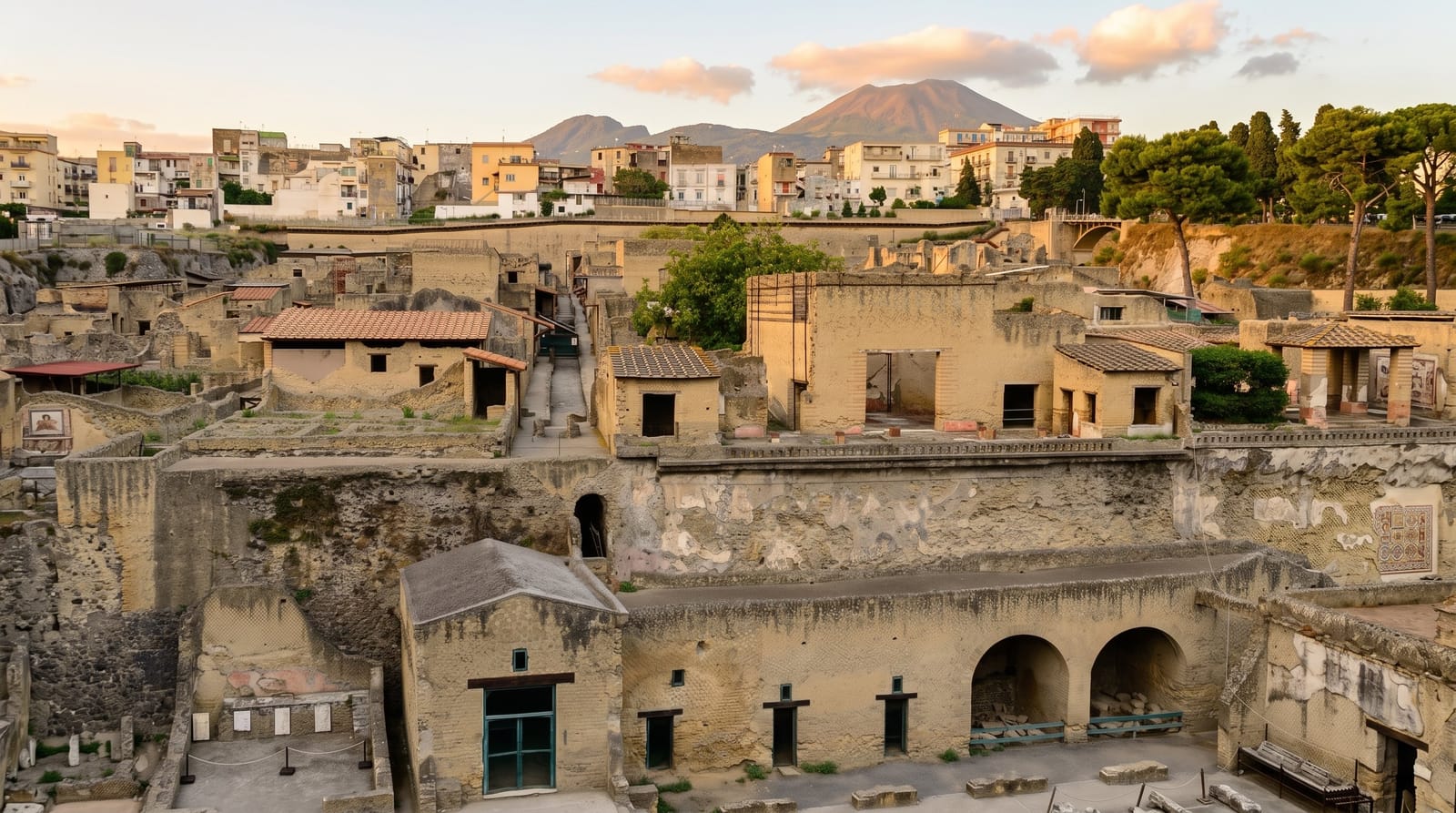
Herculaneum died in the same eruption of 79 AD as Pompeii but died differently - buried not in falling ash but in successive pyroclastic surges that sealed the town under some twenty metres of volcanic rock and, by excluding air, preserved what Pompeii lost: carbonised wooden beams, doors, stairs and furniture, upper floors still standing, even food in shop jars. The excavated area is a fraction of Pompeii's sprawl, which is precisely its advantage - an hour or two covers mosaic-floored houses like the House of Neptune and Amphitrite, the marble-and-fresco richness of a wealthy seaside town, at a fraction of the crowd. The site's darkest exhibit sits at the old shoreline: the arched boathouses where hundreds of skeletons were found in the 1980s, residents caught waiting for a rescue that never came. Sharing Pompeii's UNESCO inscription, it is the connoisseur's Vesuvius site.
History
Dionysius of Halicarnassus credited Heracles with founding the town, while Strabo says the Oscans made the first settlement, followed by Etruscans and then Greeks, who called it Heraklion and used it as a trading post; the Samnites held it from the 4th century BC. It sided with the Allies against Rome in the Social War of 91-88 BC and became a Roman municipium in 89 BC. In the eruption of AD 79 only a few centimetres of ash fell here at first and most people fled, but at about 1 am the next day pyroclastic surges swept through and buried the town under some 20 metres of material. By tradition it was found by chance when a well was dug in 1709, finds from wells and tunnels spread through the Prince d'Elbeuf's explorations, regular excavations began in 1738 under Charles III of Spain, Amedeo Maiuri uncovered some four hectares between 1927 and 1942, and in 1980-1981 hundreds of skeletons were found in the boathouses on the ancient shore; more than three quarters of the town still lies buried beneath Ercolano and Portici (Wikipedia, Herculaneum).
What to look for
- The carbonised wood - beams, doors and stairs two millennia old.
- House of Neptune and Amphitrite - the glass-mosaic wall in vivid colour.
- The boathouses - the arched fornici where the fleeing crowd was found.
- The upper storeys - second floors Pompeii almost never kept.
When to go
October to April for cool walking and thin crowds; the site is compact enough for a morning even in summer heat, when shade is scarce and an early slot is wise. Pairs naturally with Vesuvius or Pompeii in one long day.
Good to know
The modern town of Ercolano around the site is scruffy and the approach unglamorous - inside the excavation it stops mattering. Some houses rotate closed for conservation. If you must choose one Vesuvius site with limited time and patience for crowds, Herculaneum is the quieter, denser experience; Pompeii wins on sheer scale.
Nearby
Vesuvius' crater road starts from Ercolano; Pompeii is 20 minutes down the same rail line and Naples 20 minutes the other way.
Key facts
Source: Wikidata, item Q178813, read on 18 October 2026.
What to pack for Herculaneum
Chosen from what this place is for. Tap a kit for the full checklist.
- Comfortable walking shoes - Sightseeing means kilometres of pavement and cobbles daily. Find on Amazon
- A slim anti-theft daypack - Zips that close properly; keep it in front in crowds and on transit. Find on Amazon
- A refillable water bottle - Many cities have public fountains; save money and plastic. Find on Amazon
- A light layer + compact umbrella - For museum air-con and a sudden shower. Find on Amazon
Some links on this page are Amazon affiliate links - if you buy through them we may earn a small commission at no extra cost to you.
All packing kitsPlan your trip
Where to start if Herculaneum is going on the list.
Booking links on this page are affiliate links - if you book through them we may earn a small commission at no extra cost to you. It never changes what we write about a place.
Opening times, ticket prices and seasonal closures change - check the official source before you go: official site.


