Poisoned Glen
A granite amphitheatre under Errigal whose sinister name is probably a mistranslation, with a roofless church at its mouth.
Updated 19 October 2026
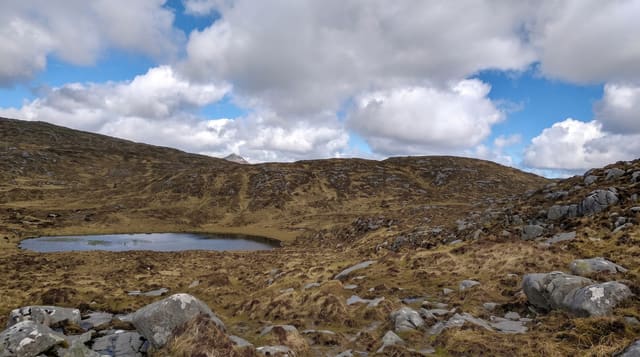
The Poisoned Glen is a steep-walled granite valley running south-east from Dunlewey, closed at its head by cliffs and floored with wet bog. The name has attracted a lot of invention - stories about a poisoned lake or a slain giant - but one suggestion, though unsourced, is a translation slip: An Gleann Neamhe, the heavenly glen, misread as An Gleann Nimhe, the poisoned glen, by a mapmaker who mistook one word for the other. Irish spurge grows here and is mildly toxic, which has kept the darker version alive. At the entrance stands the shell of Dunlewey Church, a nineteenth-century Church of Ireland building of white marble and blue quartzite, roofless since the 1950s and one of the most photographed ruins in Donegal. Walking into the glen means crossing genuinely deep wet bog on no path at all, and the granite slabs at the head are used by climbers.
History
Legend says the glen got its name when Balor, the one-eyed giant king of Tory, was killed here by his exiled grandson Lughaidh, and the poison from his eye split the rock and poisoned the glen. Its Irish name is Cró Nimhe (Wikipedia, Poisoned Glen).
The landscape
- The granite walls - a steep amphitheatre closing the head of the glen.
- Dunlewey Church - the roofless white marble shell at the entrance.
- The bog floor - deep, wet and pathless.
- Errigal - rising directly above the northern side.
When to go
May to September, when the ground is at its driest, which is relative - it stays wet. Clear weather matters; the glen is oppressive and featureless under low cloud.
What to expect
There is no path - the floor is deep wet bog and boots will not keep you dry. The church ruin is unstable and fenced in parts. Midges are severe on still days. Parking is a handful of roadside spaces.
Nearby
Errigal is directly north; Glenveagh National Park is east and Gweedore west.
Key facts
Source: Wikidata, item Q3393815, read on 18 October 2026.
What to pack for Poisoned Glen
Chosen from what this place is for. Tap a kit for the full checklist.
- Broken-in walking shoes or boots - Grip and ankle support matter more than looks; never hike in brand-new boots. Find on Amazon
- Layers + a waterproof shell - Mountain weather turns fast; a packable rain jacket saves the day. Find on Amazon
- Daypack with rain cover - 20-30 litres holds water, snacks, layers and a first-aid kit. Find on Amazon
- Offline maps + a power bank - Download the trail before you lose signal; carry backup charge. Find on Amazon
Some links on this page are Amazon affiliate links - if you buy through them we may earn a small commission at no extra cost to you.
All packing kitsPlan your trip
Where to start if Poisoned Glen is going on the list.
Booking links on this page are affiliate links - if you book through them we may earn a small commission at no extra cost to you. It never changes what we write about a place.
Opening times, ticket prices and seasonal closures change - check the official source before you go: official site.