Phaistos
A Minoan palace on a ridge above the Messara plain, left unreconstructed, where the undeciphered Phaistos Disc was found.
Updated 21 October 2026

AI illustration
UNESCO World Heritage
Phaistos was the second great palace of Minoan Crete, built around 2000 BC, destroyed and rebuilt several times, and finally destroyed around 1400 BC. Italian excavators chose not to reconstruct it, which makes it the opposite experience to Knossos: no painted concrete, no restored columns, just the original masonry, the grand staircase, the theatral area, storerooms with their pithoi, and the great central court open to the sky with the Messara plain below and Mount Psiloritis rising opposite. In 1908 a fired clay disc stamped on both sides with 241 signs in 45 distinct symbols was found here; the Phaistos Disc remains undeciphered and is displayed in Heraklion. The neighbouring villa of Agia Triada, included in the ticket, lies three kilometres away.
History
Phaistos was first settled around 3600 BC, and the first palace was built around 2000 BC on a hill that had been used for communal feasting; it was destroyed and rebuilt three times in about three centuries and finally destroyed around 1400 BC, perhaps by an earthquake. Linear A inscriptions were found here, and the name appears as pa-i-to on Linear B tablets from Knossos; the town was lived in again from the 8th century BC, minted its own staters and allied with King Eumenes II of Pergamon before Gortyn destroyed it at the end of the 3rd century BC, and in 2025 it was inscribed by UNESCO among the Minoan palatial centres (Wikipedia, Phaistos).
Highlights
- The central court - the open heart of the palace facing Psiloritis.
- The grand staircase - a monumental Minoan stair, unreconstructed.
- The storerooms - magazines with their great storage jars in place.
- The plain view - the Messara spread below the palace ridge.
When to go
Spring and autumn; the ridge is exposed and hot in summer, with almost no shade. Morning light is best across the plain, and the site is far quieter than Knossos at any hour.
Before you go
Without reconstruction the site demands imagination and a plan, and casual visitors sometimes find it hard to read. The disc itself is in Heraklion. Facilities are limited to a small cafe and shop.
Nearby
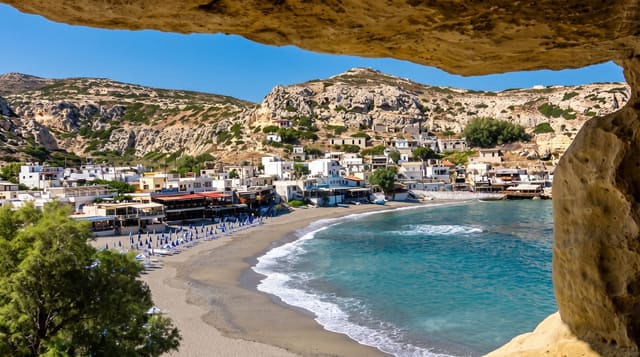
Agia Triada is three kilometres west; Gortyn and Matala lie on the same southern route.
Key facts
Source: Wikidata, item Q249707, read on 18 October 2026.
What to pack for Phaistos
Chosen from what this place is for. Tap a kit for the full checklist.
- Comfortable walking shoes - Sightseeing means kilometres of pavement and cobbles daily. Find on Amazon
- A slim anti-theft daypack - Zips that close properly; keep it in front in crowds and on transit. Find on Amazon
- A refillable water bottle - Many cities have public fountains; save money and plastic. Find on Amazon
- A light layer + compact umbrella - For museum air-con and a sudden shower. Find on Amazon
Some links on this page are Amazon affiliate links - if you buy through them we may earn a small commission at no extra cost to you.
All packing kitsPlan your trip
Where to start if Phaistos is going on the list.
Booking links on this page are affiliate links - if you book through them we may earn a small commission at no extra cost to you. It never changes what we write about a place.
Opening times, ticket prices and seasonal closures change - check the official source before you go: official site.