Ngwenya Mine
The world's oldest known mine - ochre dug at Lion Cavern over 40,000 years ago, iron-age workings and a modern pit's viewpoint tell the whole arc.
Updated 19 October 2026

AI illustration
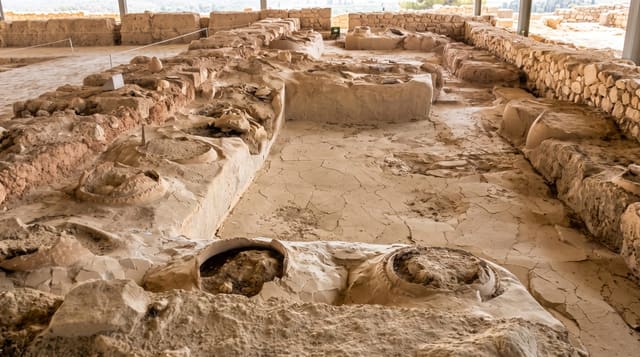
On Ngwenya mountain's slopes, people were mining before anyone was farming: at the Lion Cavern working, archaeologists dated haematite extraction - red ochre for pigment and ritual - to more than forty thousand years ago, which makes this the oldest known mine on earth. The same iron-rich mountain drew iron-age smelters two millennia back and a modern open-pit operation in the twentieth century, whose flooded terraced crater now serves as the viewpoint anchoring the visit. A guide from the visitor centre walks the story across all three eras, from hand-dug ochre galleries to industrial benches, with the highveld rolling to the horizon.
History
Ngwenya, "crocodile" in siSwati, is named after the shape of its mountain, which the heavy mining of the 1960s defaced. Stone age tools found during excavations in the late 1960s and early 1970s were first dated to more than 20,000 years, and later radiocarbon dating put the oldest mining at 41,000 to 43,000 years ago, making it the oldest known mine in the world: people dug red and specular haematite here for cosmetics and ritual, and the ancestors of the San used its ochre in rock paintings. By about 400 AD Bantu herders who knew how to smelt iron were living here and trading their iron widely. The ore, up to 60% iron, was prospected in the middle of the 19th century, and from 1964 to 1977 an open pit run by the Swaziland Iron Ore Development Company of the Anglo-American Corporation extracted an estimated 20,000,000 tonnes, mostly for Japan, bringing the Goba railway and a power network to the area before the pit flooded. The land was later given to the Swaziland National Trust Commission, and a visitor centre opened in 2005 beside the ancient working known as Lion Cavern (Wikipedia, Ngwenya Mine).
Highlights
- Lion Cavern - the ochre working dated beyond 40,000 years.
- The open-pit crater - the terraced modern mine, now still and flooded.
- The iron-age story - smelting history told on the mountain that fed it.
- The highveld views - ridgelines from the pit rim toward Malolotja.
When to go
April to September for clear, cool walking; the site visits year round with the guide schedule set at the visitor centre. Mornings give the best light into the pit.
What to expect
The archaeology asks imagination - Lion Cavern is a modest rock shelter whose meaning outruns its looks, and the guide's telling carries the visit. Paths near the pit rim are unfenced in stretches. Combine with the neighbouring glass factory and Malolotja to fill the day; alone it is a two-hour stop.
Nearby
Ngwenya Glass next door, Malolotja Nature Reserve and Mbabane.
Key facts
Source: Wikidata, item Q2558479, read on 18 October 2026.
What to pack for Ngwenya Mine
Chosen from what this place is for. Tap a kit for the full checklist.
- Head torch + spare batteries - Hands-free light is essential; caves are truly dark. Find on Amazon
- Comfortable walking shoes - Sightseeing means kilometres of pavement and cobbles daily. Find on Amazon
- Grippy closed shoes - Cave floors are wet, muddy and slick with formations. Find on Amazon
- A slim anti-theft daypack - Zips that close properly; keep it in front in crowds and on transit. Find on Amazon
Some links on this page are Amazon affiliate links - if you buy through them we may earn a small commission at no extra cost to you.
All packing kitsPlan your trip
Where to start if Ngwenya Mine is going on the list.
Booking links on this page are affiliate links - if you book through them we may earn a small commission at no extra cost to you. It never changes what we write about a place.
Opening times, ticket prices and seasonal closures change - check the official source before you go: official site.