Alcala de Henares
Cervantes's birthplace and the first purpose-planned university town in the world, listed by UNESCO in 1998.
Updated 18 October 2026
AI illustration
UNESCO World Heritage
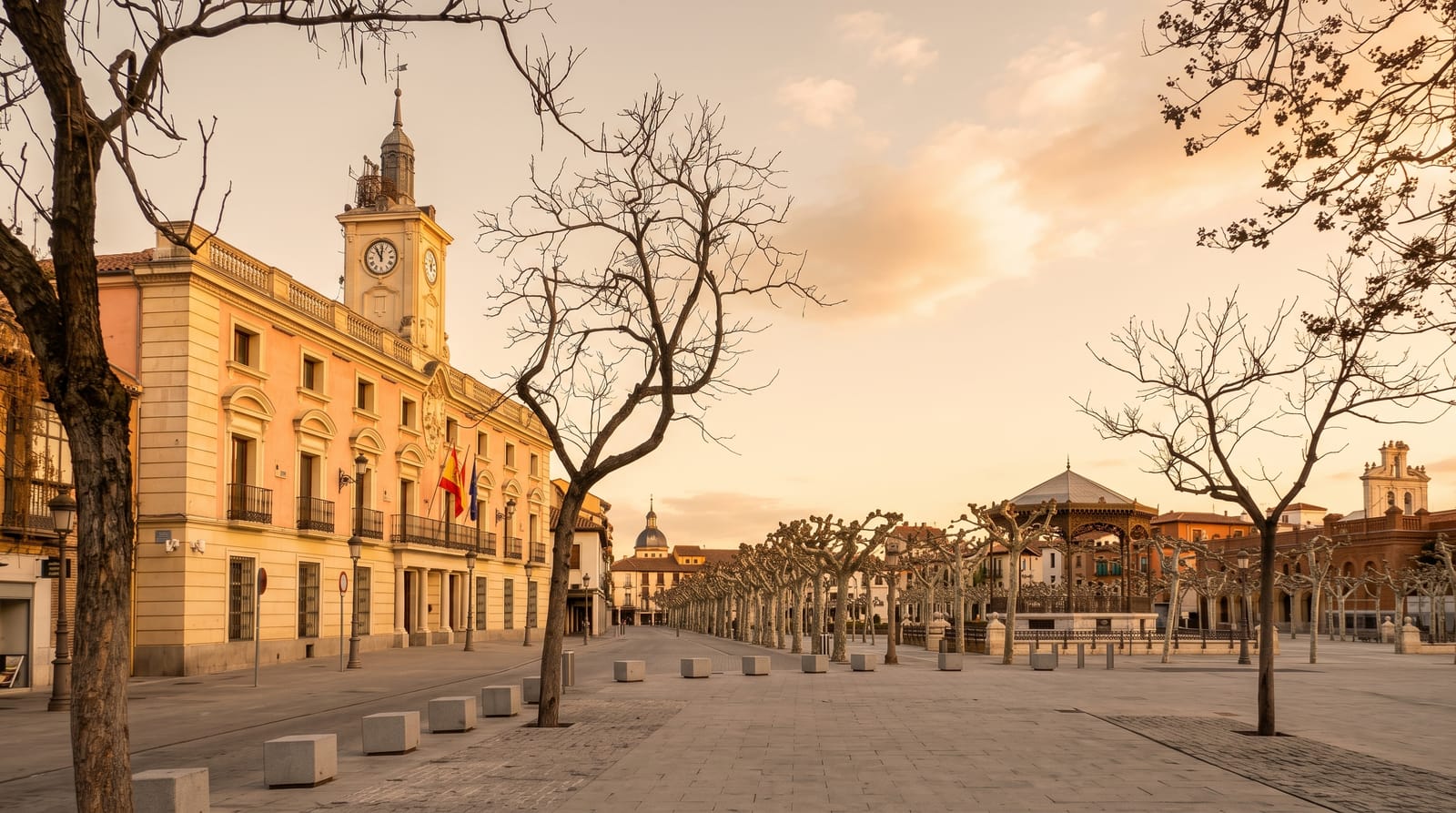
Cardinal Cisneros founded a university here in 1499 and laid out a town around it, the first place designed from the start as a university city, a model exported to Spanish America; UNESCO listed it in 1998 on that basis. The Colegio Mayor de San Ildefonso has a plateresque facade of 1543 and a hall where the Cervantes Prize is awarded each April by the king. Cervantes was born in Alcala in 1547, and a reconstructed house on Calle Mayor operates as a museum with bronzes of Don Quixote and Sancho on a bench outside. Calle Mayor itself is the longest arcaded street in Spain, and the town keeps a large stork population nesting on its towers.
History
People lived here from the Chalcolithic, and after the Roman conquest of the 1st century BC the town of Complutum grew up near the Carpetanian settlement of Iplacea, a municipium of some 10,000 people on the road between Emerita Augusta and Caesaraugusta and a bishopric by the 5th century, before it declined late in that century. Tradition places the martyrdom of the boys Justus and Pastor at Campus Laudabilis, the seed of today's centre, and under al-Andalus a watchtower on the hills of the left bank grew into the citadel of Qal'at Abd al-Salam, which gave Alcalá its name. On 3 May 1118 Archbishop Bernard of Toledo took it for Castile, and in 1129 Alfonso VII gave it to the archbishops of Toledo, who held it as a lordship for much of the late Middle Ages and the early modern period (Wikipedia, Alcalá de Henares).
What you'll find
- The San Ildefonso facade - a plateresque front of 1543 on the old college.
- The Cervantes house - a reconstructed birthplace museum on Calle Mayor.
- The arcaded street - Spain's longest colonnaded thoroughfare.
- The storks - large nests on the towers throughout the town.
When to go
April to June and September to November; the Cervantes Prize is awarded on 23 April and the town holds a book week around it, with a large medieval market in October. Summer on the Madrid plain is very hot.
Things to know
The Cervantes house is a reconstruction rather than the original building, which disappoints some. University interiors are seen only on guided tours at set times. The town is a commuter suburb outside the historic core.
Nearby
Madrid is thirty-five kilometres west; Guadalajara lies further east.
Key facts
Source: Wikidata, item Q46940, read on 18 October 2026.
What to pack for Alcala de Henares
Chosen from what this place is for. Tap a kit for the full checklist.
- Comfortable walking shoes - Sightseeing means kilometres of pavement and cobbles daily. Find on Amazon
- A slim anti-theft daypack - Zips that close properly; keep it in front in crowds and on transit. Find on Amazon
- A refillable water bottle - Many cities have public fountains; save money and plastic. Find on Amazon
- A light layer + compact umbrella - For museum air-con and a sudden shower. Find on Amazon
Some links on this page are Amazon affiliate links - if you buy through them we may earn a small commission at no extra cost to you.
All packing kitsPlan your trip
Where to start if Alcala de Henares is going on the list.
Booking links on this page are affiliate links - if you book through them we may earn a small commission at no extra cost to you. It never changes what we write about a place.
Opening times, ticket prices and seasonal closures change - check the official source before you go: official site.