Songnisan National Park
Granite peaks and old pine forest in central Korea, with Beopjusa temple and its enormous gilt Buddha at the foot.
Updated 25 August 2026
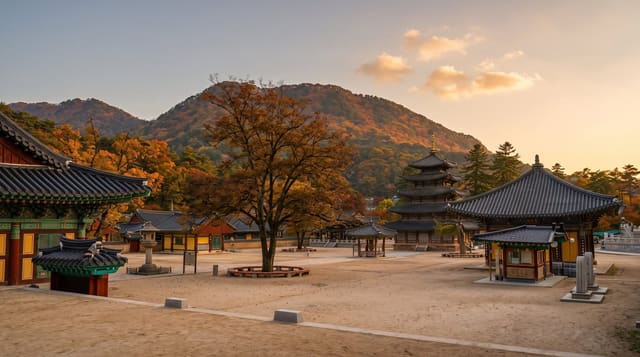
Songnisan - the mountain apart from the ordinary world - reaches 1,058 metres at Cheonwangbong in the middle of the country, and its ridges are granite domes and slabs above thick pine and oak. The way in passes through some of the best-preserved old pine forest in Korea, including Jeongipumsong, a pine beside the road said to have been given official court rank by a fifteenth-century king who was impressed when its branches lifted to let his palanquin through. At the foot of the mountain is Beopjusa, founded in 553 and one of the major temples of the country: it holds the Palsangjeon, a five-storey wooden pagoda that is the only one of its kind left in Korea, an iron cauldron large enough to have fed thousands of monks, stone lanterns and reliefs, and a thirty-three-metre gilt-bronze standing Buddha completed in the 1990s that dominates the courtyard. Ridge walks run several hours above.
The landscape
- Beopjusa - the temple, its wooden pagoda and giant Buddha.
- Palsangjeon - the only five-storey wooden pagoda in the country.
- The old pines - the forest and the court-ranked tree.
- The granite ridges - the walking routes above the temple.
When to go
May to June and October. Autumn colour is excellent and busy; the temple is worth a visit in any season and can be done without the climb.
What to expect
Park fee applies whether or not you hike. The ridge routes are long and rocky. Beopjusa is a working monastery - dress modestly and keep quiet in the halls.
Nearby
Cheongju is an hour west; Daecheongho lake and Daejeon are south-west.
Key facts
Source: Wikidata, item Q2889792, read on 18 October 2026.
What to pack for Songnisan National Park
Chosen from what this place is for. Tap a kit for the full checklist.
- Broken-in walking shoes or boots - Grip and ankle support matter more than looks; never hike in brand-new boots. Find on Amazon
- Binoculars - The single best wildlife tool - even a compact pair transforms a sighting. Find on Amazon
- Modest clothing - Shoulders and knees covered - the single most common requirement. Find on Amazon
- Layers + a waterproof shell - Mountain weather turns fast; a packable rain jacket saves the day. Find on Amazon
Some links on this page are Amazon affiliate links - if you buy through them we may earn a small commission at no extra cost to you.
All packing kitsPlan your trip
Where to start if Songnisan National Park is going on the list.
Booking links on this page are affiliate links - if you book through them we may earn a small commission at no extra cost to you. It never changes what we write about a place.
Opening times, ticket prices and seasonal closures change - check the official source before you go: official site.