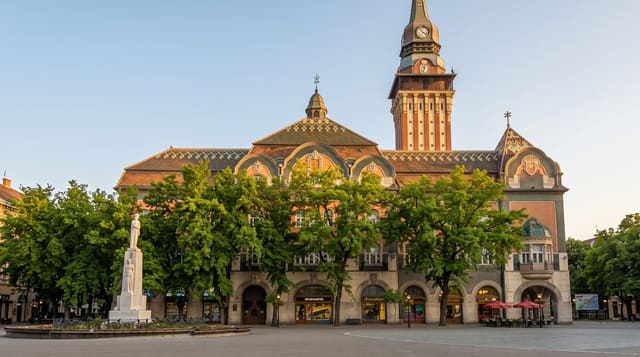
Sombor
A leafy Vojvodina town of baroque facades, some 26,000 street trees and a vast nineteenth-century battle painting.
Updated 22 October 2026
Sombor is known in Serbia as the greenest town in the country, planted through the nineteenth century with American ash until it had tens of thousands of street trees, so the centre is a grid of low baroque and neoclassical facades under continuous canopy. The County Hall holds the Battle of Senta, a painting by Franz Eisenhut some seven metres long, one of the largest in the region and displayed in the assembly hall. Around the centre are the Kronić palace, a gallery of the local painter Milan Konjović, and a scatter of quiet squares. The town produced a distinctive local style of house with an inner courtyard entered through a gate. It is unhurried, seldom visited and pleasant to walk in for a few hours.
History
The town is first recorded in 1340; under the Ottomans it was called Sonbor, and Evliya Çelebi described it in 1665 with 200 shops and 14 mosques. Its first Orthodox school opened in 1717, it became a royal free city in 1749, and from 1786 it was the seat of Bacsensis-Bodrogiensis County (Wikipedia, Sombor).
What to look for
- The tree canopy - streets shaded by tens of thousands of planted ash.
- The Eisenhut painting - a seven-metre battle canvas in the County Hall.
- Baroque facades - low ornamented buildings around the central squares.
- Konjović gallery - the local painter's collected work.
When to go
April to October, with the canopy at its best from May. Autumn colour in the streets is good. The County Hall and museums keep office-hours access and close at weekends in part, so a weekday visit sees more.
Before you go
There are few major sights and the appeal is atmosphere; a half-day covers it. Access to the assembly hall with the painting depends on the building being open, which is not guaranteed. Museums have limited hours. The town is a long way from Belgrade with slow transport.
Nearby
Subotica lies northeast; the Danube and Apatin are west.
Key facts
Source: Wikidata, item Q204475, read on 18 October 2026.
What to pack for Sombor
Chosen from what this place is for. Tap a kit for the full checklist.
- Comfortable walking shoes - Sightseeing means kilometres of pavement and cobbles daily. Find on Amazon
- Modest clothing - Shoulders and knees covered - the single most common requirement. Find on Amazon
- A slim anti-theft daypack - Zips that close properly; keep it in front in crowds and on transit. Find on Amazon
- A scarf or shawl - To cover the head or shoulders on entry; women especially at mosques. Find on Amazon
Some links on this page are Amazon affiliate links - if you buy through them we may earn a small commission at no extra cost to you.
All packing kitsPlan your trip
Where to start if Sombor is going on the list.
Booking links on this page are affiliate links - if you book through them we may earn a small commission at no extra cost to you. It never changes what we write about a place.
Opening times, ticket prices and seasonal closures change - check the official source before you go: official site.