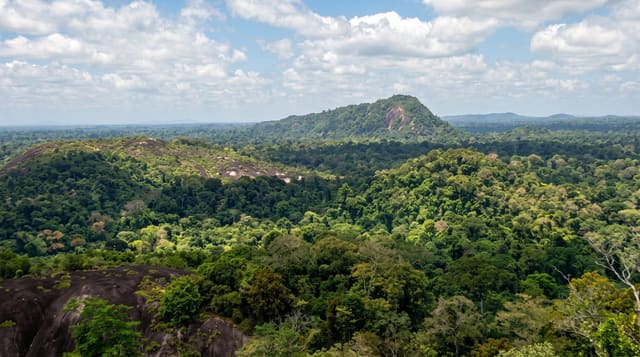
Nouabale-Ndoki National Park
The forest that never met the axe - Mbeli Bai's gorilla clearings and naive wildlife in the Congo Basin's most intact wilderness.
Updated 18 October 2026
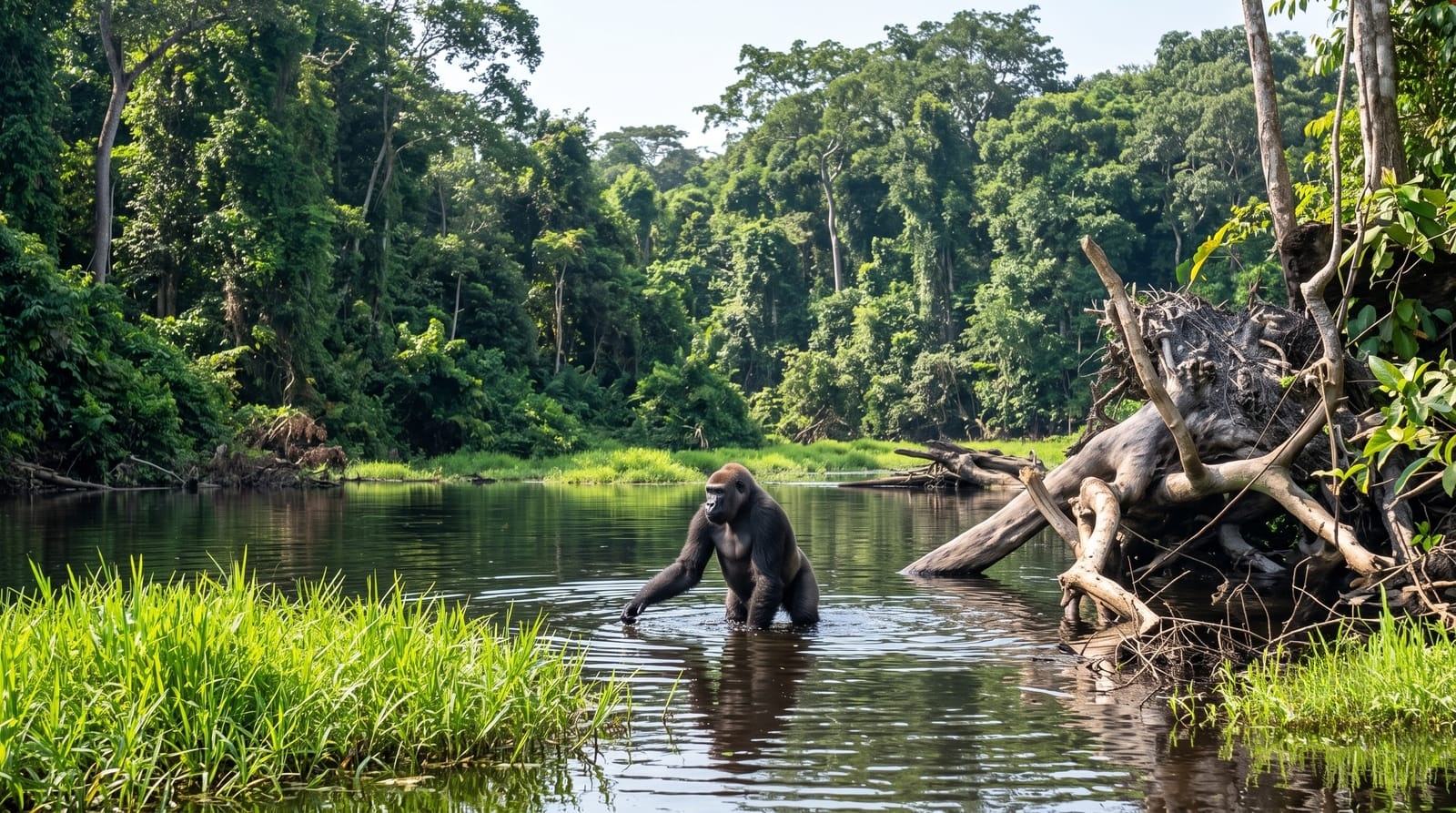
AI illustration
UNESCO World Heritage
Nouabale-Ndoki protects forest that logging never reached - a rarity so complete that researchers found chimpanzees here meeting humans without fear, and the park's fame rests on its bais: natural forest clearings where the canopy's secrets assemble in the open. Mbeli Bai is the celebrated stage, its viewing platform overlooking western lowland gorillas wading for sedges - silverbacks, mothers, infants riding shoulders - alongside forest elephants and sitatunga in rotations researchers have logged for decades. Inscribed with the Sangha Trinational as UNESCO World Heritage, the park runs visits expedition-style through Bomassa: boats, forest walks and platform days that reward the journey's considerable commitment.
History
The idea of reserved parks took shape in the 1980s, when it became clear that elephants roaming freely across the region needed protection from poachers and the logging industry, and in 1991 the Wildlife Conservation Society and the Government of Congo, with support from USAID, began planning the park as a cross-border project. It was established in September 1993 over 3,921.69 square kilometres between the Sangha and Likouala departments, in 1999 the timber company CIB and local communities joined WCS and the government to limit the impact of logging around it, and in 2001 a logging firm gave up 100 square kilometres of the Goualougo Triangle, which was added to the park, and agreed to ban hunting there. The park itself has stayed free of logging, and with the Dzanga-Sangha reserve and Dzanga-Ndoki park in the Central African Republic and Lobéké in Cameroon it forms the Sangha Trinational, a protected area of 11,331 square kilometres (Wikipedia, Nouabalé-Ndoki National Park).
Highlights
- Mbeli Bai - gorilla families in the open from the platform.
- Forest elephants - bai gatherings of the shy forest giants.
- The intact canopy - primary forest at continental best.
- The research legacy - decades of science hosted at the camps.
When to go
The drier windows - roughly June to September and December to February - make travel workable; bai activity runs year round with daily rhythms the guides know. Book months ahead: capacity is tiny by design.
Things to know
This is one of Africa's least accessible great parks: flights or long river-and-road chains to Ouesso, then park logistics - all arranged ahead, priced accordingly, and worth it precisely because so few make it. Camps are comfortable-basic; walking is humid and real. The wildlife owes nothing and delivers generously anyway.
Nearby
Ouesso, the Sangha river and the trinational's neighbouring parks.
Key facts
Source: Wikidata, item Q3015170, read on 18 October 2026.
What to pack for Nouabale-Ndoki National Park
Chosen from what this place is for. Tap a kit for the full checklist.
- Broken-in walking shoes or boots - Grip and ankle support matter more than looks; never hike in brand-new boots. Find on Amazon
- Binoculars - The single best wildlife tool - even a compact pair transforms a sighting. Find on Amazon
- Strong insect repellent - DEET or picaridin; the jungle is where bites and disease risk are highest. Find on Amazon
- Shelter suited to the place - Tent, tarp or hut booking - match it to the terrain and rules. Find on Amazon
Some links on this page are Amazon affiliate links - if you buy through them we may earn a small commission at no extra cost to you.
All packing kitsPlan your trip
Where to start if Nouabale-Ndoki National Park is going on the list.
Booking links on this page are affiliate links - if you book through them we may earn a small commission at no extra cost to you. It never changes what we write about a place.
Opening times, ticket prices and seasonal closures change - check the official source before you go: official site.