Swayambhunath
A hilltop stupa above Kathmandu with painted eyes on all four sides, reached by a stairway of several hundred steps and a great many monkeys.
Updated 18 October 2026
AI illustration
UNESCO World Heritage
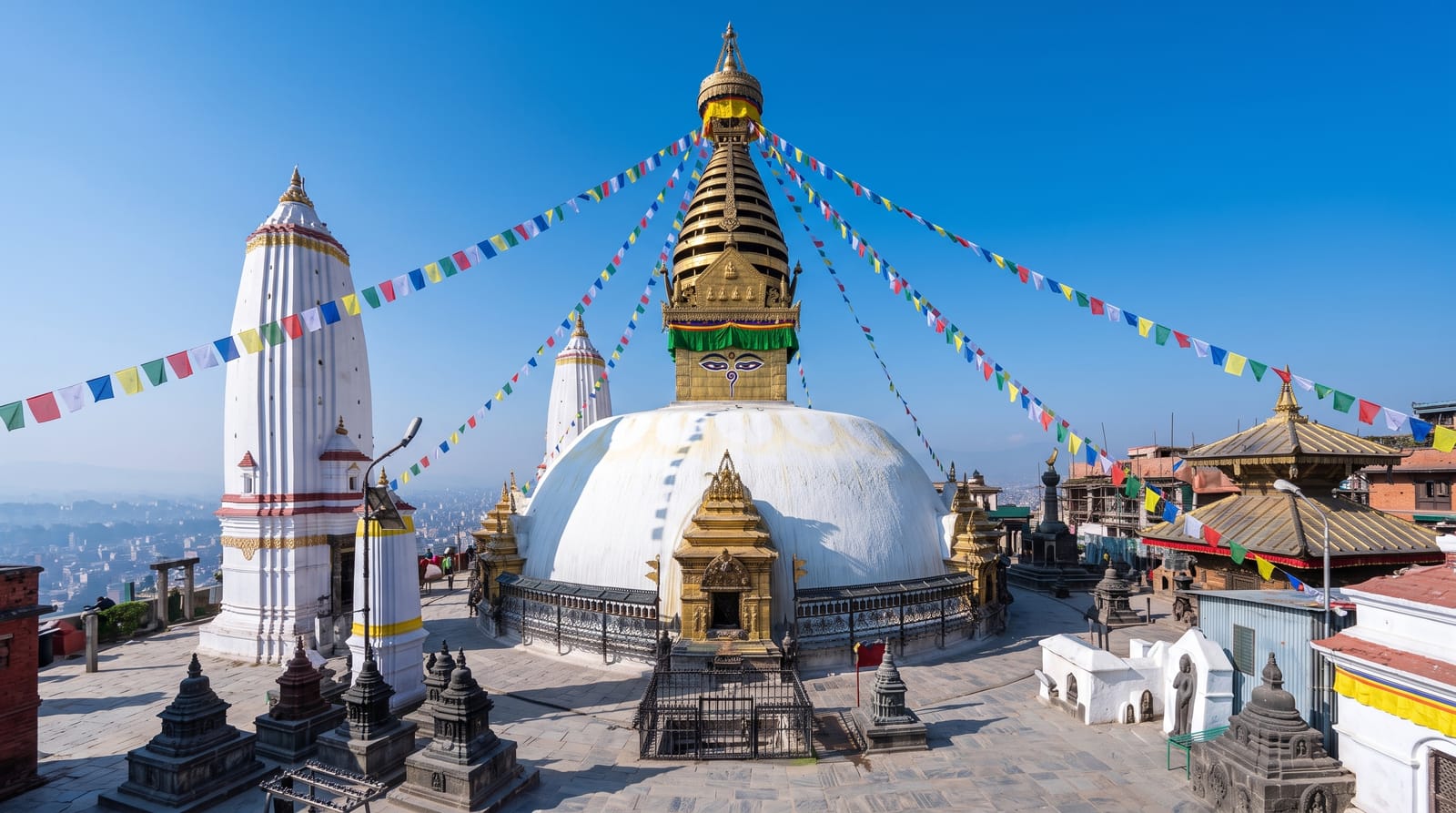
Swayambhunath crowns a hill on the western edge of Kathmandu and is one of the oldest religious sites in the valley, sacred to both Buddhists and Hindus. The white dome carries a gilded square tower painted on each face with a pair of eyes and a curl between them that represents the number one in Nepali script, a symbol of unity. Prayer flags run down the hill in every direction, butter lamps burn in the shrines, and the whole complex is circumambulated clockwise past rows of prayer wheels. The eastern approach is a stairway of several hundred steep steps, and the resident rhesus macaques that gave it the nickname Monkey Temple line the route. From the platform, the whole valley lies below in the haze.
History
The Swayambhu Purana tells that the valley was once a lake in which the Buddha Vipassi sowed a lotus that blossomed into a self-arisen light, Swayambhu, until Manjushri drained the lake with his sword so that people could worship it. Tradition says the Emperor Ashoka came here in the 3rd century BC with his teacher Upagupta and his daughter Charumati, who married the Nepalese prince Devapala, and the Licchavi kings added stupas; the Gopalarajavamsavali says King Vrsadeva, great-grandfather of Manadeva, carried out much rebuilding, and a damaged inscription records work he ordered. Pratap Malla, the powerful king of Kathmandu, built the eastern stairway in the 17th century, in 1979 the site became a World Heritage Site, and it was damaged in the earthquake of April 2015 (Wikipedia, Swayambhunath).
What's there
- The painted eyes - the gilded tower with its watching eyes on all four sides.
- The prayer wheel circuit - the clockwise walk around the stupa base.
- The eastern stairway - several hundred steep steps lined with monkeys and stone figures.
- The valley view - Kathmandu spread out below from the platform.
When to go
October to November for the clearest air, when the mountains occasionally show behind the valley. Early morning brings worshippers, butter lamps and mist; sunset is popular for the view but crowded.
What to expect
The monkeys are bold and will take food, bags and sunglasses; keep everything closed and do not eat on the steps. The stairway is steep enough to be a genuine effort, though a road reaches the western side for anyone who needs it. Kathmandu's air quality often reduces the view to grey haze, and the site was damaged in 2015 with repairs still evident.
Nearby
Kathmandu Durbar Square and Thamel are a short ride east; Boudhanath is across the city.
Key facts
Source: Wikidata, item Q12946982, read on 18 October 2026.
What to pack for Swayambhunath
Chosen from what this place is for. Tap a kit for the full checklist.
- Comfortable walking shoes - Sightseeing means kilometres of pavement and cobbles daily. Find on Amazon
- Modest clothing - Shoulders and knees covered - the single most common requirement. Find on Amazon
- A slim anti-theft daypack - Zips that close properly; keep it in front in crowds and on transit. Find on Amazon
- A scarf or shawl - To cover the head or shoulders on entry; women especially at mosques. Find on Amazon
Some links on this page are Amazon affiliate links - if you buy through them we may earn a small commission at no extra cost to you.
All packing kitsPlan your trip
Where to start if Swayambhunath is going on the list.
Booking links on this page are affiliate links - if you book through them we may earn a small commission at no extra cost to you. It never changes what we write about a place.
Opening times, ticket prices and seasonal closures change - check the official source before you go: official site.