Patan Durbar Square
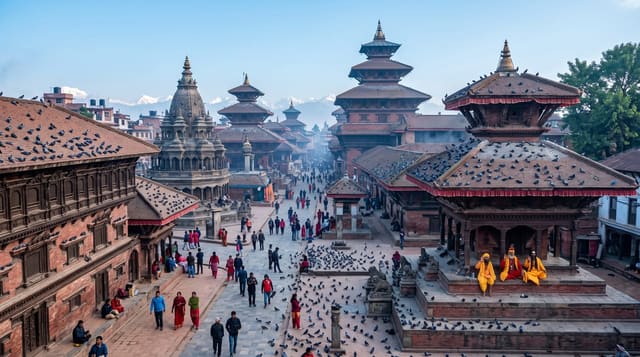
The most concentrated square of Newar architecture in Nepal, with a palace museum widely rated the best in the country.
Updated 18 October 2026

AI illustration
UNESCO World Heritage
Patan, properly Lalitpur, was the third of the valley's royal cities and remains its craft capital, with metalworkers and woodcarvers still working in the lanes behind the square. The Durbar Square packs a remarkable density of building into a small space: the Krishna Mandir carved entirely from stone in a style unlike its brick and timber neighbours, the tiered Bhimsen temple, the sunken royal bath at Sundari Chowk, and the Golden Temple a few streets away, a Buddhist monastery courtyard with gilded facades and a resident colony of temple monkeys. The Patan Museum, installed in restored palace courtyards, is the standout: a calm, well-labelled collection of Hindu and Buddhist bronzes that explains the iconography properly.
History
The square's early history is unclear: the Malla kings of Lalitpur are credited with creating it, but the site was an ancient crossroads, the Pradhanas lived around it before them, and there is evidence that Patan was founded in the 3rd century BC by the Kirat dynasty and enlarged in the 6th century. Inscriptions of 560 and 643 in and near the palace complex show the area's importance in the early medieval period. Most of the present buildings date from the 1600s, under King Siddhi Narsingh Malla and his son Srinivasa Sukriti. The square, part of the Kathmandu Valley World Heritage Site, was heavily damaged by the earthquake of April 2015, and at least one temple that fell was rebuilt using its documented and conserved original timbers (Wikipedia, Patan Durbar Square).
What's there
- Krishna Mandir - the stone-carved temple of twenty-one gilded pinnacles.
- Patan Museum - restored palace courtyards holding the country's best-presented bronze collection.
- The Golden Temple - a gilded Buddhist monastery courtyard in the lanes north of the square.
- Sundari Chowk - the sunken royal bath with carved stone spouts.
When to go
October to November or March to April for clear weather. Early morning brings worshippers rather than tourists, and the light on the brick is best then. The museum is a good option in the heat of the day.
What to expect
Like Bhaktapur, Patan levies a substantial entry fee on foreigners. Earthquake repairs are still visible in places. The square is smaller than Bhaktapur's and can be walked in an hour, so the museum and the surrounding craft lanes are what justify the ticket rather than the square alone.
Nearby
Kathmandu is minutes north; Bhaktapur lies east across the valley.
Key facts
Source: Wikidata, item Q7144236, read on 18 October 2026.
What to pack for Patan Durbar Square
Chosen from what this place is for. Tap a kit for the full checklist.
- Comfortable walking shoes - Sightseeing means kilometres of pavement and cobbles daily. Find on Amazon
- Modest clothing - Shoulders and knees covered - the single most common requirement. Find on Amazon
- A slim anti-theft daypack - Zips that close properly; keep it in front in crowds and on transit. Find on Amazon
- A scarf or shawl - To cover the head or shoulders on entry; women especially at mosques. Find on Amazon
Some links on this page are Amazon affiliate links - if you buy through them we may earn a small commission at no extra cost to you.
All packing kitsPlan your trip
Where to start if Patan Durbar Square is going on the list.
Booking links on this page are affiliate links - if you book through them we may earn a small commission at no extra cost to you. It never changes what we write about a place.
Opening times, ticket prices and seasonal closures change - check the official source before you go: official site.