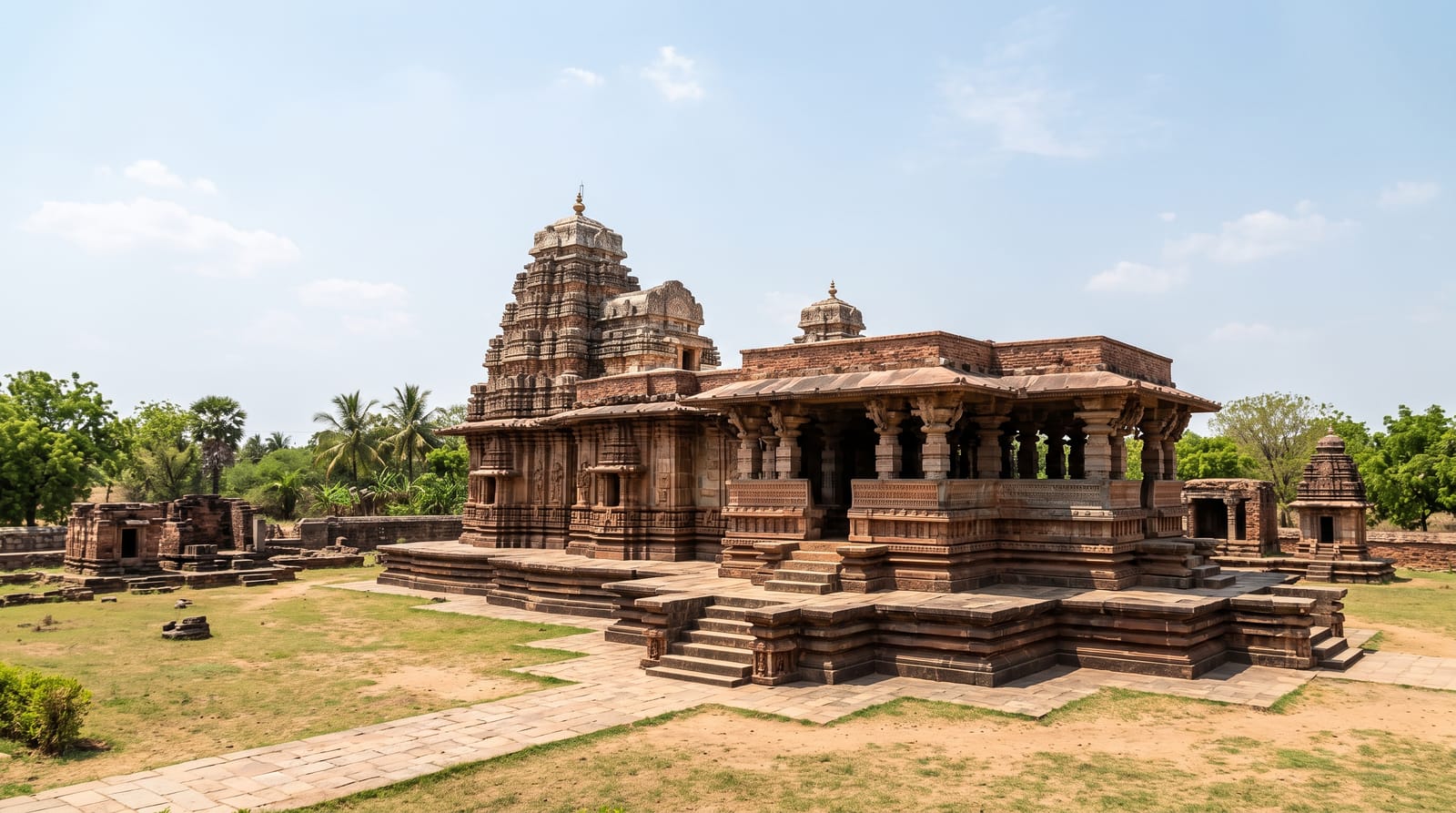
Horyuji
The oldest surviving wooden buildings in the world, standing since roughly the beginning of the eighth century.
Updated 18 October 2026
UNESCO World Heritage
Horyuji was founded by Prince Shotoku, and the temple burned in 670; the buildings in the western precinct - the main hall, the five-storey pagoda, the middle gate and part of the corridor - were rebuilt after that and dendrochronology on their timbers has produced felling dates in the late seventh century. They are the oldest surviving wooden buildings anywhere, and the entasis on the corridor columns, the swelling profile also found in classical Greek architecture, is regularly noted as evidence of how far building ideas travelled along the continental routes. The pagoda's central pillar was felled around 594. Inside the main hall is a bronze Shaka triad of 623 by Tori Busshi. The eastern precinct holds the octagonal Yumedono of 739, whose hidden Kannon was unwrapped only in 1884 after centuries in cloth. It was Japan's first UNESCO inscription in 1993.
History
Prince Shōtoku commissioned the first temple, then called Wakakusadera, which is believed to have been completed by 607 and was dedicated to Yakushi, the Buddha of healing, in honour of his father; excavations in 1939 showed that his palace stood in the eastern part of today's complex. According to the Nihon Shoki every building burned after a lightning strike in 670, and the temple was rebuilt slightly reoriented, probably by around 711, early in the 8th century, though tree-ring dating shows that some timbers were felled before 670 and the pagoda's central pillar in 594. It was repaired in the early 12th century, in 1374 and in 1603, and in the Kamakura period it became a centre of devotion to the prince, whose annual memorial, the Shōryō-e, has been held since the early 12th century. A fire on 26 January 1949, during repairs to the main hall, badly damaged its first floor and murals, and in 1993 Hōryū-ji and Hokki-ji were registered as Japan's first World Heritage Site (Wikipedia, Hōryū-ji).
Highlights
- The oldest wooden buildings on earth - the western precinct, standing since about 700.
- Entasis columns - swelling profiles in the corridor, an idea shared with classical architecture.
- A 623 bronze triad - Tori Busshi's Shaka in the main hall.
- The Yumedono - an octagonal hall of 739 holding an image kept wrapped until 1884.
When to go
All year; weekday mornings. Half a day.
What to expect
Interiors are dim and photography inside the halls is prohibited. The precincts are far apart and the walking is substantial. The Yumedono image is shown only during limited spring and autumn openings. English explanation is limited.
Nearby
Nara city and Todaiji are north-east; Yakushiji is between them.
Key facts
Source: Wikidata, item Q261932, read on 18 October 2026.
What to pack for Horyuji
Chosen from what this place is for. Tap a kit for the full checklist.
- Comfortable walking shoes - Sightseeing means kilometres of pavement and cobbles daily. Find on Amazon
- Modest clothing - Shoulders and knees covered - the single most common requirement. Find on Amazon
- A slim anti-theft daypack - Zips that close properly; keep it in front in crowds and on transit. Find on Amazon
- A scarf or shawl - To cover the head or shoulders on entry; women especially at mosques. Find on Amazon
Some links on this page are Amazon affiliate links - if you buy through them we may earn a small commission at no extra cost to you.
All packing kitsPlan your trip
Where to start if Horyuji is going on the list.
Booking links on this page are affiliate links - if you book through them we may earn a small commission at no extra cost to you. It never changes what we write about a place.
Opening times, ticket prices and seasonal closures change - check the official source before you go: official site.