Somanathapura Temple
The last great Hoysala temple, star-shaped and complete, carved in soapstone soft enough to work like wood.
Updated 18 October 2026
AI illustration
UNESCO World Heritage
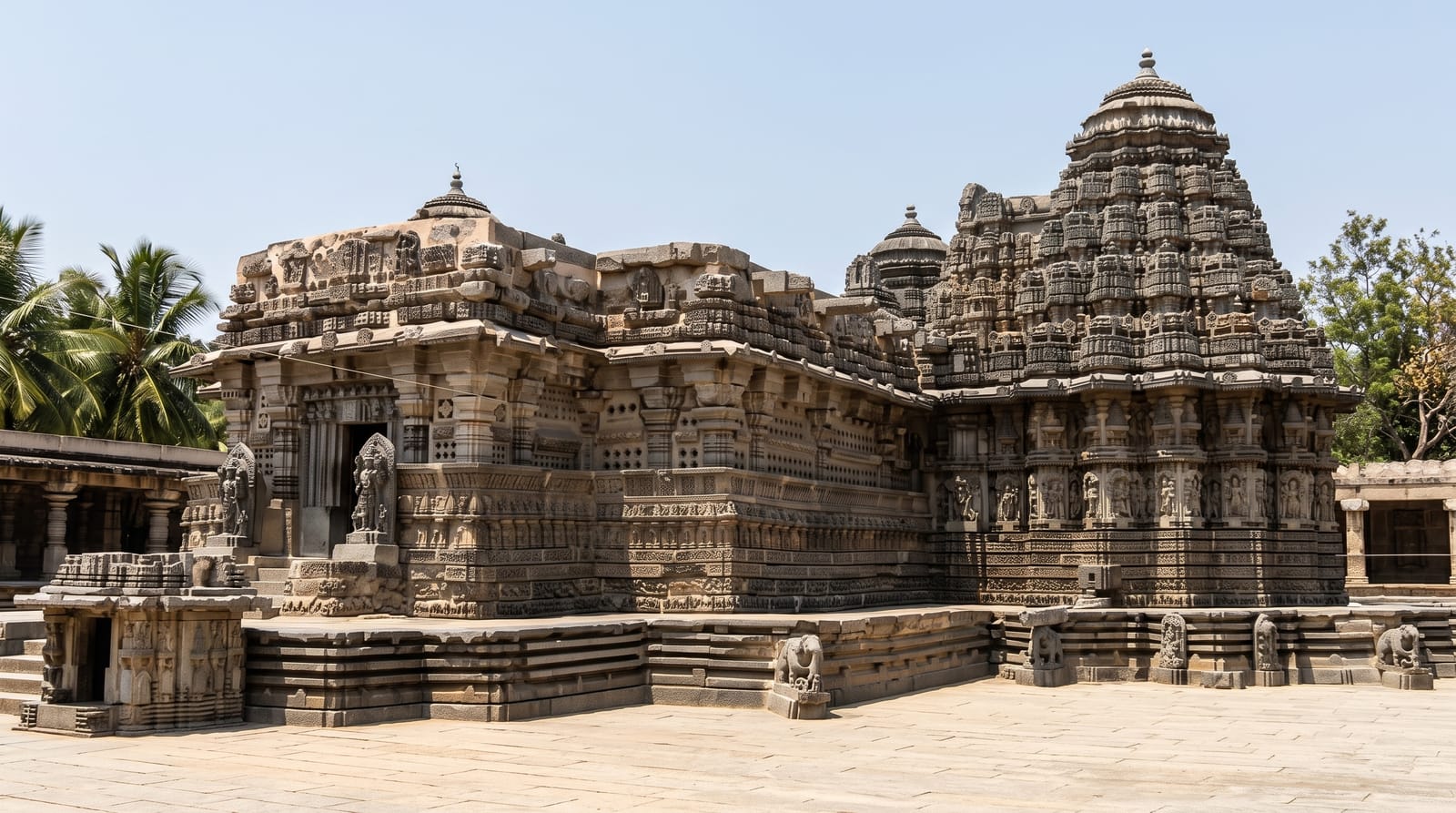
The Chennakeshava temple at Somanathapura was consecrated in 1258 and is the most complete surviving Hoysala building, built on a star-shaped platform with three shrines around a common hall, the whole set within a pillared cloister. Hoysala builders used chloritic schist, a soapstone soft enough when quarried to be carved almost like wood and hardening on exposure, which allowed the density of detail: horizontal friezes of elephants, horsemen, foliage and epic scenes run round the base, and larger figures stand above, with ceilings inside worked into deep coiled patterns. It was inscribed by UNESCO in 2023 with Belur and Halebidu.
History
The town was founded in the 13th century by Somanatha, a general of the Hoysala king Narasimha III, who set it up as an agrahara, land granted to Brahmins with resources to build and keep temples, and it took his name. At its centre he built the Kesava temple, consecrated in 1258, as well as a Panchalinga temple to Shiva and a fort wall, now in ruins; of the further temples he built in the region only the Lakshminarasimha remains, itself a ruin, the others having been lost when wars between Hindu kingdoms and Muslim sultanates ravaged the region. The Kesava temple was badly damaged, as 15th-century inscriptions record, and was repaired in the 16th century with grants from the Vijayanagara emperors, which shows in the different colour and quality of the stone in parts of the veranda, the northern tower and the platform; damaged again in the 19th century, it was repaired once more in the early 20th by the Mysore government. It is one of some 1,500 temples built under the Hoysala kings (Wikipedia, Chennakeshava Temple, Somanathapura).
The main sights
- The star platform - the stepped stellate base the temple stands on.
- The frieze bands - elephants, horsemen and epic scenes around the base.
- The three shrines - a triple sanctum around a shared hall.
- The ceilings - deep coiled soapstone patterns inside the hall.
When to go
October to March; Karnataka's plains are hot from March. Morning light rakes the friezes best. The site is quiet compared with Belur and Halebidu.
What to expect
The main images in the shrines were damaged and the temple is no longer in worship. Some outer figures were defaced historically. The site is compact and a visit takes under two hours.
Nearby
Mysore lies west; Talakadu is south on the Kaveri.
Key facts
Source: Wikidata, item Q3537502, read on 18 October 2026.
What to pack for Somanathapura Temple
Chosen from what this place is for. Tap a kit for the full checklist.
- Comfortable walking shoes - Sightseeing means kilometres of pavement and cobbles daily. Find on Amazon
- Modest clothing - Shoulders and knees covered - the single most common requirement. Find on Amazon
- A slim anti-theft daypack - Zips that close properly; keep it in front in crowds and on transit. Find on Amazon
- A scarf or shawl - To cover the head or shoulders on entry; women especially at mosques. Find on Amazon
Some links on this page are Amazon affiliate links - if you buy through them we may earn a small commission at no extra cost to you.
All packing kitsPlan your trip
Where to start if Somanathapura Temple is going on the list.
Booking links on this page are affiliate links - if you book through them we may earn a small commission at no extra cost to you. It never changes what we write about a place.
Opening times, ticket prices and seasonal closures change - check the official source before you go: official site.