Santa Maria Maggiore
A basilica whose fifth-century mosaics survive above a colonnade, with a ceiling said to be gilded with American gold.
Updated 21 October 2026
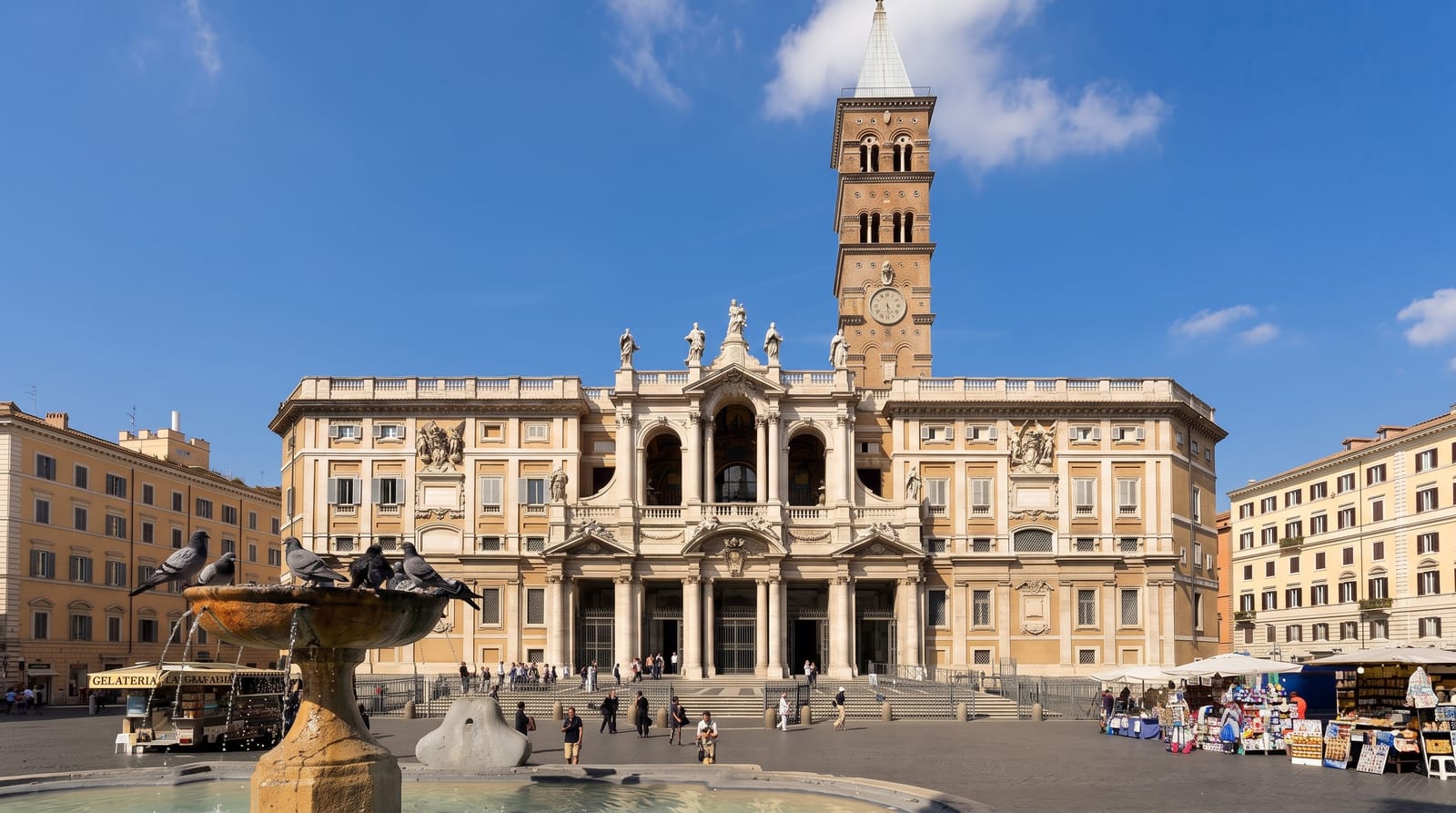
AI illustration
UNESCO World Heritage
One of the four papal basilicas, Santa Maria Maggiore was built in the 430s and keeps its original nave: a colonnade of ancient columns with a band of fifth-century mosaics above it showing Old Testament scenes, among the oldest Christian narrative mosaics anywhere, and a triumphal arch of the same date. The apse mosaic of the Coronation of the Virgin is a thirteenth-century addition by Torriti. The coffered ceiling was gilded around 1500 and tradition holds the gold was the first brought back from the Americas, presented by Ferdinand and Isabella. Bernini is buried here in a plain floor slab, as he asked.
History
The church was built on the Esquiline Hill under Pope Celestine I and consecrated to the Virgin Mary by Pope Sixtus III on 5 August 434, soon after the Council of Ephesus of 431 had proclaimed Mary Mother of God; the inscription on the triumphal arch, Sixtus Episcopus plebi Dei, records his part. It keeps the core of its 5th-century structure, with the mosaics of the nave and triumphal arch, despite later building and damage in the earthquake of 1348, and it is the largest Marian church in Rome, dedicated to Our Lady of the Snow (Wikipedia, Santa Maria Maggiore).
Highlights
- The fifth-century nave mosaics - Old Testament scenes above the colonnade.
- The Torriti apse - a thirteenth-century Coronation of the Virgin.
- The gilded ceiling - said to use the first gold brought from the Americas.
- Bernini's grave - a plain floor slab for the sculptor of baroque Rome.
When to go
Year-round; the basilica is free and open daily, with services throughout. The nave mosaics are high and small, so binoculars help considerably. Dress rules are enforced.
What to expect
The fifth-century mosaics are far above eye level and hard to read without optics. Dress codes are enforced at the door. The area around Termini is busy and unremarkable.
Nearby
Termini station lies east; the Colosseum is southwest.
Key facts
Source: Wikidata, item Q186282, read on 18 October 2026.
What to pack for Santa Maria Maggiore
Chosen from what this place is for. Tap a kit for the full checklist.
- Warm base layers - Merino or synthetic against the skin - never cotton, which chills when damp. Find on Amazon
- Comfortable walking shoes - Sightseeing means kilometres of pavement and cobbles daily. Find on Amazon
- Modest clothing - Shoulders and knees covered - the single most common requirement. Find on Amazon
- An insulated + windproof jacket - A down or synthetic layer under a hard shell handles most cold. Find on Amazon
Some links on this page are Amazon affiliate links - if you buy through them we may earn a small commission at no extra cost to you.
All packing kitsPlan your trip
Where to start if Santa Maria Maggiore is going on the list.
Booking links on this page are affiliate links - if you book through them we may earn a small commission at no extra cost to you. It never changes what we write about a place.
Opening times, ticket prices and seasonal closures change - check the official source before you go: official site.