Clare Island
A mountainous island at the mouth of Clew Bay, home in the sixteenth century to Grace O'Malley, who ran a fleet from it.
Updated 19 October 2026
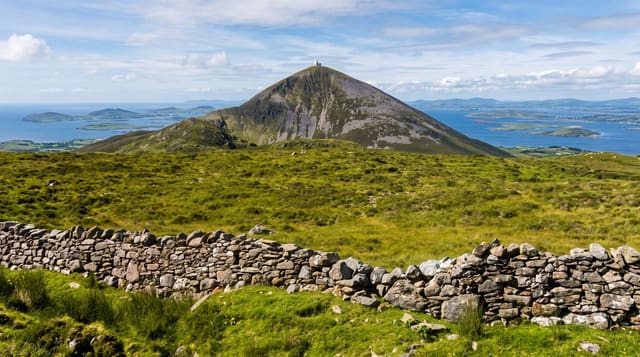
Clare Island stands across the mouth of Clew Bay, rising to 462 metres at Knockmore, whose north-western face falls in sea cliffs. Around a hundred and forty people live there. It is inseparable from Grainne Ni Mhaille - Grace O'Malley - who in the second half of the sixteenth century controlled the sea around this coast from a tower house at the harbour, traded and raided by galley, and famously sailed to London in 1593 to negotiate with Elizabeth I in person. Her tower still stands above the pier, and the Cistercian abbey on the island holds her reputed tomb and, more remarkably, a set of medieval painted ceiling frescoes, rare survivals in Ireland, showing animals, hunting and figures. The island has walking routes, a lighthouse converted to accommodation, beaches and a pub. Ferry crossings are exposed and cancel in swell.
History
Through the Middle Ages the island belonged to the O'Malleys, whose tower house near the pier is known as Granuaile's Castle after its most famous resident, and the abbey near the south coast was founded by them. The lighthouse was established in 1806 by John Denis Browne, 1st Marquess of Sligo; a fire on 29 September 1813 damaged part of the tower and the lantern, and the rebuilt light was ready in 1818 (Wikipedia, Clare Island).
Highlights
- The abbey frescoes - rare medieval painted ceilings, with O'Malley's tomb.
- The tower house - Grace O'Malley's stronghold above the harbour.
- Knockmore - 462 metres, with sea cliffs on its northern face.
- The lighthouse - converted to accommodation on the northern shore.
When to go
May to September, when ferries run frequently and services are open. The abbey has limited opening; check before travelling for it specifically.
What to expect
Ferries cancel in swell and winter schedules are thin. Limited accommodation and one pub. The abbey is not always open. Cliff ground on Knockmore is unfenced and steep.
Nearby
Louisburgh and Roonagh Quay are on the mainland; Inishturk is south-west.
Key facts
Source: Wikidata, item Q1095319, read on 18 October 2026.
What to pack for Clare Island
Chosen from what this place is for. Tap a kit for the full checklist.
- Reef-safe sunscreen - High SPF that will not bleach the coral you are swimming over. Find on Amazon
- Quick-dry towel - A microfibre towel packs small and dries in minutes. Find on Amazon
- Water shoes - Protect your feet on rocky entries, hot sand and sea-urchin spines. Find on Amazon
- Dry bag - Keeps phone, cash and keys safe while you are in the water. Find on Amazon
Some links on this page are Amazon affiliate links - if you buy through them we may earn a small commission at no extra cost to you.
All packing kitsPlan your trip
Where to start if Clare Island is going on the list.
Booking links on this page are affiliate links - if you book through them we may earn a small commission at no extra cost to you. It never changes what we write about a place.
Opening times, ticket prices and seasonal closures change - check the official source before you go: official site.