Aran Islands
Three Irish-speaking limestone islands in Galway Bay - stone walls, ancient forts and a cliff-edge fort above the Atlantic, reached by ferry.
Updated 16 October 2026
AI illustration
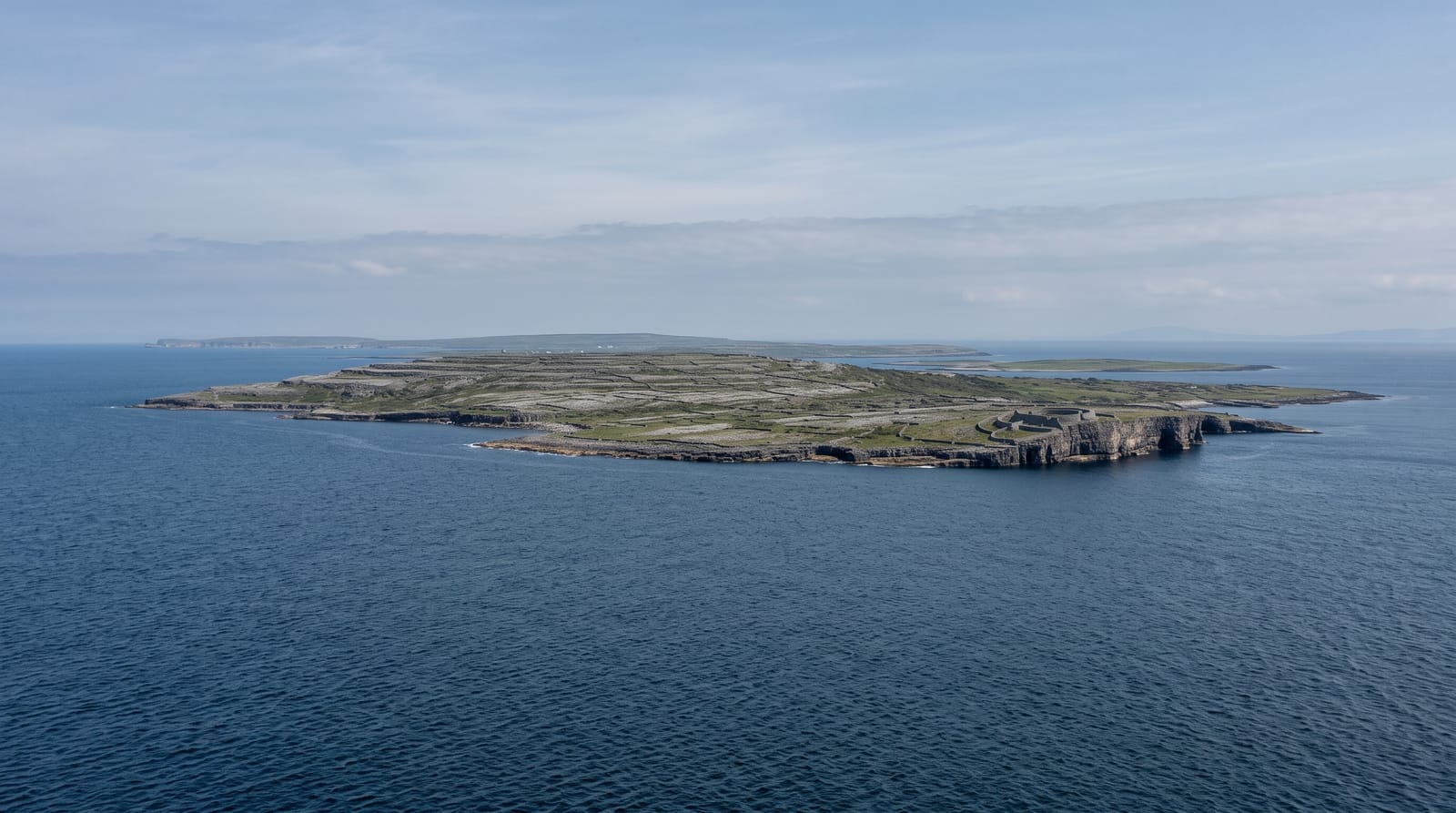
The three Aran Islands lie across the mouth of Galway Bay, windswept limestone islands laced with a maze of dry-stone walls, where Irish is still the everyday language and traditional life lingers. The largest, Inishmore, holds Dun Aonghasa, a prehistoric stone fort perched on the edge of a hundred-metre cliff, one of the most spectacular ancient sites in Europe.
Background
The islands rest on limestone laid down approximately 350 million years ago as sediment on the floor of a tropical sea, in horizontal beds holding fossil corals, crinoids, sea urchins and ammonites, while the karst surface dates from around 11,000 years ago. Seven prehistoric stone forts stand on the islands, and Dún Aonghasa goes back to 1100 BC. The Killeany monastery on Inishmore was founded by Enda of Aran in AD 490. John Millington Synge began spending his summers here in 1898, and Inishmaan is the setting of his 1904 play Riders to the Sea. The stone walls run to 1600 kilometres in all. In 2022 the islands had 1,347 residents, against approximately 3,500 in 1841.
Source: Wikipedia, "Aran Islands"
Highlights
- Dun Aonghasa - the prehistoric fort on the edge of a sheer sea cliff.
- The stone-wall maze - the endless dry-stone walls dividing tiny fields.
- The Irish-speaking culture - the living Gaeltacht language and traditions.
- The three islands - Inishmore, Inishmaan and quiet Inisheer.
When to go
Late spring to early autumn for the mildest weather and full ferry services; the islands are wild and quiet in winter with fewer boats. Bikes are the classic way to explore Inishmore.
Practical notes
The ferry crossing can be rough, and services thin outside summer. Dun Aonghasa's cliff edge is unfenced and genuinely dangerous, so keep well back. It is a place of quiet, wild beauty rather than busy sights.
Nearby
Galway city and the Connemara coast are on the mainland; the Cliffs of Moher lie across the bay.
Key facts
Source: Wikidata, item Q212893, read on 18 October 2026.
What to pack for Aran Islands
Chosen from what this place is for. Tap a kit for the full checklist.
- Reef-safe sunscreen - High SPF that will not bleach the coral you are swimming over. Find on Amazon
- Modest clothing - Shoulders and knees covered - the single most common requirement. Find on Amazon
- Quick-dry towel - A microfibre towel packs small and dries in minutes. Find on Amazon
- A scarf or shawl - To cover the head or shoulders on entry; women especially at mosques. Find on Amazon
Some links on this page are Amazon affiliate links - if you buy through them we may earn a small commission at no extra cost to you.
All packing kitsPlan your trip
Where to start if Aran Islands is going on the list.
Booking links on this page are affiliate links - if you book through them we may earn a small commission at no extra cost to you. It never changes what we write about a place.
Opening times, ticket prices and seasonal closures change - check the official source before you go: official site.


