Inis Meain
The middle and quietest Aran island, where about a hundred and eighty people still speak Irish as their first language.
Updated 21 October 2026
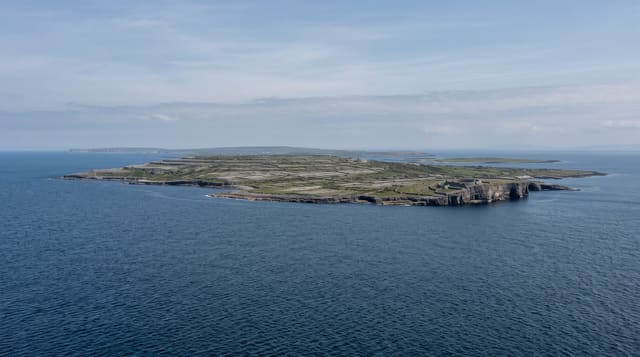
Inis Meain is the middle of the three Aran islands and takes a small fraction of the visitors that Inis Mor does, which is why people who want the Aran of the imagination tend to go here. Around a hundred and eighty people live on it and Irish is the everyday language. J M Synge spent summers here between 1898 and 1902 and the plays came out of what he heard; the cottage he stayed in and a stone seat above the cliffs, Synge's Chair, are both on the island. Dun Chonchuir, a large oval stone fort on the high ground, is one of the better preserved of its kind in Ireland and there is nobody at the gate. The land is a grid of tiny fields inside dry stone walls on bare limestone, built up over centuries with sand and seaweed. There is one shop, one pub, a knitwear company and very limited accommodation.
The landscape
- Dun Chonchuir - a large oval stone fort on the island's high ground.
- The stone wall grid - tiny fields built on bare limestone over centuries.
- Synge's Chair - the cliff-edge seat above the western shore.
- The living language - Irish spoken as the everyday tongue.
When to go
May to September; ferries and flights are reduced out of season and cancel in swell. Accommodation is very limited - book before travelling, not on arrival.
Before you go
One shop and one pub; almost no services and no car hire. Ferries cancel in weather. Cliffs on the southern side are high and completely unfenced. It is quiet in a way that some visitors find dull.
Nearby
Inis Mor is north-west, Inis Oirr south-east; the Cliffs of Moher face the islands.
Key facts
Source: Wikidata, item Q1424587, read on 18 October 2026.
What to pack for Inis Meain
Chosen from what this place is for. Tap a kit for the full checklist.
- Reef-safe sunscreen - High SPF that will not bleach the coral you are swimming over. Find on Amazon
- Quick-dry towel - A microfibre towel packs small and dries in minutes. Find on Amazon
- Water shoes - Protect your feet on rocky entries, hot sand and sea-urchin spines. Find on Amazon
- Dry bag - Keeps phone, cash and keys safe while you are in the water. Find on Amazon
Some links on this page are Amazon affiliate links - if you buy through them we may earn a small commission at no extra cost to you.
All packing kitsPlan your trip
Where to start if Inis Meain is going on the list.
Booking links on this page are affiliate links - if you book through them we may earn a small commission at no extra cost to you. It never changes what we write about a place.
Opening times, ticket prices and seasonal closures change - check the official source before you go: official site.