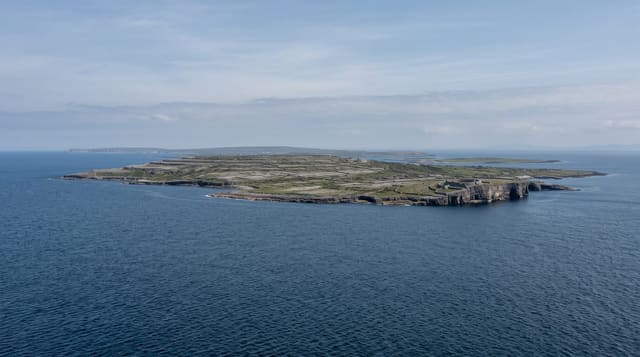
Dun Aonghasa
A prehistoric stone fort on the cliff edge of Inis Mor, its fourth side being a hundred-metre drop into the Atlantic.
Updated 21 October 2026
Dun Aonghasa stands on the southern cliff of Inis Mor, the largest Aran island, with three concentric drystone walls enclosing a semicircular area whose open side is the cliff edge - a drop of about a hundred metres straight into the sea. Building here began in the Bronze Age, around 1100 BC, with major work in the Iron Age. Outside the middle wall is a chevaux de frise: a broad band of thousands of upright limestone slabs set close together to break a charge, one of the best surviving examples in Europe. Whether it was a fortress, a ceremonial enclosure or a status site is argued; excavation found domestic occupation. The walls were partly rebuilt in the 1880s, which is not always made clear. The path from the visitor centre climbs about 900 metres over limestone. There is no fence at the cliff; the edge undercuts in places.
History
It is not known exactly when the fort was built, though most of its structures are now thought to date from the Bronze Age and Iron Age, and an early Iron Age bird-head brooch was found in one of its walls in 1839; it stands at the edge of a 100-metre cliff (Wikipedia, Dún Aonghasa).
Highlights
- The cliff edge - the fort's open fourth side, a hundred-metre drop.
- The chevaux de frise - thousands of upright stones set as a defensive band.
- The concentric walls - three drystone enclosures, partly rebuilt in the 1880s.
- The Bronze Age origin - occupation here from around 1100 BC.
When to go
April to October, when ferries and the visitor centre run fully. The path is exposed and the cliff dangerous in wind. Early or late avoids the day-trip crowd from the ferries.
What to expect
No fence or barrier at the cliff edge, and it is undercut. The approach path is 900 metres of uneven rock, unsuitable for limited mobility. Sections of the walls are Victorian reconstruction.
Nearby
The Worm Hole is on the shore platform below; Kilronan and the ferry are east.
Key facts
Source: Wikidata, item Q1265205, read on 18 October 2026.
What to pack for Dun Aonghasa
Chosen from what this place is for. Tap a kit for the full checklist.
- Comfortable walking shoes - Sightseeing means kilometres of pavement and cobbles daily. Find on Amazon
- A slim anti-theft daypack - Zips that close properly; keep it in front in crowds and on transit. Find on Amazon
- A refillable water bottle - Many cities have public fountains; save money and plastic. Find on Amazon
- A light layer + compact umbrella - For museum air-con and a sudden shower. Find on Amazon
Some links on this page are Amazon affiliate links - if you buy through them we may earn a small commission at no extra cost to you.
All packing kitsPlan your trip
Where to start if Dun Aonghasa is going on the list.
Booking links on this page are affiliate links - if you book through them we may earn a small commission at no extra cost to you. It never changes what we write about a place.
Opening times, ticket prices and seasonal closures change - check the official source before you go: official site.