McLeod Ganj
A hillside town that became the centre of the Tibetan exile community, with monasteries, cafes and cedar forest.
Updated 19 October 2026
AI illustration
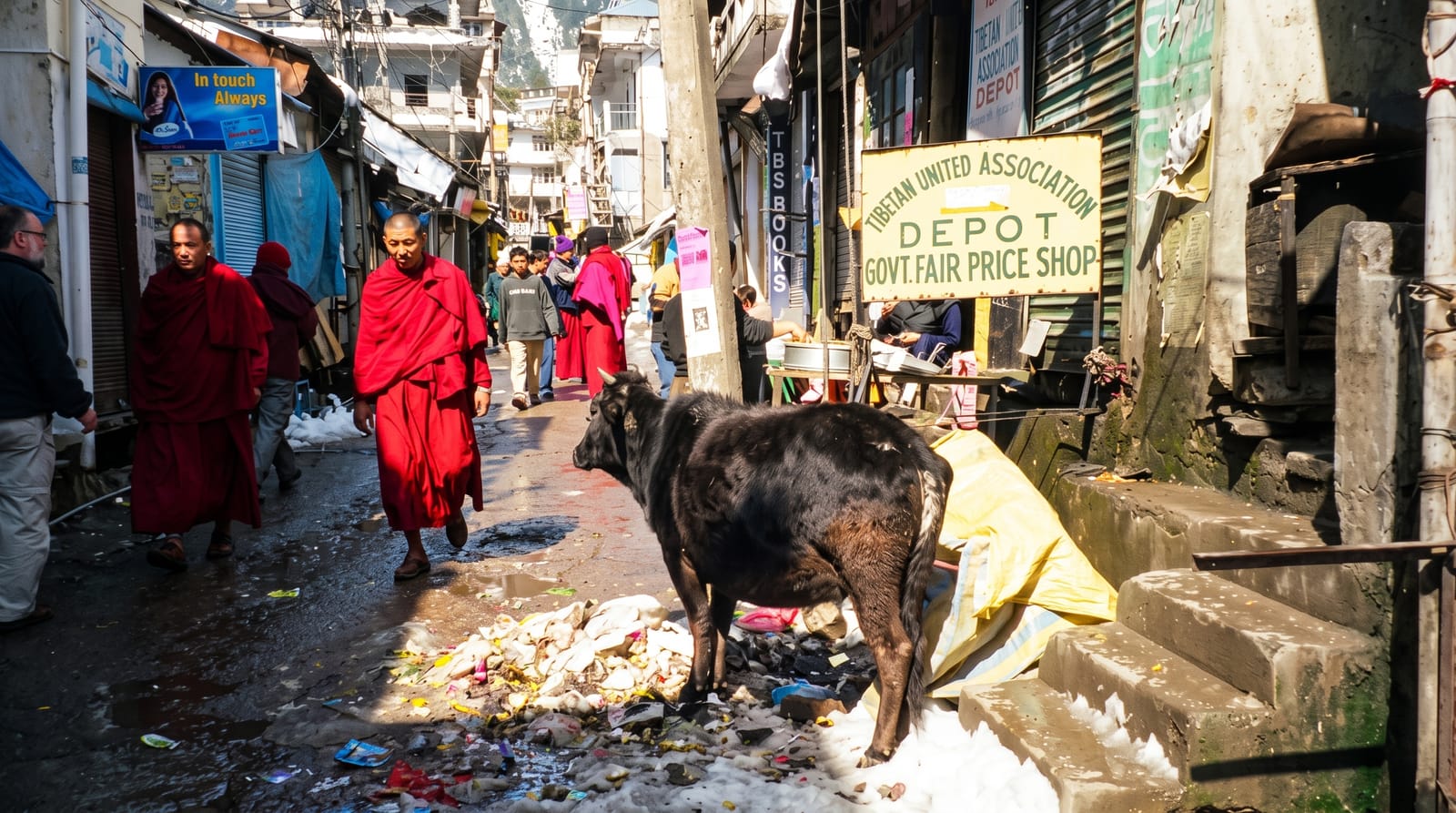
McLeod Ganj sits at about 2,080 metres on a spur above Dharamshala, and since 1960 it has been the seat of the Tibetan community in exile, which reshaped an old British hill settlement into a town of monasteries, institutes and Tibetan-run guesthouses and kitchens. The Tsuglagkhang complex holds the main temple, a museum on Tibetan history and the residence, with a kora path circling it hung with prayer flags. The Norbulingka Institute below teaches thangka painting, woodcarving and appliqué. Above the town, Bhagsu waterfall and the meadow at Triund, a nine-kilometre walk, look up at the Dhauladhar wall.
History
McLeod Ganj is named after Sir Donald Friell McLeod, a Lieutenant Governor of Punjab, ganj being the common word for a neighbourhood. The region appears in the Rig Veda and the Mahabharata and is mentioned by Panini and by the Chinese traveller Xuanzang, its indigenous people being the Gaddis; Mahmud of Ghazni attacked it in 1009, Akbar took it in 1566, in 1785 it passed to Sansar Chand of the Katoch dynasty, and after 1846 it came under British rule, with the 66th Gurkha Light Infantry moved to Dharamshala in 1860 (Wikipedia, McLeod Ganj).
What to look for
- The Tsuglagkhang complex - the main temple, museum and kora circuit.
- Norbulingka Institute - workshops teaching Tibetan crafts.
- Triund - a nine-kilometre walk to a ridge under the Dhauladhar.
- The Tibetan kitchens - momo and thukpa cooked throughout the town.
When to go
March to June and September to November; the monsoon here is among the heaviest in India. Losar, the Tibetan new year, falls in late winter. Triund is crowded at weekends.
Before you go
The town is small and congested with narrow roads and difficult parking. Triund is heavily trafficked and littered in places. Monsoon rain is exceptional and landslides close roads.
Nearby
Dharamshala lies below; Bir Billing is southeast.
Key facts
Source: Wikidata, item Q3072050, read on 18 October 2026.
What to pack for McLeod Ganj
Chosen from what this place is for. Tap a kit for the full checklist.
- Strong insect repellent - DEET or picaridin; the jungle is where bites and disease risk are highest. Find on Amazon
- Comfortable walking shoes - Sightseeing means kilometres of pavement and cobbles daily. Find on Amazon
- Modest clothing - Shoulders and knees covered - the single most common requirement. Find on Amazon
- Long, light, quick-dry clothing - Covers skin from insects and sun without cooking you in the humidity. Find on Amazon
Some links on this page are Amazon affiliate links - if you buy through them we may earn a small commission at no extra cost to you.
All packing kitsPlan your trip
Where to start if McLeod Ganj is going on the list.
Booking links on this page are affiliate links - if you book through them we may earn a small commission at no extra cost to you. It never changes what we write about a place.
Opening times, ticket prices and seasonal closures change - check the official source before you go: official site.