Kangra Fort
One of the oldest forts in India, on a spur above two rivers, holding a treasury that drew repeated invasion.
Updated 19 October 2026
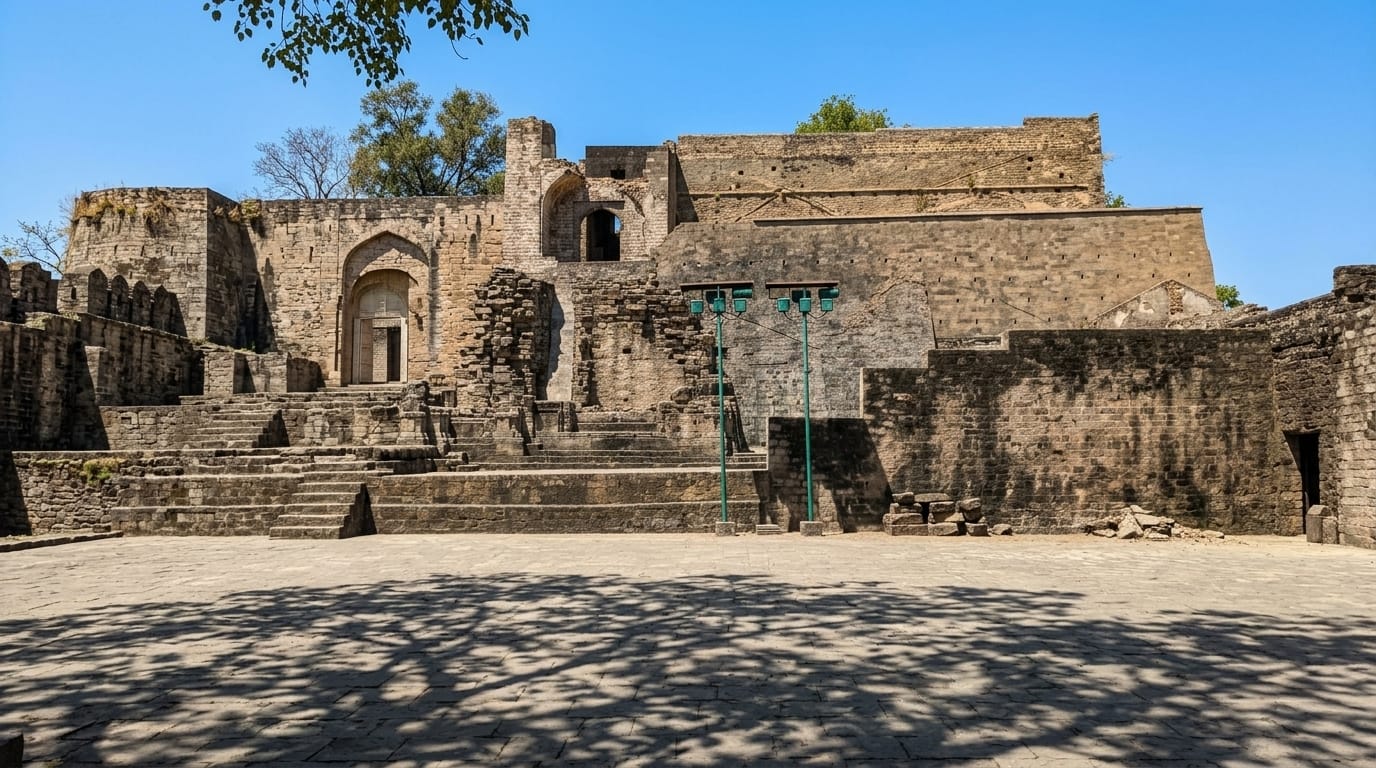
AI illustration
The fort stands on a spur where the Banganga meets the Manjhi, built by the Katoch dynasty of Rajputs and among the oldest forts in India, though it changed hands many times. Its wealth came from the Brajeshwari temple below, whose treasury was rich enough that Mahmud of Ghazni sacked it in 1009 and others followed, and the fort itself was besieged repeatedly through Mughal and Sikh periods. An earthquake in 1905 wrecked much of it. What stands is a long gated approach climbing through successive courtyards, ruined temples of stone at the top, and a wide view over the Kangra valley to the Dhauladhar.
History
The fort was built by the Katoch dynasty of Rajputs, and its earliest surviving remains are Jain and Hindu temples of about the 9th and 10th centuries. The first recorded mention is its invasion by Mahmud of Ghazni in 1009; it was taken by Muhammad bin Tughluq in 1337, by Firuz Shah Tughluq in 1351 and by a general of Sher Shah Suri in 1540, the Katoch raja Dharam Chand submitted to Akbar in 1556, and in 1620 Jahangir annexed the Kangra kingdom and the fort was captured, staying under Mughal control until it was surrendered to the Sikh leader Jai Singh Kanhaiya in 1783 (Wikipedia, Kangra Fort).
Highlights
- The gated ascent - a series of gates and courtyards climbing the spur.
- The ruined temples - stone shrines at the summit of the fort.
- The earthquake damage - collapsed structures from the 1905 shock.
- The valley view - Kangra spread below with the Dhauladhar behind.
When to go
March to June and September to November; the monsoon in Kangra is very heavy. Mornings are best for the climb and the mountain view. The site is quiet compared with Dharamshala.
What to expect
The fort is largely ruined, with the 1905 earthquake having brought down much of it. The climb is steep on uneven stone. Interpretation beyond the audio guide is limited.
Nearby
Masroor temples lie southwest; Dharamshala is north.
Key facts
Source: Wikidata, item Q6362859, read on 18 October 2026.
What to pack for Kangra Fort
Chosen from what this place is for. Tap a kit for the full checklist.
- Strong insect repellent - DEET or picaridin; the jungle is where bites and disease risk are highest. Find on Amazon
- Comfortable walking shoes - Sightseeing means kilometres of pavement and cobbles daily. Find on Amazon
- Modest clothing - Shoulders and knees covered - the single most common requirement. Find on Amazon
- Long, light, quick-dry clothing - Covers skin from insects and sun without cooking you in the humidity. Find on Amazon
Some links on this page are Amazon affiliate links - if you buy through them we may earn a small commission at no extra cost to you.
All packing kitsPlan your trip
Where to start if Kangra Fort is going on the list.
Booking links on this page are affiliate links - if you book through them we may earn a small commission at no extra cost to you. It never changes what we write about a place.
Opening times, ticket prices and seasonal closures change - check the official source before you go: official site.