Humayun's Tomb
The first great Mughal garden tomb in India, red sandstone inlaid with marble on a high plinth in a quartered walled garden.
Updated 18 October 2026
AI illustration
UNESCO World Heritage
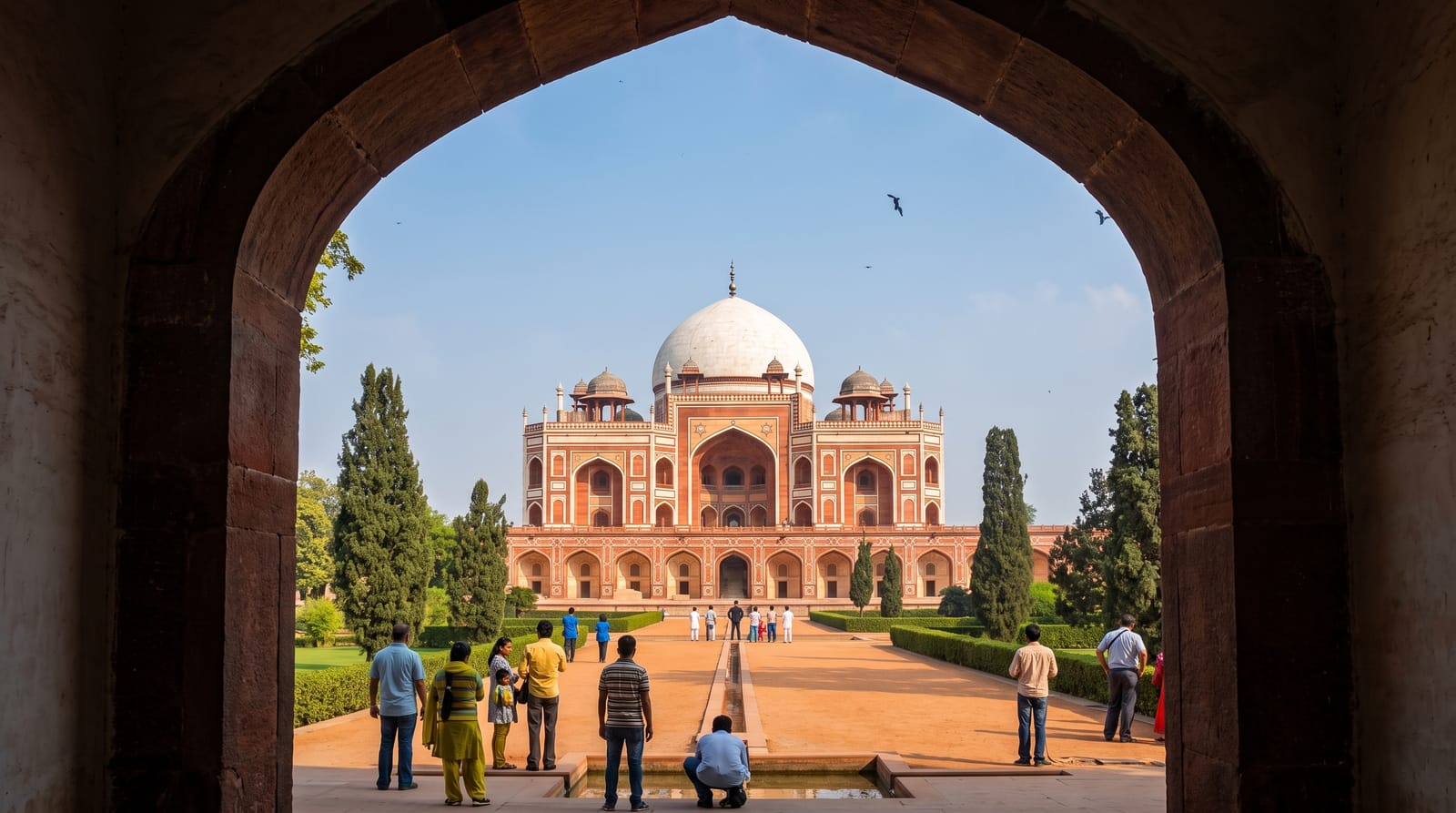
Humayun's tomb was built in the 1560s by the emperor's widow, and it set the pattern that Mughal architecture followed for the next century, the Taj included. A red sandstone mass inlaid with white marble sits on a high arcaded plinth in the middle of a walled garden divided into quarters by water channels, with a double dome above and deep recessed arches on every face. The gardens were replanted and the channels made to run again during a long restoration, so the setting now reads roughly as it was intended to. The wider enclosure holds dozens of other tombs, among them the older octagonal tomb of Isa Khan behind its own wall, always quieter than the main lawn.
History
After his death on 27 January 1556, Humayun was first buried in his palace in the Purana Qila and then taken to Sirhind; his first wife and chief consort, Empress Bega Begum, had the tomb built near the Yamuna from 1565 to 1572 at a cost of 1.5 million rupees, choosing the Persian architect Mirak Mirza Ghiyas, brought from Herat, whose son Sayyid Muhammad finished it after his death. It was the first garden-tomb in the Indian subcontinent and the first building to use red sandstone on such a scale. When the English merchant William Finch visited in 1611 the central chamber held rich carpets and Humayun's sword, turban and shoes, but the Mughal decline of the 18th century let the gardens decay into townspeople's vegetable plots; in 1857 the British captured Bahadur Shah Zafar here, in 1860 they replanted the garden in English style, and in 1993 the tomb was declared a World Heritage Site (Wikipedia, Humayun's tomb).
What to look for
- The main tomb - red sandstone with marble inlay on a high plinth, under a white double dome.
- The charbagh garden - the quartered layout with restored water channels and causeways.
- Isa Khan's tomb - an older octagonal tomb in its own sunken walled garden near the entrance.
- The plinth arcades - the vaulted chambers under the platform, holding further graves.
When to go
October to March is the workable season in Delhi; May and June are extreme and the garden gives little shade. Come at opening, when the light is low on the west face and the lawns are empty, or in the last hour before closing. Winter mornings can be lost to heavy haze, so a clear afternoon is sometimes the better bet.
What to expect
Delhi's air quality can flatten the view entirely for weeks at a time in winter. Ticket prices for foreign visitors are several times the local rate. The main chamber is plain inside and takes five minutes. Weekend afternoons bring large groups and the lawns become picnic ground. Persistent guides work the entrance path.
Nearby
Sunder Nursery adjoins the site, and the lanes of Nizamuddin with their food stalls are just across the road.
Key facts
Source: Wikidata, item Q189648, read on 18 October 2026.
What to pack for Humayun's Tomb
Chosen from what this place is for. Tap a kit for the full checklist.
- Comfortable walking shoes - Sightseeing means kilometres of pavement and cobbles daily. Find on Amazon
- A slim anti-theft daypack - Zips that close properly; keep it in front in crowds and on transit. Find on Amazon
- A refillable water bottle - Many cities have public fountains; save money and plastic. Find on Amazon
- A light layer + compact umbrella - For museum air-con and a sudden shower. Find on Amazon
Some links on this page are Amazon affiliate links - if you buy through them we may earn a small commission at no extra cost to you.
All packing kitsPlan your trip
Where to start if Humayun's Tomb is going on the list.
Booking links on this page are affiliate links - if you book through them we may earn a small commission at no extra cost to you. It never changes what we write about a place.
Opening times, ticket prices and seasonal closures change - check the official source before you go: official site.