Olynthos
A classical city laid out on a grid, where excavated houses preserve pebble mosaics and the earliest known street plan of its kind.
Updated 19 October 2026
AI illustration
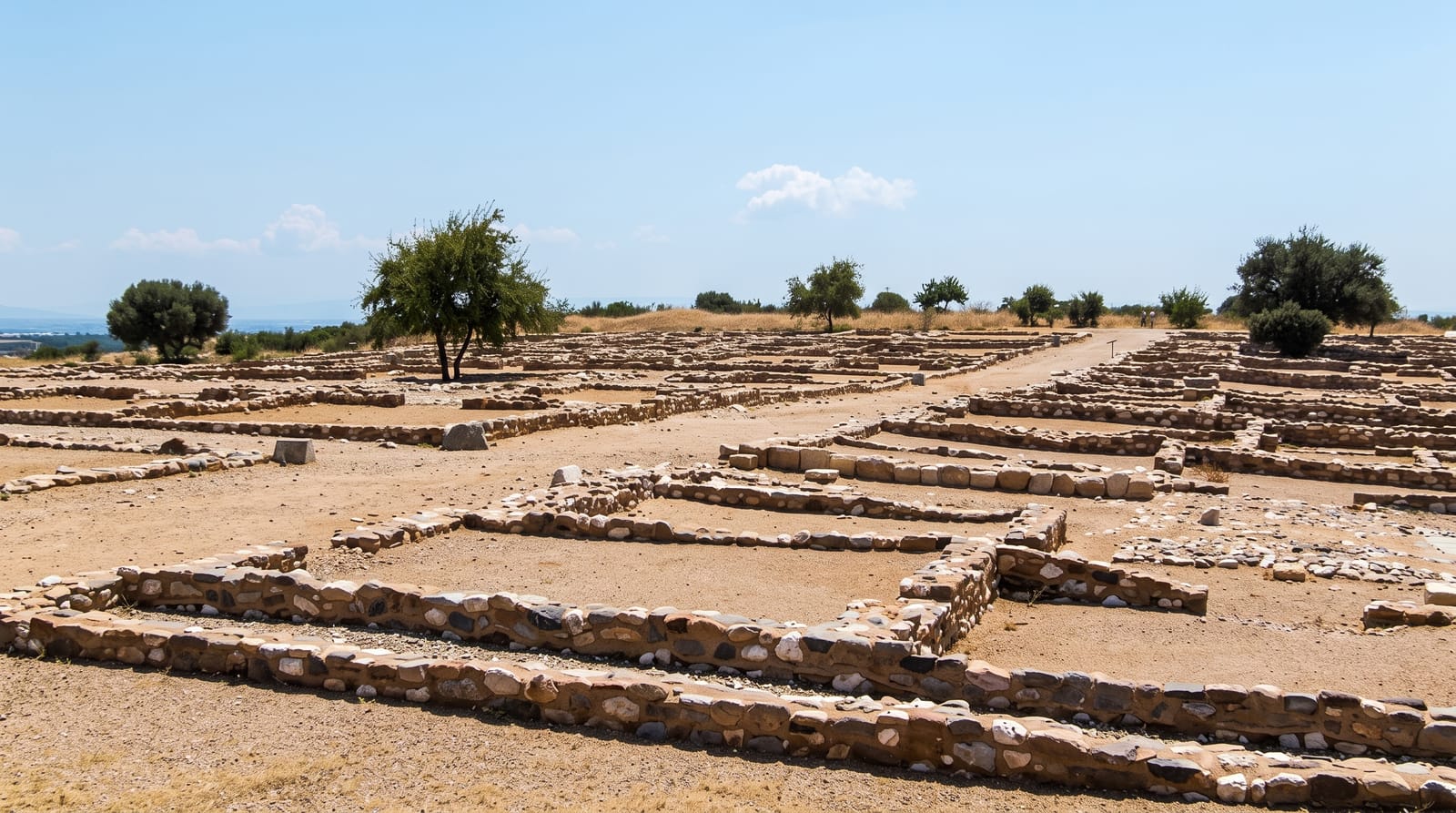
Olynthos was destroyed in 348 BC and never rebuilt, which froze a classical Greek town at a single moment and made it one of the most informative sites in Greece for how people actually lived. American excavations in the 1920s and 30s uncovered a planned city on the North Hill laid out on a strict grid, an early and unusually complete example of what ancient writers associated with Hippodamian planning: standard blocks of ten houses, each about seventeen metres square, with courtyards, andrones for male dining, bathrooms and drainage. Several floors keep pebble mosaics with mythological scenes, protected under shelters, including the celebrated Bellerophon panel. Walking the excavated streets gives a clear sense of a residential quarter rather than a monumental centre.
History
A Neolithic settlement was founded here in the 4th millennium BCE and thrived from 3000 to 2900 BCE, a farming community known only from archaeology; after it was abandoned the site was resettled in the 7th century BC and later taken by the Bottiaeans, a Thracian people driven out of Macedon by Alexander I. Olynthus, named after a son of Heracles or of Strymon, led the Chalcidian League from just before the Peloponnesian War and flourished from 432 BCE until Philip II of Macedon destroyed it in 348 BCE; it was finally abandoned in 316 BCE (Wikipedia, Olynthus).
The main sights
- The grid streets - a planned classical town laid out in regular blocks.
- The houses - courtyards, dining rooms and bathrooms in excavated plan.
- The pebble mosaics - fourth-century BC floors under protective shelters.
- The hill setting - the site above the plain with views to the gulf.
When to go
Spring and autumn; the hill is open and hot in summer, and there is little shade. Mornings are best for light on the mosaics.
Good to know
The remains stand knee-high, so the interest is in plan and detail rather than spectacle. Some mosaics are covered for protection outside the main season. Signage exists but a guidebook adds a great deal.
Nearby
Halkidiki's beaches are twenty minutes south; Thessaloniki lies an hour north.
Key facts
Source: Wikidata, item Q1141669, read on 18 October 2026.
What to pack for Olynthos
Chosen from what this place is for. Tap a kit for the full checklist.
- Reef-safe sunscreen - High SPF that will not bleach the coral you are swimming over. Find on Amazon
- Comfortable walking shoes - Sightseeing means kilometres of pavement and cobbles daily. Find on Amazon
- Quick-dry towel - A microfibre towel packs small and dries in minutes. Find on Amazon
- A slim anti-theft daypack - Zips that close properly; keep it in front in crowds and on transit. Find on Amazon
Some links on this page are Amazon affiliate links - if you buy through them we may earn a small commission at no extra cost to you.
All packing kitsPlan your trip
Where to start if Olynthos is going on the list.
Booking links on this page are affiliate links - if you book through them we may earn a small commission at no extra cost to you. It never changes what we write about a place.
Opening times, ticket prices and seasonal closures change - check the official source before you go: official site.