Delos
The sacred island of Apollo - an entire ancient city of temples, mosaics and marble lions, uninhabited since antiquity and reached by boat from Mykonos.
Updated 18 October 2026
AI illustration
UNESCO World Heritage
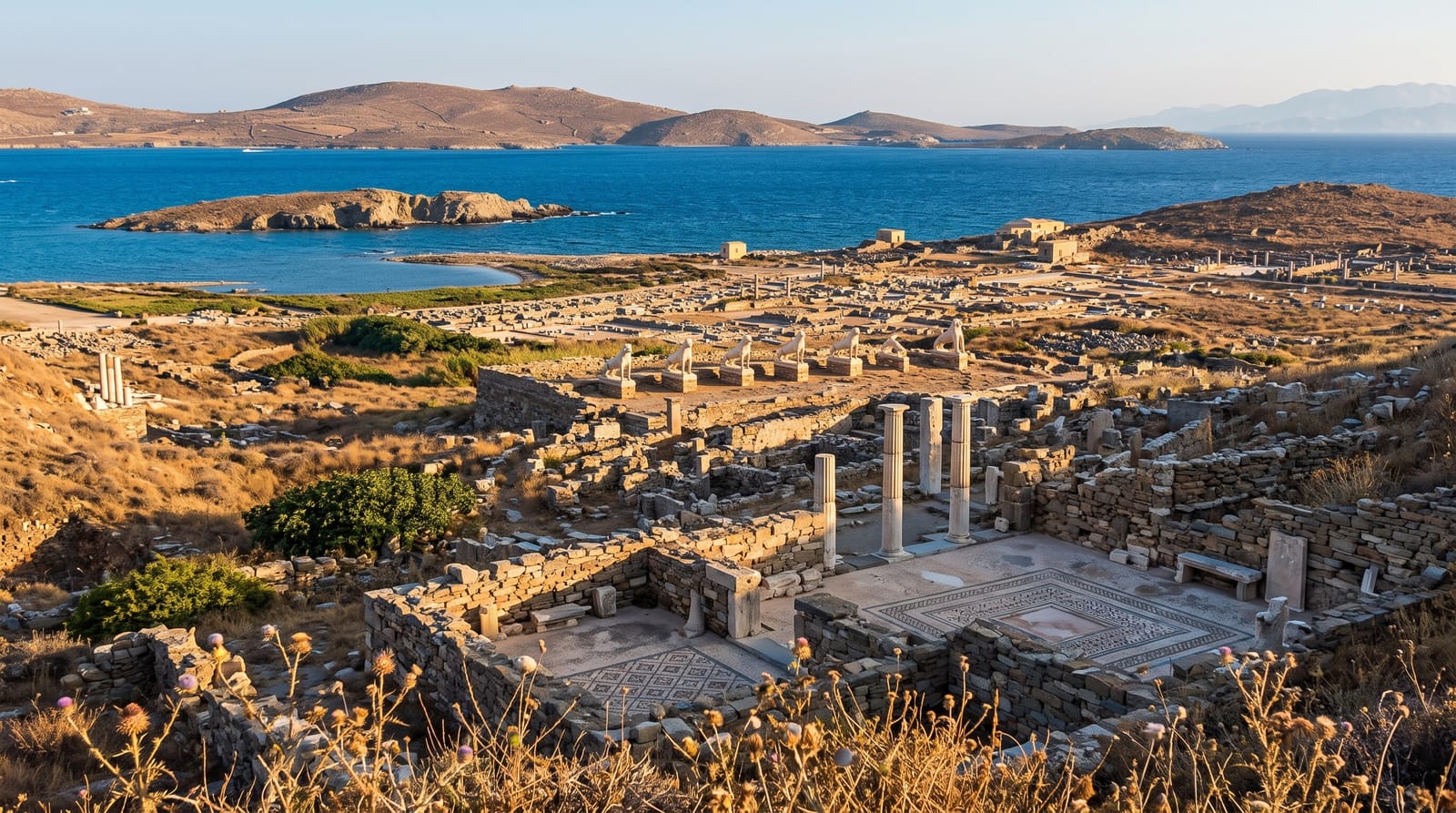
Delos anchors the Cyclades in myth and marble: the island where Leto was said to have borne Apollo and Artemis grew into one of antiquity's great sanctuaries and busiest free ports, and when history moved on it simply stopped - no later town ever built over it, leaving a whole ancient city open to the sky. UNESCO inscribed the island in 1990 for exactly that completeness. The Terrace of the Lions guards the old processional way (the weathered originals sheltered in the site museum, replicas standing watch outside), the hillside mansions keep their dolphin and Dionysos mosaics, and the stony climb up Mount Kynthos surveys the ring of islands the ancients believed circled this still centre. Boats make the short crossing from Mykonos through the morning; by late afternoon the island empties back to its lizards and wind.
History
Stone huts show Delos was inhabited from the 3rd millennium BC, and by the time of the Odyssey it was famous as the birthplace of Apollo and Artemis; between 900 BC and AD 100 it was a major cult centre. Athens carried out purifications of the island, first under Pisistratus in the 6th century BC, then in the sixth year of the Peloponnesian War, when all the dead were removed and birth and burial on Delos were forbidden, and four years later all its inhabitants were moved to Adramyttium. After the Persian Wars it became the meeting place of the Delian League, founded in 478 BC, whose treasury was kept here until Pericles moved it to Athens in 454 BC; in the Hellenistic period its trade drew a Phoenician colony and Samaritan and Jewish communities, and in 1990 the island was added to the World Heritage List (Wikipedia, Delos).
What's there
- The Terrace of the Lions - the archaic guardians of the processional way.
- The mosaic houses - dolphins, masks and Dionysos on merchant floors.
- Mount Kynthos - the summit view over the whole sanctuary and the Cyclades.
- The site museum - the original lions and finds from the sacred island.
When to go
April to June and September to October give warm light without the shadeless furnace of midsummer. Boats are wind-dependent - the meltemi cancels crossings, so build in a spare morning. First boats beat both heat and crowds.
What to expect
There is almost no shade and no swimming stop - hat, water and decent shoes are non-negotiable. Visiting hours are tied to the boat schedule, and the combined ticket and fare make it a full-price outing; it earns every euro if ruins move you at all.
Nearby
Mykonos town's windmills and Little Venice, and Rhenia's quiet coves across the channel.
What to pack for Delos
Chosen from what this place is for. Tap a kit for the full checklist.
- Reef-safe sunscreen - High SPF that will not bleach the coral you are swimming over. Find on Amazon
- Binoculars - The single best wildlife tool - even a compact pair transforms a sighting. Find on Amazon
- Comfortable walking shoes - Sightseeing means kilometres of pavement and cobbles daily. Find on Amazon
- Modest clothing - Shoulders and knees covered - the single most common requirement. Find on Amazon
Some links on this page are Amazon affiliate links - if you buy through them we may earn a small commission at no extra cost to you.
All packing kitsPlan your trip
Where to start if Delos is going on the list.
Booking links on this page are affiliate links - if you book through them we may earn a small commission at no extra cost to you. It never changes what we write about a place.
Opening times, ticket prices and seasonal closures change - check the official source before you go: official site.