Anjar
The only major Umayyad city site in the country, a planned eighth-century town laid out on a Roman grid in the Bekaa.
Updated 18 October 2026
AI illustration
UNESCO World Heritage
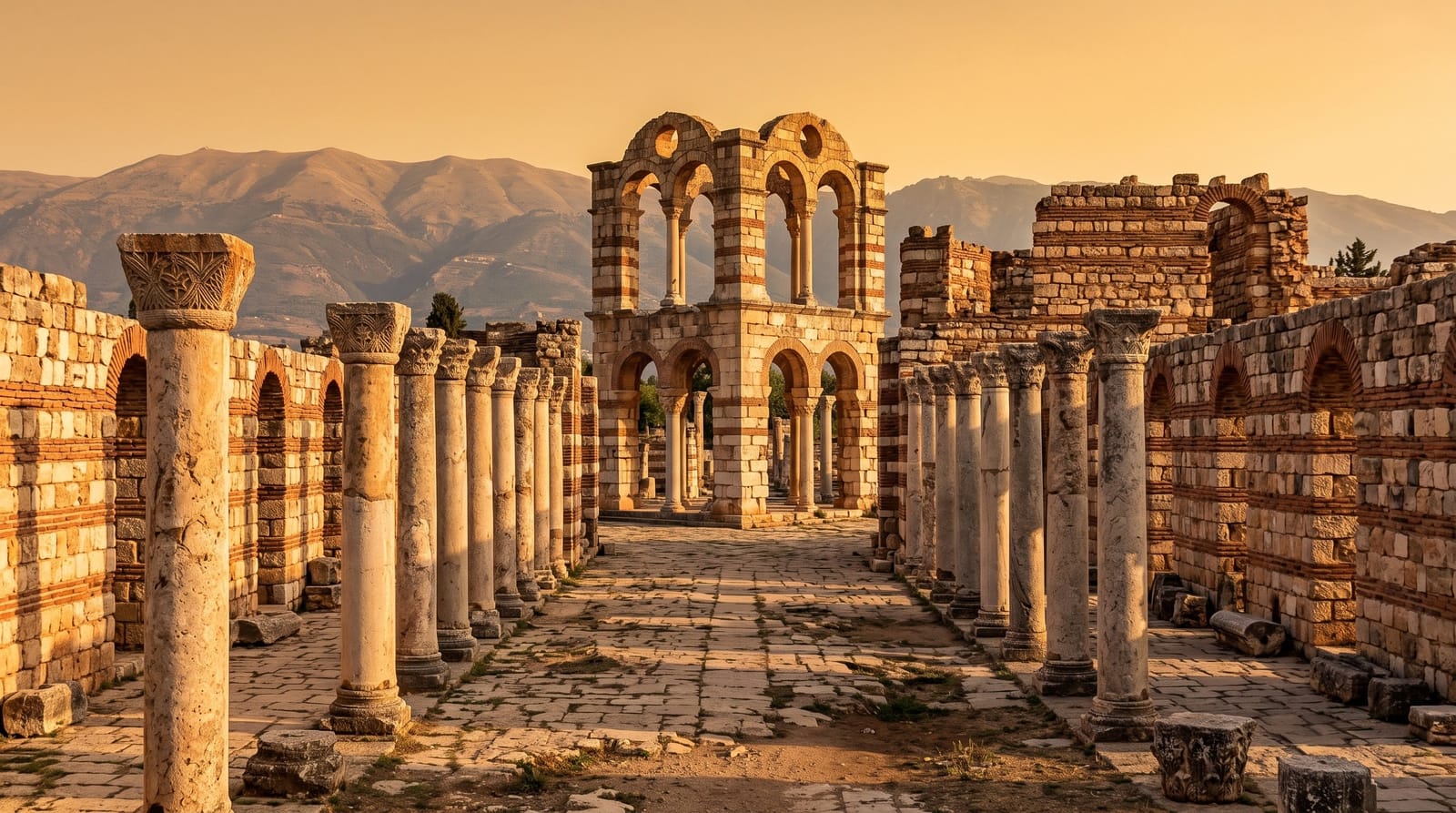
Anjar is unusual in Lebanon because it belongs to a single moment: built in the early eighth century under the Umayyad caliph Walid I, occupied briefly, and then abandoned, which means there is no medieval or Ottoman layer on top. The plan is a rectangle divided into quarters by two colonnaded avenues crossing at a tetrapylon, following Roman city-planning conventions with Byzantine building techniques and Umayyad decoration, a hybrid you can read directly in the stonework of alternating stone and brick courses. A great palace, a smaller one, baths and shops line the streets. The setting adds to it: flat Bekaa farmland with the Anti-Lebanon range rising behind, and the site is usually quiet.
History
The town is generally attributed to the Umayyad caliph al-Walid I, who founded it as a palace-city at the beginning of the 8th century: Syriac graffiti in the quarry that supplied its best stone give the year 714, a Syriac chronicle names Walid, and the Byzantine chronicler Theophanes says that his son al-Abbas began building in 709-710, a date the historian Jere L. Bacharach accepts. Earlier materials were reused, but much of the city stands on virgin ground. Later abandoned, Anjar was resettled in 1939 by several thousand Armenian refugees from Musa Dagh, whose six villages give their names to its neighbourhoods, and since 1984 the Umayyad ruins have been a World Heritage Site (Wikipedia, Anjar, Lebanon).
What you'll find
- The tetrapylon - the four-way monument where the two colonnaded avenues cross.
- The great palace - arcaded facade with reused Roman columns and capitals.
- The shop foundations - rows of small units along the main avenues.
- The alternating stone and brick - the distinctive Umayyad building technique.
When to go
Spring and autumn are best; the Bekaa is hot in summer and cold in winter. Spring brings green fields around the site. Mornings give better light on the arcades.
Before you go
Much of the site is foundations rather than standing building, and it is smaller than Baalbek an hour away, which tends to overshadow it entirely. There is minimal shade and limited interpretation. Its interest is architectural and historical rather than spectacular, and it rewards knowing what you are looking at.
Nearby
Baalbek is an hour north; Zahle and the Bekaa wineries lie west.
What to pack for Anjar
Chosen from what this place is for. Tap a kit for the full checklist.
- Comfortable walking shoes - Sightseeing means kilometres of pavement and cobbles daily. Find on Amazon
- A slim anti-theft daypack - Zips that close properly; keep it in front in crowds and on transit. Find on Amazon
- A refillable water bottle - Many cities have public fountains; save money and plastic. Find on Amazon
- A light layer + compact umbrella - For museum air-con and a sudden shower. Find on Amazon
Some links on this page are Amazon affiliate links - if you buy through them we may earn a small commission at no extra cost to you.
All packing kitsPlan your trip
Where to start if Anjar is going on the list.
Booking links on this page are affiliate links - if you book through them we may earn a small commission at no extra cost to you. It never changes what we write about a place.
Opening times, ticket prices and seasonal closures change - check the official source before you go: official site.