Xanadu Ruins
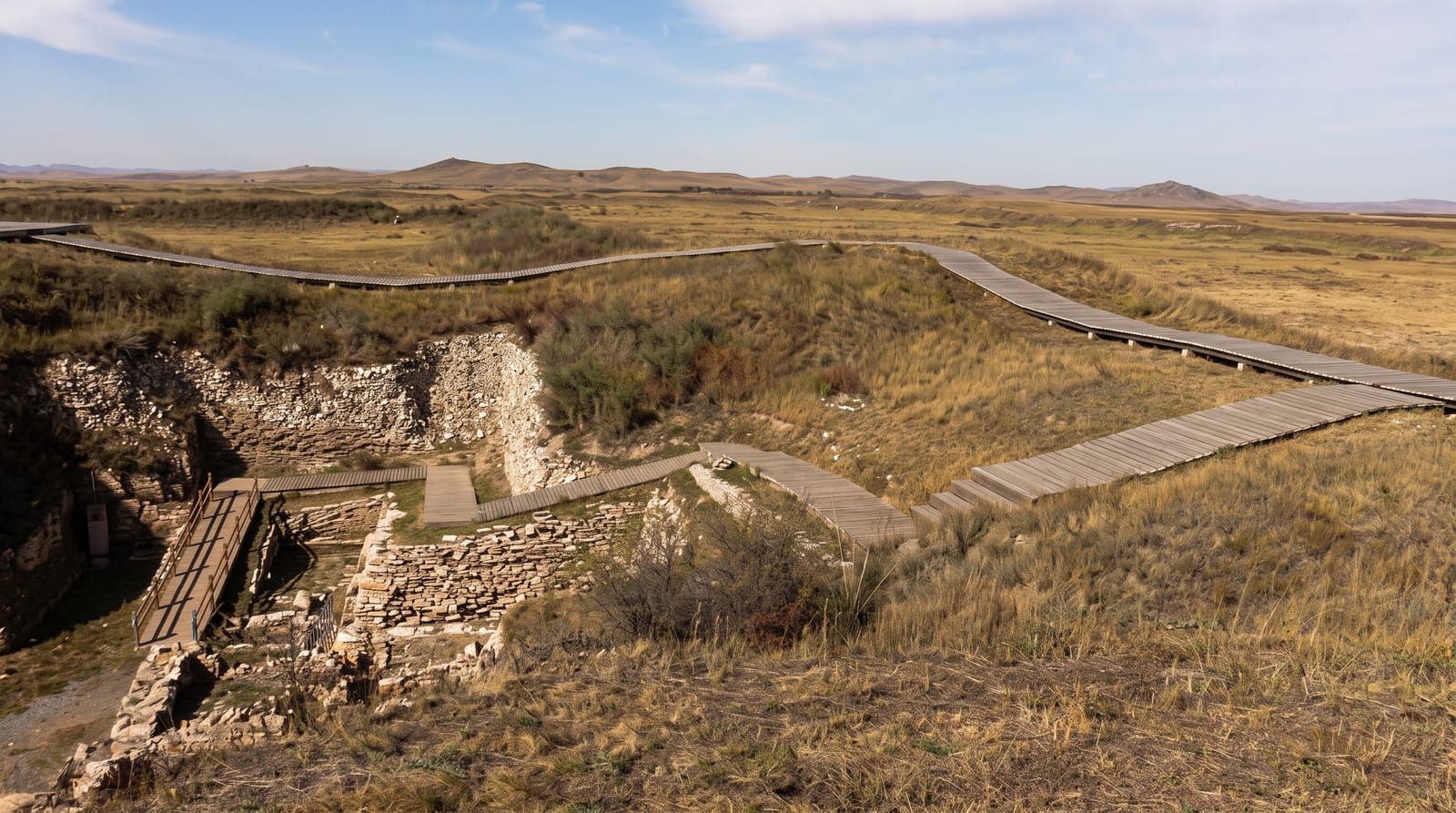
The grass-covered remains of Kublai Khan's summer capital, the Shangdu that Coleridge turned into Xanadu.
Updated 4 September 2026
AI illustration
Shangdu was built from 1256 as Kublai Khan's summer capital, a city of over a hundred thousand people laid out where the steppe meets the agricultural north, deliberately combining Mongol and Chinese planning: a walled palace city inside an imperial city inside an outer city, with grasslands beyond where the court kept its nomadic practices. Marco Polo described it, and Coleridge's 1816 poem fixed the name Xanadu in English as a byword for exotic splendour. The city was destroyed in the 1360s and what remains is earthworks, foundations, walls reduced to grassy ridges and scattered stone, inscribed as UNESCO World Heritage in 2012. A museum interprets the layout.
The main sights
- The city outlines - walls and foundations reduced to grass-covered ridges.
- The palace platform - the raised base of the main hall.
- The museum - reconstructions and finds explaining the city's plan.
- The steppe setting - open grassland where the Mongol court camped.
When to go
June to September, when the grassland is green and the site accessible; winter is severe and the site effectively closed. The plain is exposed with no shade, and wind is constant.
Practical notes
There is very little standing: the site is earthworks and foundations, and imagination does most of the work. It is remote, with a car essential and several hours' drive from Beijing. English interpretation is limited to the museum.
Nearby
Duolun lies south; the Xilingol grasslands stretch north and west.
What to pack for Xanadu Ruins
Chosen from what this place is for. Tap a kit for the full checklist.
- Comfortable walking shoes - Sightseeing means kilometres of pavement and cobbles daily. Find on Amazon
- A slim anti-theft daypack - Zips that close properly; keep it in front in crowds and on transit. Find on Amazon
- A refillable water bottle - Many cities have public fountains; save money and plastic. Find on Amazon
- A light layer + compact umbrella - For museum air-con and a sudden shower. Find on Amazon
Some links on this page are Amazon affiliate links - if you buy through them we may earn a small commission at no extra cost to you.
All packing kitsPlan your trip
Where to start if Xanadu Ruins is going on the list.
Booking links on this page are affiliate links - if you book through them we may earn a small commission at no extra cost to you. It never changes what we write about a place.
Opening times, ticket prices and seasonal closures change - check the official source before you go: official site.