Wudangzhao Monastery
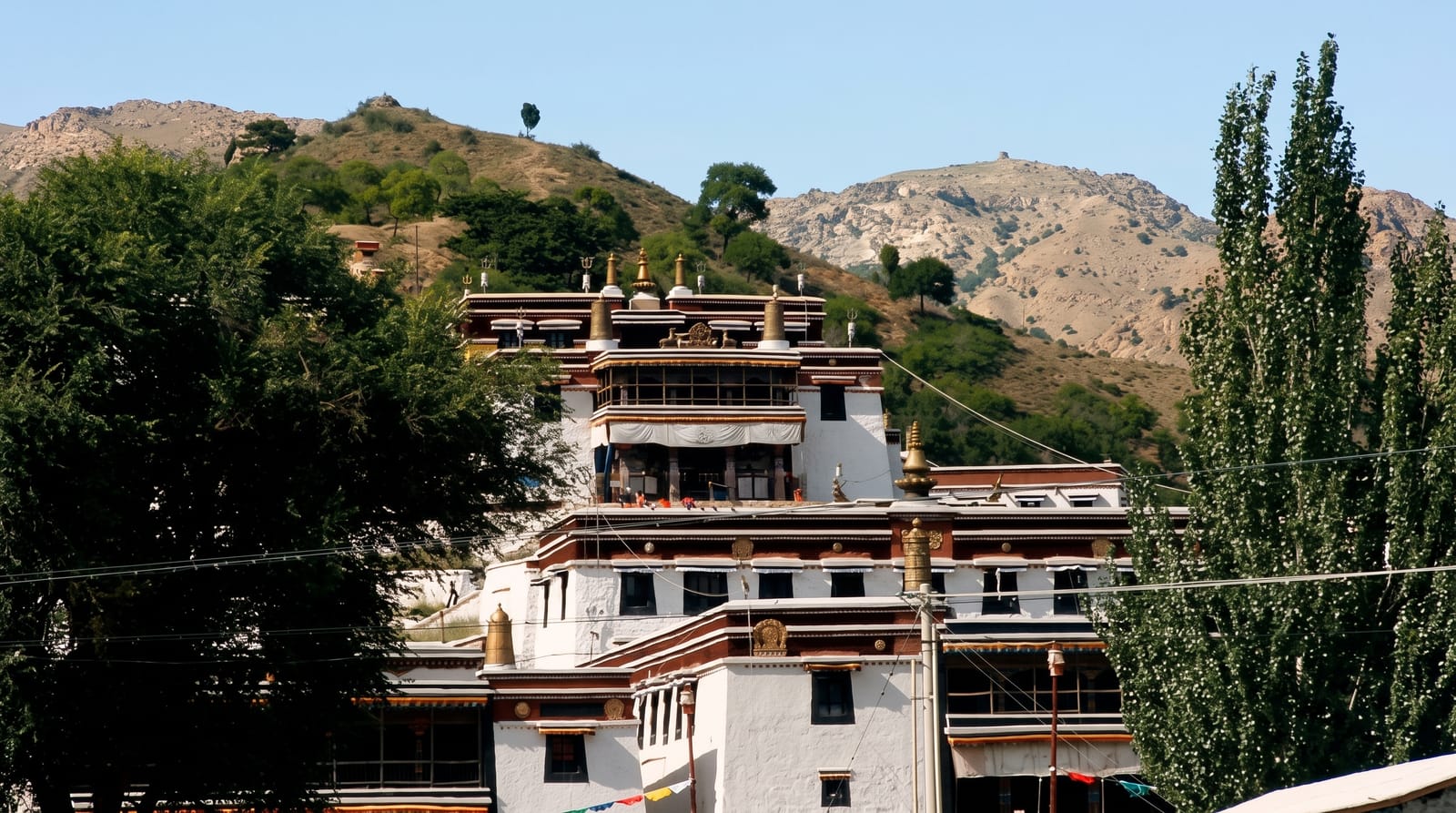
The largest surviving Tibetan Buddhist monastery in Inner Mongolia, white halls stacked up a hillside in Tibetan style.
Updated 4 September 2026
AI illustration
Wudangzhao was founded in 1749 and grew into the largest monastery in Inner Mongolia, with some two and a half thousand rooms across more than fifty buildings, housing well over a thousand monks at its height. Unlike most Mongolian monasteries, which followed Chinese architectural models, it was built in a Tibetan style: whitewashed blocks with battered walls, flat roofs and dark window bands, stacked up a hillside in a valley of the Yinshan mountains so that the complex reads as a Tibetan village rather than a Chinese temple. Murals inside the main halls cover thousands of square metres, and a smaller monastic community continues there. The setting in a dry mountain valley is bare and striking.
Highlights
- The Tibetan-style buildings - whitewashed blocks terraced up the hillside.
- The murals - thousands of square metres of painting inside the halls.
- The scale - the largest surviving monastery complex in Inner Mongolia.
- The mountain valley - the bare Yinshan setting around the monastery.
When to go
May to October for the best weather; winter is severely cold and exposed. Festival days bring ceremonies and masked dances. The site is quiet on ordinary weekdays.
Practical notes
Getting there requires a car or an infrequent bus from Baotou, around ninety minutes each way. The complex is steep with a lot of stair climbing. Photography inside the halls is generally prohibited, and English interpretation is minimal.
Nearby
Baotou lies southwest; Hohhot and Dazhao are further east.
What to pack for Wudangzhao Monastery
Chosen from what this place is for. Tap a kit for the full checklist.
- Comfortable walking shoes - Sightseeing means kilometres of pavement and cobbles daily. Find on Amazon
- Modest clothing - Shoulders and knees covered - the single most common requirement. Find on Amazon
- A slim anti-theft daypack - Zips that close properly; keep it in front in crowds and on transit. Find on Amazon
- A scarf or shawl - To cover the head or shoulders on entry; women especially at mosques. Find on Amazon
Some links on this page are Amazon affiliate links - if you buy through them we may earn a small commission at no extra cost to you.
All packing kitsPlan your trip
Where to start if Wudangzhao Monastery is going on the list.
Booking links on this page are affiliate links - if you book through them we may earn a small commission at no extra cost to you. It never changes what we write about a place.
Opening times, ticket prices and seasonal closures change - check the official source before you go: official site.