Panagia Ekatontapiliani
One of the oldest churches in Greece, a fourth-century foundation rebuilt by Justinian, with ninety-nine doors and a legend about the hundredth.
Updated 19 October 2026
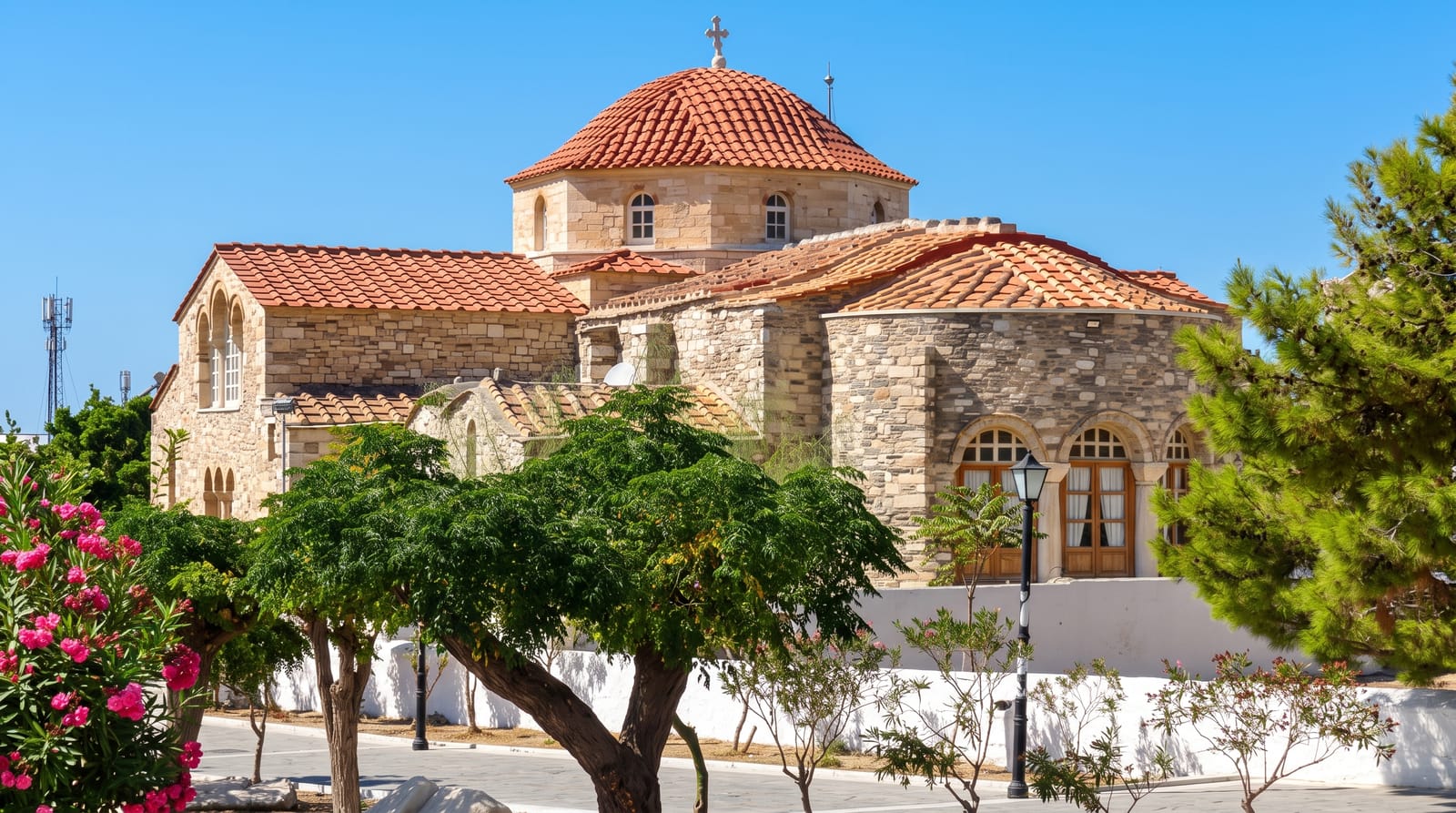
AI illustration
The church of a hundred doors traces its foundation to the fourth century and Saint Helena, and was rebuilt in the sixth under Justinian into the cruciform basilica that stands today, one of the best-preserved early Christian churches in Greece. The name comes from a tradition that ninety-nine doors are visible and a hundredth will appear when Constantinople is Greek again; visitors count them without success. The complex includes the main church with its marble iconostasis and ancient columns, the older baptistery with a cruciform font in the floor, the chapel of Agios Nikolaos, and a small Byzantine museum in the cloister. Ancient blocks are reused throughout, and the whole is enclosed within a courtyard of monastic cells and a defensive wall.
History
The church dates to 326, and tradition credits its founding to Saint Helen, mother of Constantine the Great, who stopped on Paros on her pilgrimage to the Holy Land; Justinian is credited with later building on the site. The name, "of a hundred doors", may be a corruption of Katapoliani, "the lower town church", for its place by the sea; badly damaged by an earthquake in the 18th century and gradually restored, it is the second most famous Marian pilgrimage church of the Aegean after the church on Tinos (Wikipedia, Panagia Ekatontapiliani).
What you'll find
- The main basilica - a sixth-century cruciform church with marble screens.
- The baptistery - an early Christian font sunk into the floor.
- The doors - the ninety-nine of the legend, countable and disputed.
- The Byzantine museum - icons and church treasures in the cloister.
When to go
Year-round; the church is open daily with a midday break and is busiest around the feast of the Dormition on 15 August, when Parikia fills with pilgrims.
What to expect
Modest dress is required and photography inside is limited. The interior is dim, and much of the original decoration was lost in later rebuildings. The visit takes under an hour without the museum.
Nearby
Parikia's Venetian castle and waterfront are minutes away; the Marathi marble quarries lie inland.
Key facts
Source: Wikidata, item Q1231781, read on 18 October 2026.
What to pack for Panagia Ekatontapiliani
Chosen from what this place is for. Tap a kit for the full checklist.
- Comfortable walking shoes - Sightseeing means kilometres of pavement and cobbles daily. Find on Amazon
- Modest clothing - Shoulders and knees covered - the single most common requirement. Find on Amazon
- A slim anti-theft daypack - Zips that close properly; keep it in front in crowds and on transit. Find on Amazon
- A scarf or shawl - To cover the head or shoulders on entry; women especially at mosques. Find on Amazon
Some links on this page are Amazon affiliate links - if you buy through them we may earn a small commission at no extra cost to you.
All packing kitsPlan your trip
Where to start if Panagia Ekatontapiliani is going on the list.
Booking links on this page are affiliate links - if you book through them we may earn a small commission at no extra cost to you. It never changes what we write about a place.
Opening times, ticket prices and seasonal closures change - check the official source before you go: official site.