Qalb Lozeh
A fifth-century basilica whose towered facade prefigures Romanesque Europe.
Updated 16 October 2026
UNESCO World Heritage
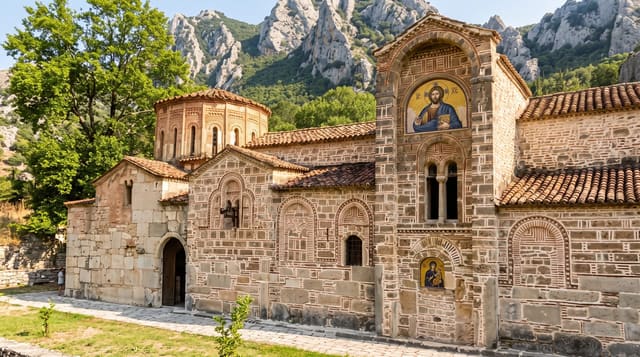
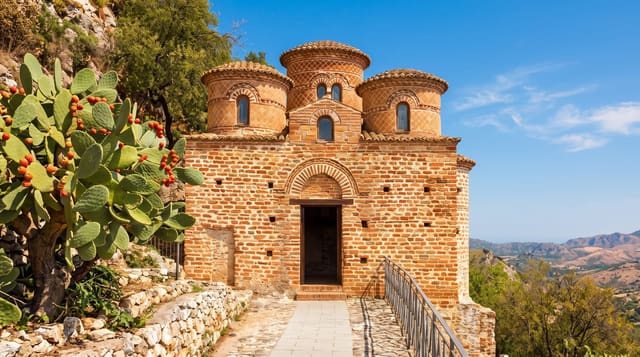
Qalb Lozeh is a basilica of about 460 standing in a Druze village in the limestone hills, and architectural historians treat it as a landmark: its twin-towered facade, wide nave arcades on piers and carved mouldings anticipate what Europe would build as Romanesque half a millennium later. The church survives close to complete, roofless but with walls, apse and towers standing. It sits within the UNESCO Ancient Villages landscape of the Limestone Massif.
Background
The name translates as Heart of the Almond. The village stands at 670 meters on the A'la Mountain, or Jabal Summaq, plateau, a remote hilly part of the northern Syrian limestone massif about 35 kilometres west of Aleppo, in the area known as the Dead Cities. About 150 people lived here in the mid-1960s and 1,290 at the 2004 census, most of them farming tobacco and olives. The village has grown since Gertrude Bell came in the early 1900s, and modern houses now surround the church. After years of neglect, including a spell from 2014 to 2016 when it housed livestock, the church was cleared of debris and rubbish in 2022 and damaged parts of its floor were restored.
Source: Wikipedia, "Qalb Loze"
What's there
- The twin-towered facade - the front that looks toward Romanesque.
- The nave arcades - broad arches on piers rather than columns.
- The carved apse - the decorated east end.
- The village setting - houses of the living village among the stones.
When to go
March to May and October to November are mild, with spring flowers in the limestone. Summer is hot. Light on the facade is best in the afternoon.
Practical notes
The church stands in an inhabited village and visits should be respectful. Access arrangements in the northwest change and need local checking. There are no facilities.
Nearby
Harim and the Jebel al-Ala villages are around it, and Aleppo is east.
Key facts
Source: Wikidata, item Q984315, read on 18 October 2026.
What to pack for Qalb Lozeh
Chosen from what this place is for. Tap a kit for the full checklist.
- Comfortable walking shoes - Sightseeing means kilometres of pavement and cobbles daily. Find on Amazon
- Modest clothing - Shoulders and knees covered - the single most common requirement. Find on Amazon
- A slim anti-theft daypack - Zips that close properly; keep it in front in crowds and on transit. Find on Amazon
- A scarf or shawl - To cover the head or shoulders on entry; women especially at mosques. Find on Amazon
Some links on this page are Amazon affiliate links - if you buy through them we may earn a small commission at no extra cost to you.
All packing kitsPlan your trip
Where to start if Qalb Lozeh is going on the list.
Booking links on this page are affiliate links - if you book through them we may earn a small commission at no extra cost to you. It never changes what we write about a place.
Opening times, ticket prices and seasonal closures change - check the official source before you go: official site.