Saint-Laurent-du-Maroni
The river capital of the penal era - the Transportation Camp's cell blocks, Creole-colonial streets and Maroni river life on the Suriname border.
Updated 19 October 2026
AI illustration
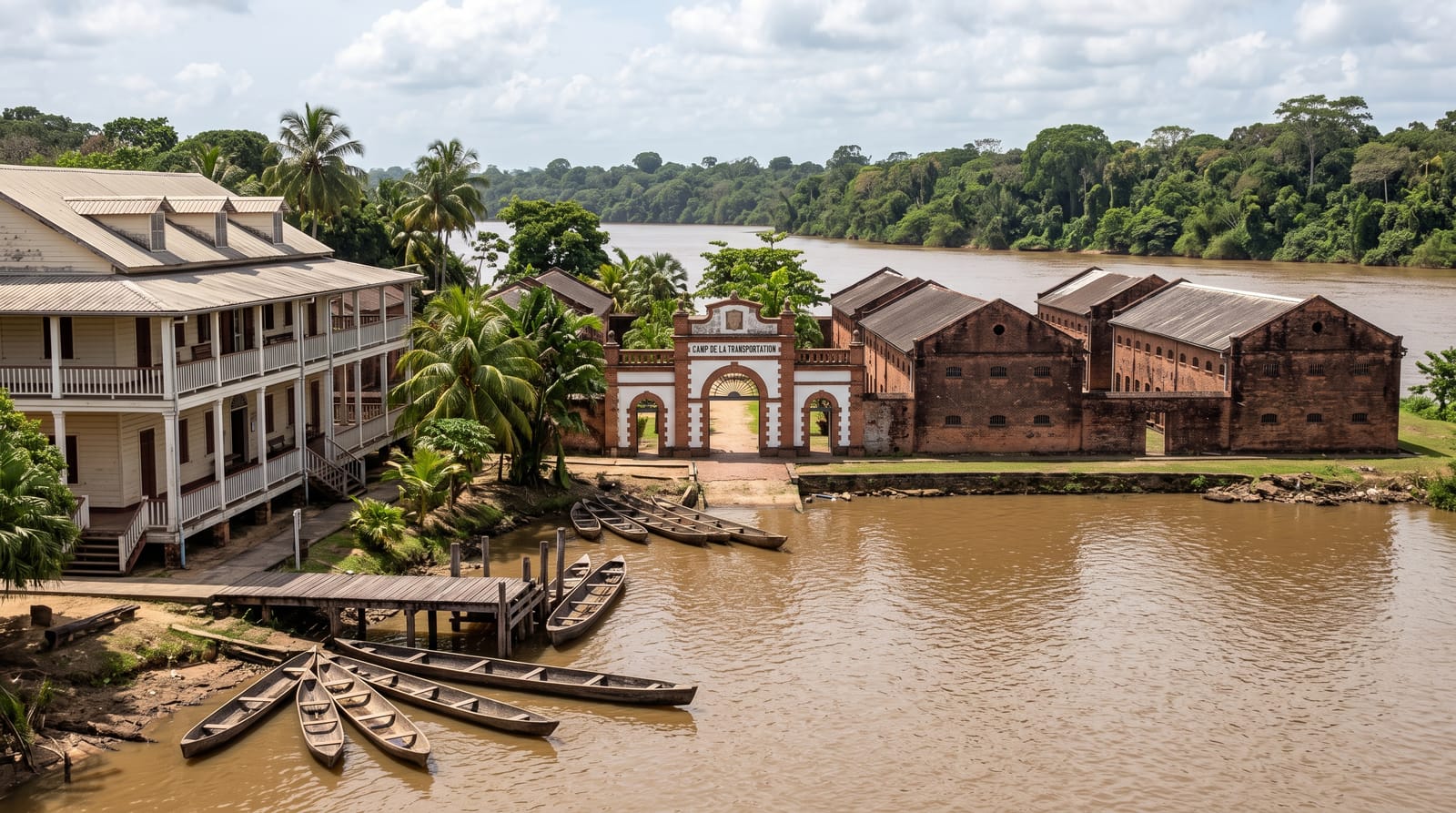
Saint-Laurent was built as the reception port of France's penal colony, and it keeps the era's fabric with unusual honesty: the Camp de la Transportation's gate, cell blocks and courtyards - where tens of thousands of convicts landed between 1858 and the system's end - now stand as a classified monument toured with guides who tell the history straight, Papillon chapter included. Around the camp spreads a gridded colonial town of verandahed administration buildings and Creole houses, and in front runs the Maroni: the great border river whose pirogues, Maroon villages and market traffic give the town its living second identity as gateway to the river world upstream.
History
Saint-Laurent was founded in 1858 by Auguste Baudin as the arrival point of the penal colony, where convicts landed at the Camp de la Transportation, near an Amerindian settlement called Kamalakuli after its chief. On 15 September 1880 it became the capital of a special penitentiary commune whose mayor was the director of the prison administration, and its town hall was completed in 1907. Transportation of convicts was abolished on 17 June 1938, but the final closure came only in 1946, and on 9 November 1949 Saint-Laurent-du-Maroni became an ordinary commune (Wikipedia, Saint-Laurent-du-Maroni).
Highlights
- The Transportation Camp - gates, cells and courtyards of the penal era.
- The colonial grid - verandahed official quarters and Creole streets.
- The Maroni waterfront - pirogues and border-river commerce.
- The market days - Maroon, Creole and Hmong produce on Wednesdays and Saturdays.
When to go
July to December for drier wandering; market mornings (midweek and Saturday) put the town at its liveliest. Camp tours run to schedule - check times on arrival or ahead.
Good to know
The penal history is heavy and the best tours treat it with documentary seriousness rather than ghoulishness - bring the same. The town beyond the monuments is workaday; river trips upstream need arranging with piroguiers and time. Border-town practicalities (documents, currency for Suriname hops) reward forethought.
Nearby
The Maroni's Maroon villages, Awala-Yalimapo's turtle beach and Mana.
Key facts
Source: Wikidata, item Q319959, read on 18 October 2026.
What to pack for Saint-Laurent-du-Maroni
Chosen from what this place is for. Tap a kit for the full checklist.
- Binoculars - The single best wildlife tool - even a compact pair transforms a sighting. Find on Amazon
- Comfortable walking shoes - Sightseeing means kilometres of pavement and cobbles daily. Find on Amazon
- A zoom camera or long lens - Animals rarely come close; reach beats megapixels. Find on Amazon
- A slim anti-theft daypack - Zips that close properly; keep it in front in crowds and on transit. Find on Amazon
Some links on this page are Amazon affiliate links - if you buy through them we may earn a small commission at no extra cost to you.
All packing kitsPlan your trip
Where to start if Saint-Laurent-du-Maroni is going on the list.
Booking links on this page are affiliate links - if you book through them we may earn a small commission at no extra cost to you. It never changes what we write about a place.
Opening times, ticket prices and seasonal closures change - check the official source before you go: official site.


