Perpignan
A Catalan city that was briefly the mainland capital of the kings of Majorca, with their palace still in it.
Updated 19 October 2026

AI illustration
Perpignan was the mainland capital of the kingdom of Majorca from 1276 to 1344, and the palace built for those kings survives inside a later Spanish citadel: a fortified residence around a courtyard with a two-level chapel, Gothic and Mediterranean rather than northern French in feel. The city stayed Spanish until 1659 and remains Catalan in language, food and festival; Sant Jordi and the Sanch procession at Easter are kept. The Castillet, a brick gate tower of 1368 in red brick, is the city's emblem. Salvador Dali once declared the railway station the centre of the universe, and the station plays along with a plaque.
History
Settlement goes back to Roman times, but the medieval town seems to have been founded around the beginning of the 10th century and soon became the capital of the counts of Roussillon; in 1172 Count Girard II left his lands to the Counts of Barcelona, and in 1197 the town gained a partly self-governing commune. When James I of Aragon created the Kingdom of Majorca in 1276, Perpignan became the capital of its mainland territories, a golden age of cloth, leather and goldsmiths' work, and Philip III of France died here in 1285. Peter IV of Aragon took the kingdom back in 1344, the Black Death carried off about half the people a few years later, and the town changed hands between France and Aragon in the 15th century; taken by the French in September 1642, it was ceded by Spain in the Treaty of the Pyrenees 17 years later (Wikipedia, Perpignan).
The main sights
- The Palace of the Kings of Majorca - a fortified Gothic residence with a double chapel.
- The Castillet - a red brick gate tower of 1368.
- The Catalan old town - lanes, the Loge de Mer and Catalan signage.
- The Dali station - the railway station he called the centre of the universe.
When to go
April to June and September to October; the Sanch procession falls on Good Friday and is a serious religious event. Summer is very hot inland from the coast.
Things to know
Parts of the old town are run-down and busy, and ordinary care is sensible at night. The palace is inside a citadel with a long approach. Summer heat is heavy.
Nearby
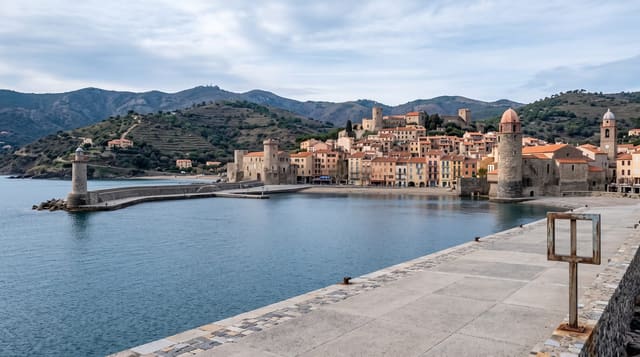
Collioure lies southeast; Ille-sur-Tet is west.
Key facts
Source: Wikidata, item Q6730, read on 18 October 2026.
What to pack for Perpignan
Chosen from what this place is for. Tap a kit for the full checklist.
- Comfortable walking shoes - Sightseeing means kilometres of pavement and cobbles daily. Find on Amazon
- A slim anti-theft daypack - Zips that close properly; keep it in front in crowds and on transit. Find on Amazon
- A refillable water bottle - Many cities have public fountains; save money and plastic. Find on Amazon
- A light layer + compact umbrella - For museum air-con and a sudden shower. Find on Amazon
Some links on this page are Amazon affiliate links - if you buy through them we may earn a small commission at no extra cost to you.
All packing kitsPlan your trip
Where to start if Perpignan is going on the list.
Booking links on this page are affiliate links - if you book through them we may earn a small commission at no extra cost to you. It never changes what we write about a place.
Opening times, ticket prices and seasonal closures change - check the official source before you go: official site.