La Plata
A city designed from nothing in 1882 on a perfect grid with diagonals, crowned by an enormous neo-Gothic cathedral.
Updated 18 October 2026
AI illustration
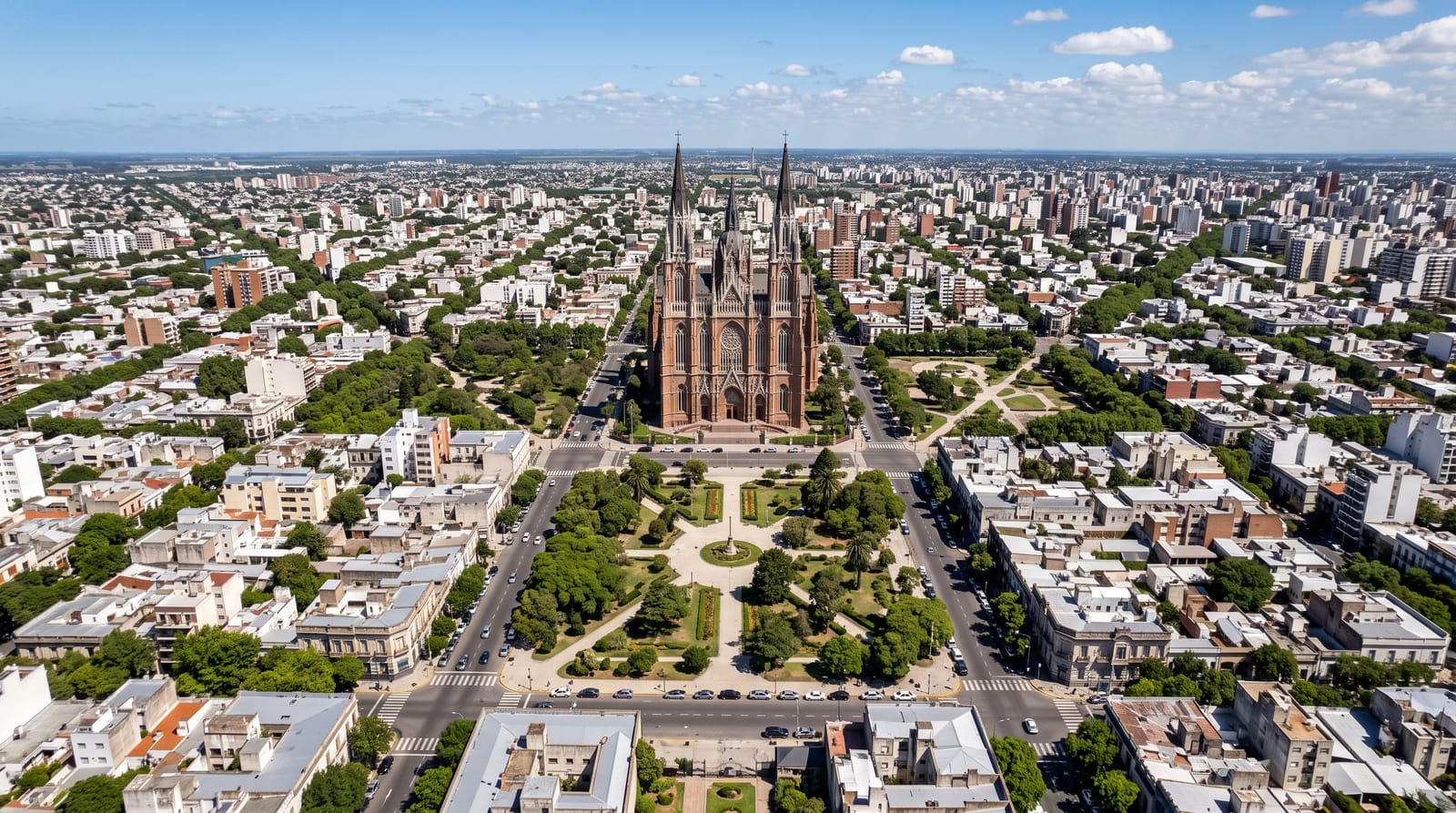
La Plata was founded in 1882 as the capital of Buenos Aires province, planned in advance by the engineer Pedro Benoit on a strict grid of square blocks crossed by diagonals, with a park or plaza every six blocks and a great civic axis running through the centre. The plan won prizes in Paris and is still legible on the ground. Its cathedral, begun in 1885 and finished with its spires only in 1999, is one of the largest neo-Gothic churches in the Americas, and a lift climbs a tower for views over the grid. The Museo de La Plata is the country's finest natural history museum, with its famous halls of South American fossil mammals and dinosaurs among Beaux-Arts galleries.
History
After the city of Buenos Aires was federalised in 1880 the province needed a new capital, and Governor Dardo Rocha founded La Plata on 19 November 1882, hiring the planner Pedro Benoit, who laid it out as a square with a central park, two main diagonal avenues, numbered streets and a small park every six blocks; both men were Freemasons, and the plan and buildings are said to carry Masonic symbols. The government buildings were chosen by international competition, the Governor's Palace designed by Italians and the City Hall by Germans, electric street lighting came in 1884, the first of its kind in Latin America, and the university was founded in 1897 and nationalised in 1905. The city was briefly called Ciudad Eva Perón from 1952 to 1955, and on 18 October 1977 fire all but wrecked the Teatro Argentino, later replaced by a new building (Wikipedia, La Plata).
What to look for
- The cathedral - the vast neo-Gothic church with a climbable tower.
- The Museo de La Plata - fossil mammals, dinosaurs and anthropology collections.
- The planned grid - the diagonals, plazas and civic axis of the 1882 design.
- The Bosque park - the wooded park holding the museum, zoo and observatory.
When to go
Year-round; spring and autumn are most comfortable, summer humid. Museums close on some Mondays, and the cathedral tower operates limited hours. Student life makes the city lively during term.
What to expect
The city is functional and worn in places, and its interest is architectural and museum-based rather than atmospheric. Distances between sights are longer than the map suggests because the blocks are large. Summer humidity is heavy.
Nearby
Buenos Aires lies northwest; the Río de la Plata coast is close to the east.
Key facts
Source: Wikidata, item Q44059, read on 18 October 2026.
What to pack for La Plata
Chosen from what this place is for. Tap a kit for the full checklist.
- Spare batteries + cards - Cold and long shoots drain power; never run out at the good light. Find on Amazon
- Strong insect repellent - DEET or picaridin; the jungle is where bites and disease risk are highest. Find on Amazon
- Comfortable walking shoes - Sightseeing means kilometres of pavement and cobbles daily. Find on Amazon
- Modest clothing - Shoulders and knees covered - the single most common requirement. Find on Amazon
Some links on this page are Amazon affiliate links - if you buy through them we may earn a small commission at no extra cost to you.
All packing kitsPlan your trip
Where to start if La Plata is going on the list.
Booking links on this page are affiliate links - if you book through them we may earn a small commission at no extra cost to you. It never changes what we write about a place.
Opening times, ticket prices and seasonal closures change - check the official source before you go: official site.