Garabit Viaduct
A red iron arch Eiffel built across a gorge in 1884, five years before his tower in Paris.
Updated 21 October 2026
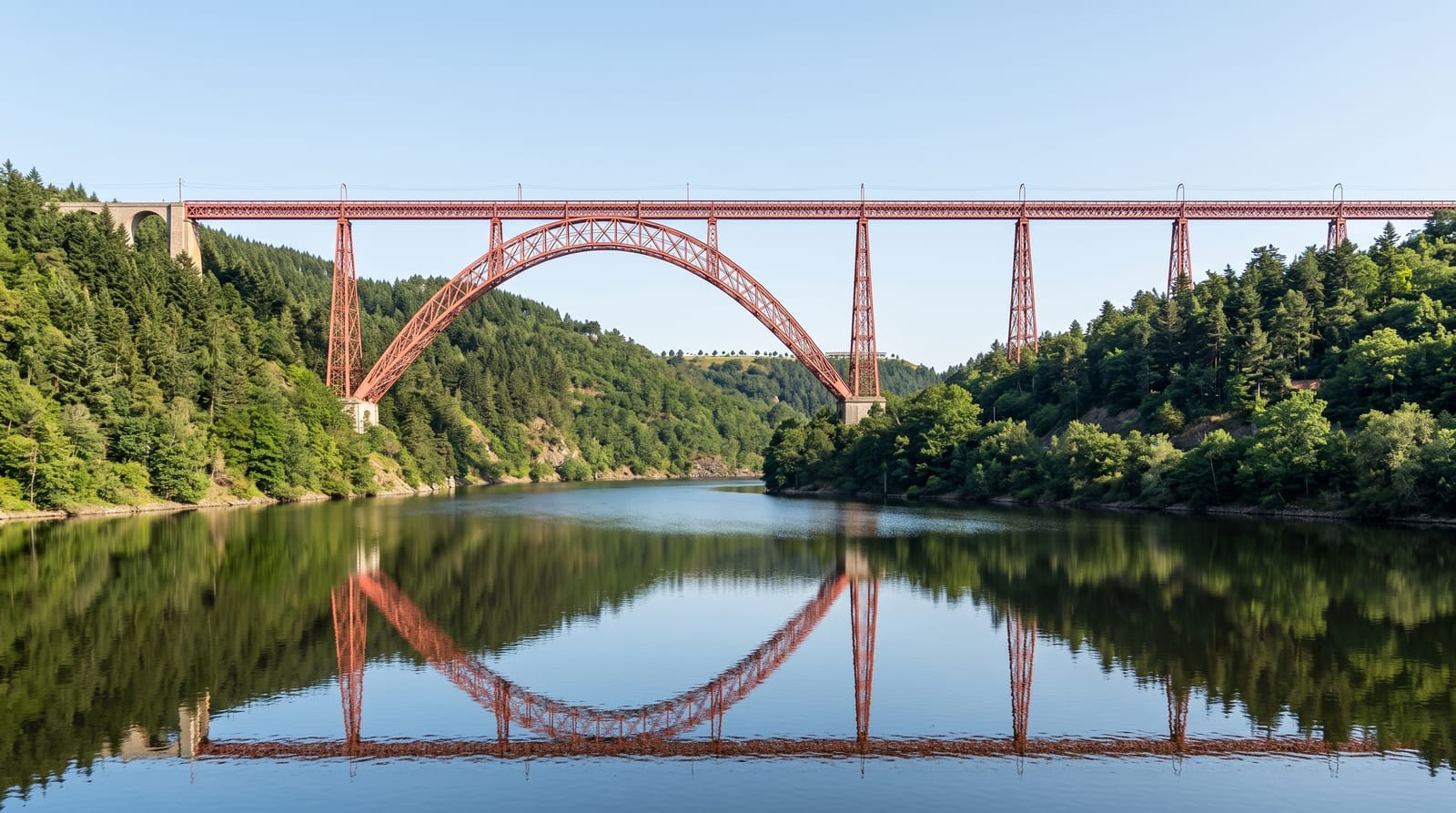
AI illustration
Gustave Eiffel's company built the Garabit viaduct between 1882 and 1884 to carry the railway over the Truyere gorge, and it uses the same principle as his earlier Maria Pia bridge in Portugal: a single crescent arch of one hundred and sixty-five metres span carrying the deck about one hundred and twenty-two metres above the original river level. It was the highest railway bridge in the world when built. Painted red, it stands out sharply against the gorge and the water, which is now a reservoir behind the Grandval dam and higher than the river Eiffel bridged. Trains still cross it, and boat trips run beneath.
History
By the late 1870s Eiffel and Cie, the company Gustave Eiffel had founded with Théophile Seyrig, ranked among the leading French engineering firms, and having built the Maria Pia Bridge over the Douro at Porto in 1875-1877, it was given the viaduct over the Truyère on the new railway from Marvejols to Neussargues without the usual competitive tender, because the problems were so similar. The bridge was built between 1882 and 1884, with structural engineering by Maurice Koechlin, and opened in 1885: 565 metres long, with a main arch of 165 metres span (Wikipedia, Garabit viaduct).
Highlights
- The crescent arch - a 165-metre iron span across the gorge.
- The red paintwork - the structure standing out against water and rock.
- The crossing trains - the line still in use over the deck.
- The boat trips - views up at the arch from the reservoir.
When to go
May to October; boat trips on the reservoir run in season. Late afternoon light on the red iron is best from the roadside viewpoints. Winter is bleak at this altitude.
Good to know
The viaduct cannot be walked and there is no visitor centre; you look at it from viewpoints or the water. Rail traffic on the line is sparse, so seeing a train cross needs timing or luck.
Nearby
Saint-Flour lies north-west; Chaudes-Aigues is south.
Key facts
Source: Wikidata, item Q1333442, read on 18 October 2026.
What to pack for Garabit Viaduct
Chosen from what this place is for. Tap a kit for the full checklist.
- Comfortable walking shoes - Sightseeing means kilometres of pavement and cobbles daily. Find on Amazon
- A slim anti-theft daypack - Zips that close properly; keep it in front in crowds and on transit. Find on Amazon
- A refillable water bottle - Many cities have public fountains; save money and plastic. Find on Amazon
- A light layer + compact umbrella - For museum air-con and a sudden shower. Find on Amazon
Some links on this page are Amazon affiliate links - if you buy through them we may earn a small commission at no extra cost to you.
All packing kitsPlan your trip
Where to start if Garabit Viaduct is going on the list.
Booking links on this page are affiliate links - if you book through them we may earn a small commission at no extra cost to you. It never changes what we write about a place.
Opening times, ticket prices and seasonal closures change - check the official source before you go: official site.