National Museum of China
One of the largest museums in the world, holding bronzes, jade and ceramics spanning several thousand years.
Updated 19 October 2026
AI illustration
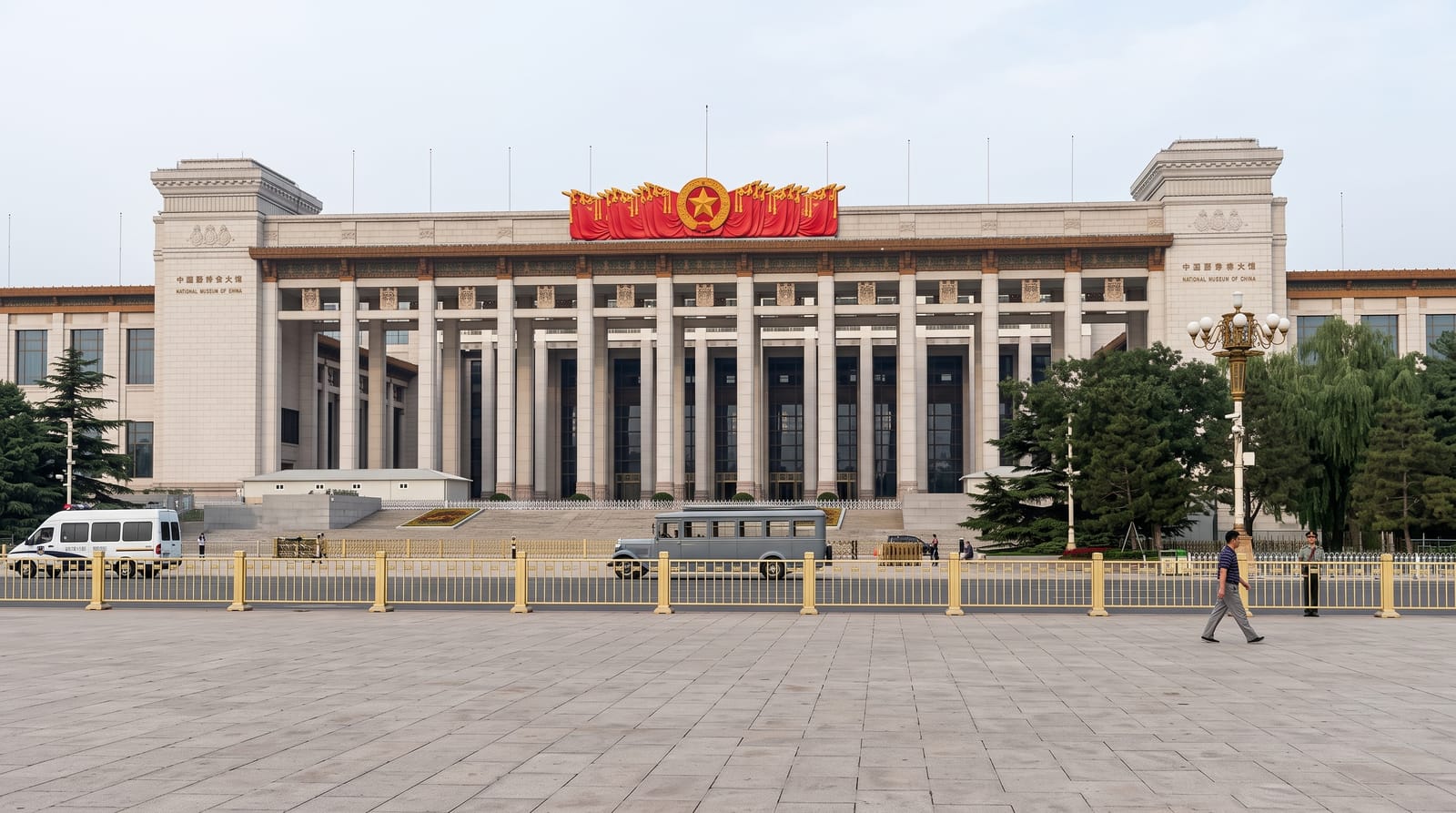
The National Museum occupies the eastern side of Tiananmen Square in a building of nearly two hundred thousand square metres, formed in 2003 from the merger of two earlier museums and reopened in 2011 after a major reconstruction that made it one of the largest museum buildings anywhere. Its permanent exhibition of Ancient China runs through the dynasties with objects of exceptional quality: the Simuwu ding, a bronze ritual vessel of over eight hundred kilograms cast in the Shang dynasty, jade suits, Tang figures, and ceramics across the full range of Chinese production. Special exhibitions occupy multiple floors. Entry is free but requires booking with passport details several days ahead.
History
The building was finished in 1959 as one of the Ten Great Buildings for the tenth anniversary of the People's Republic, facing the Great Hall of the People across the square, with a front 313 metres long and ten square pillars at its centre. Two museums shared it, one of history and one of the revolution, and in 2003 they were merged into the National Museum of China; after four years of renovation designed by the German firm Gerkan, Marg and Partners it reopened on 17 March 2011 with nearly 200,000 square metres of floor space and more than a million objects (Wikipedia, National Museum of China).
What you'll find
- The Simuwu ding - the massive Shang bronze ritual vessel.
- The Ancient China galleries - the permanent chronological exhibition.
- The jade and ceramics - collections spanning several thousand years.
- The building - one of the largest museum structures in the world.
When to go
Year-round, since it is indoors; weekdays are far quieter than weekends and Chinese holidays. Booking opens a set number of days ahead and slots for popular periods disappear quickly. Security screening on entry is thorough.
Things to know
Free entry requires advance online registration with a passport, which foreign visitors often find difficult, and same-day entry is not possible. The museum is enormous and cannot be seen in one visit. English labelling is uneven.
Nearby
Tiananmen Square is directly west; the Forbidden City lies beyond it.
Key facts
Source: Wikidata, item Q1074318, read on 18 October 2026.
What to pack for National Museum of China
Chosen from what this place is for. Tap a kit for the full checklist.
- Comfortable walking shoes - Sightseeing means kilometres of pavement and cobbles daily. Find on Amazon
- A slim anti-theft daypack - Zips that close properly; keep it in front in crowds and on transit. Find on Amazon
- A refillable water bottle - Many cities have public fountains; save money and plastic. Find on Amazon
- A light layer + compact umbrella - For museum air-con and a sudden shower. Find on Amazon
Some links on this page are Amazon affiliate links - if you buy through them we may earn a small commission at no extra cost to you.
All packing kitsPlan your trip
Where to start if National Museum of China is going on the list.
Booking links on this page are affiliate links - if you book through them we may earn a small commission at no extra cost to you. It never changes what we write about a place.
Opening times, ticket prices and seasonal closures change - check the official source before you go: official site.