Beihai Park
An imperial lake garden of more than eight hundred years, centred on an island crowned by a white Tibetan-style dagoba.
Updated 21 October 2026

AI illustration
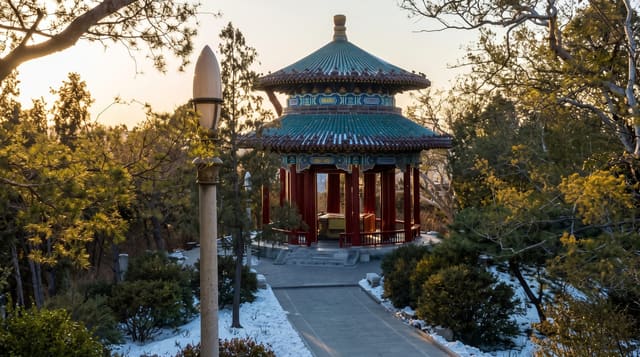
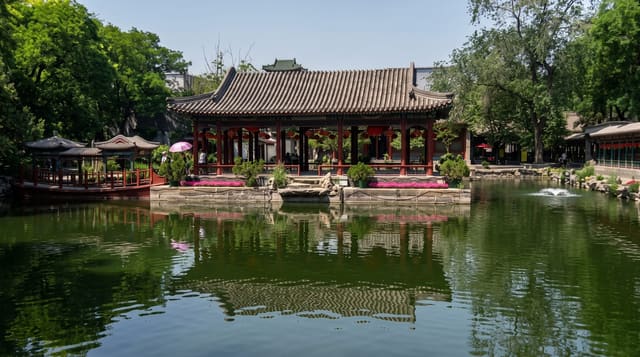
Beihai, the northern sea, is one of the oldest and best preserved imperial gardens in China, laid out from 1179 and developed by successive dynasties into a lake covering more than half the park with Jade Flower Island at its centre. The White Dagoba on the island's summit, a Tibetan-style stupa built in 1651 to mark a visit by the Dalai Lama, is the park's emblem and visible across much of central Beijing. Around the shore are the Nine Dragon Screen of glazed tile, the Round City, halls, pavilions and covered walkways. Boats cross the lake in summer, and in winter Beijingers skate on it when the ice holds.
History
In 1179 Emperor Zhangzong of the Jurchen Jin dynasty had a country resort built north-east of his capital Zhongdu, digging Taiye Lake and putting up the Palace of Great Peace on Jade Flower Island; under Kublai Khan the island was redesigned by Liu Bingzhong, Guo Shoujing and Amir al-Din and the lake enclosed in the Imperial City of Khanbaliq. When the Yongle Emperor moved the Ming court to Beijing, building from 1406, the lake was divided into the Northern, Central and Southern Seas within the Western Garden; in 1747 the Qianlong Emperor had famous calligraphy by Wang Xizhi, Wang Xianzhi and Wang Xun carved in stone for a pavilion beside Beihai, and the park has been open to the public since 1925 (Wikipedia, Beihai Park).
The main sights
- The White Dagoba - the 1651 stupa on Jade Flower Island.
- The Nine Dragon Screen - a glazed tile wall of nine dragons on the northern shore.
- The lake - boating in summer, skating in hard winters.
- The garden architecture - halls, pavilions and covered walkways around the water.
When to go
April to June and September to October for the mildest weather; lotus flowers fill parts of the lake in July and August. Winter skating depends on ice thickness and official opening. Weekends and holidays are crowded.
Things to know
Entry tickets are tiered, with the island and dagoba charged separately. The park is large and involves considerable walking. Beijing's summer heat and humidity are heavy, and winter is bitterly cold with a strong wind off the lake.
Nearby
The Forbidden City lies southeast; Jingshan Park is directly east.
Key facts
Source: Wikidata, item Q133650, read on 18 October 2026.
What to pack for Beihai Park
Chosen from what this place is for. Tap a kit for the full checklist.
- Strong insect repellent - DEET or picaridin; the jungle is where bites and disease risk are highest. Find on Amazon
- Comfortable walking shoes - Sightseeing means kilometres of pavement and cobbles daily. Find on Amazon
- Long, light, quick-dry clothing - Covers skin from insects and sun without cooking you in the humidity. Find on Amazon
- A slim anti-theft daypack - Zips that close properly; keep it in front in crowds and on transit. Find on Amazon
Some links on this page are Amazon affiliate links - if you buy through them we may earn a small commission at no extra cost to you.
All packing kitsPlan your trip
Where to start if Beihai Park is going on the list.
Booking links on this page are affiliate links - if you book through them we may earn a small commission at no extra cost to you. It never changes what we write about a place.
Opening times, ticket prices and seasonal closures change - check the official source before you go: official site.