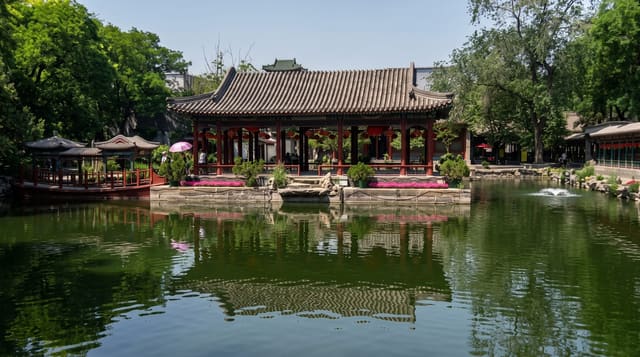
Jingshan Park
An artificial hill built from moat spoil, giving the one view that shows the whole Forbidden City at once.
Updated 19 October 2026
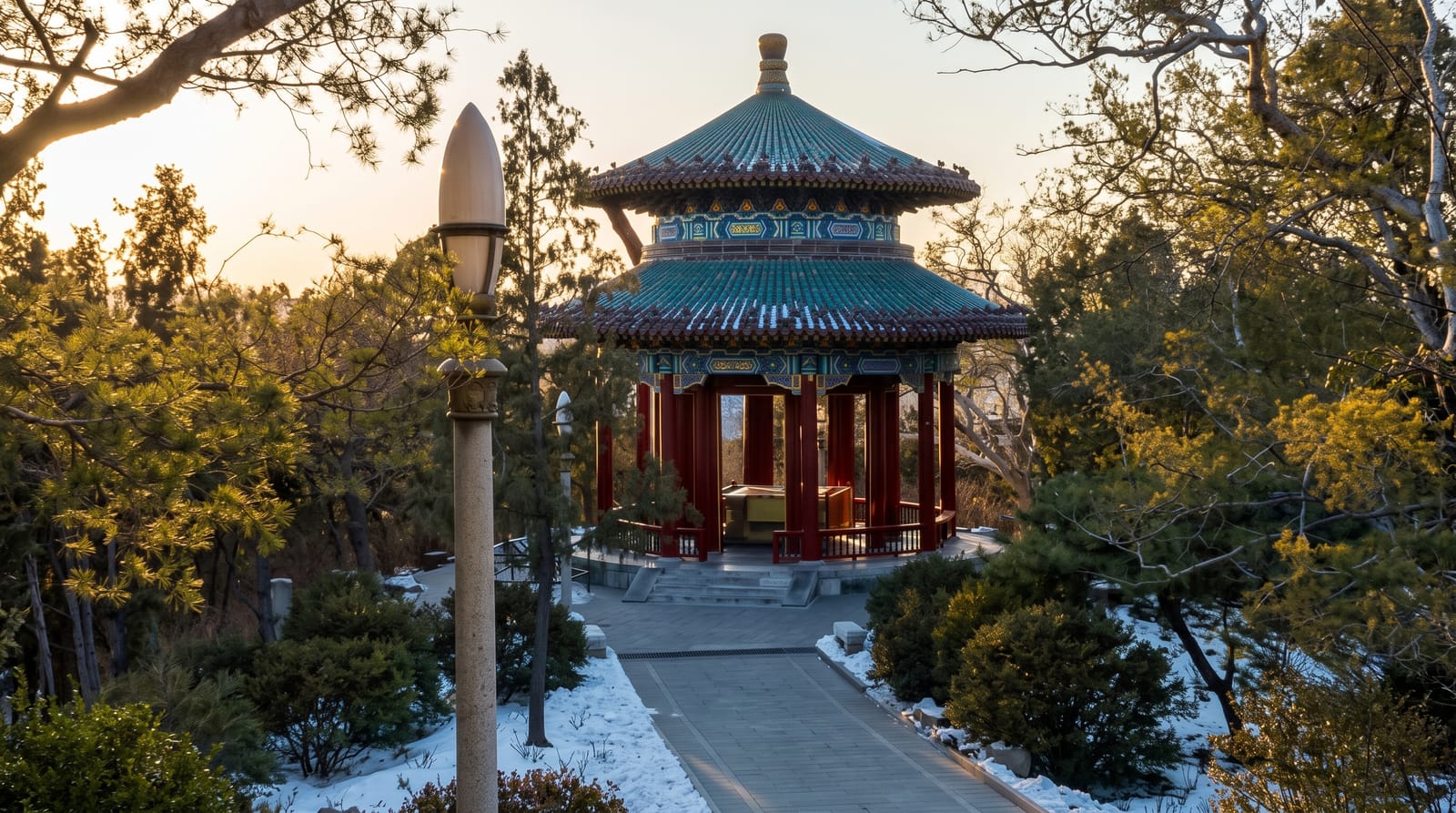
AI illustration
Jingshan is a hill of about forty-five metres raised from earth excavated when the Forbidden City's moat was dug in the fifteenth century, placed to shelter the palace from northern winds according to feng shui principles. From the Wanchun Pavilion at its summit, the entire Forbidden City is laid out below in a single frame of golden roofs receding south, the view that appears in most photographs of the palace complex as a whole. The park's other note is grim: the last Ming emperor, Chongzhen, hanged himself on this hill in 1644 as rebel forces entered the city, and a tree marks the spot. Locals use the park for morning exercise, singing and dancing.
History
Jingshan's history reaches back to the Liao and Jin dynasties, but the 45.7-metre hill was raised in the Yongle era of the Ming entirely from the earth dug out for the moats of the palace and nearby canals, moved by hand and by animals. Its five peaks each carry a pavilion and mark the old north-south axis of the city, and it was placed by feng shui to shield the palace from the cold north wind; once a private imperial garden, the grounds opened to the public in 1928 (Wikipedia, Jingshan Park).
Highlights
- The summit view - the Forbidden City's roofs seen whole from Wanchun Pavilion.
- The Chongzhen tree - the marked site of the last Ming emperor's death.
- The morning activity - singing groups, dancers and exercisers in the park.
- The pavilions - five hilltop pavilions along the ridge.
When to go
April to May and September to October for the clearest air; Beijing's pollution can flatten the view badly at any time. Sunset is popular and crowded on the summit. Early morning gives both clear air and local life.
Practical notes
The summit pavilion is small and crowded, particularly at sunset, with queues for the best viewpoint. Air quality determines whether the view is spectacular or grey. The climb is short but steep.
Nearby
The Forbidden City is directly south; Beihai Park lies west.
Key facts
Source: Wikidata, item Q734499, read on 18 October 2026.
What to pack for Jingshan Park
Chosen from what this place is for. Tap a kit for the full checklist.
- Comfortable walking shoes - Sightseeing means kilometres of pavement and cobbles daily. Find on Amazon
- A slim anti-theft daypack - Zips that close properly; keep it in front in crowds and on transit. Find on Amazon
- A refillable water bottle - Many cities have public fountains; save money and plastic. Find on Amazon
- A light layer + compact umbrella - For museum air-con and a sudden shower. Find on Amazon
Some links on this page are Amazon affiliate links - if you buy through them we may earn a small commission at no extra cost to you.
All packing kitsPlan your trip
Where to start if Jingshan Park is going on the list.
Booking links on this page are affiliate links - if you book through them we may earn a small commission at no extra cost to you. It never changes what we write about a place.
Opening times, ticket prices and seasonal closures change - check the official source before you go: official site.