Maijishan Grottoes
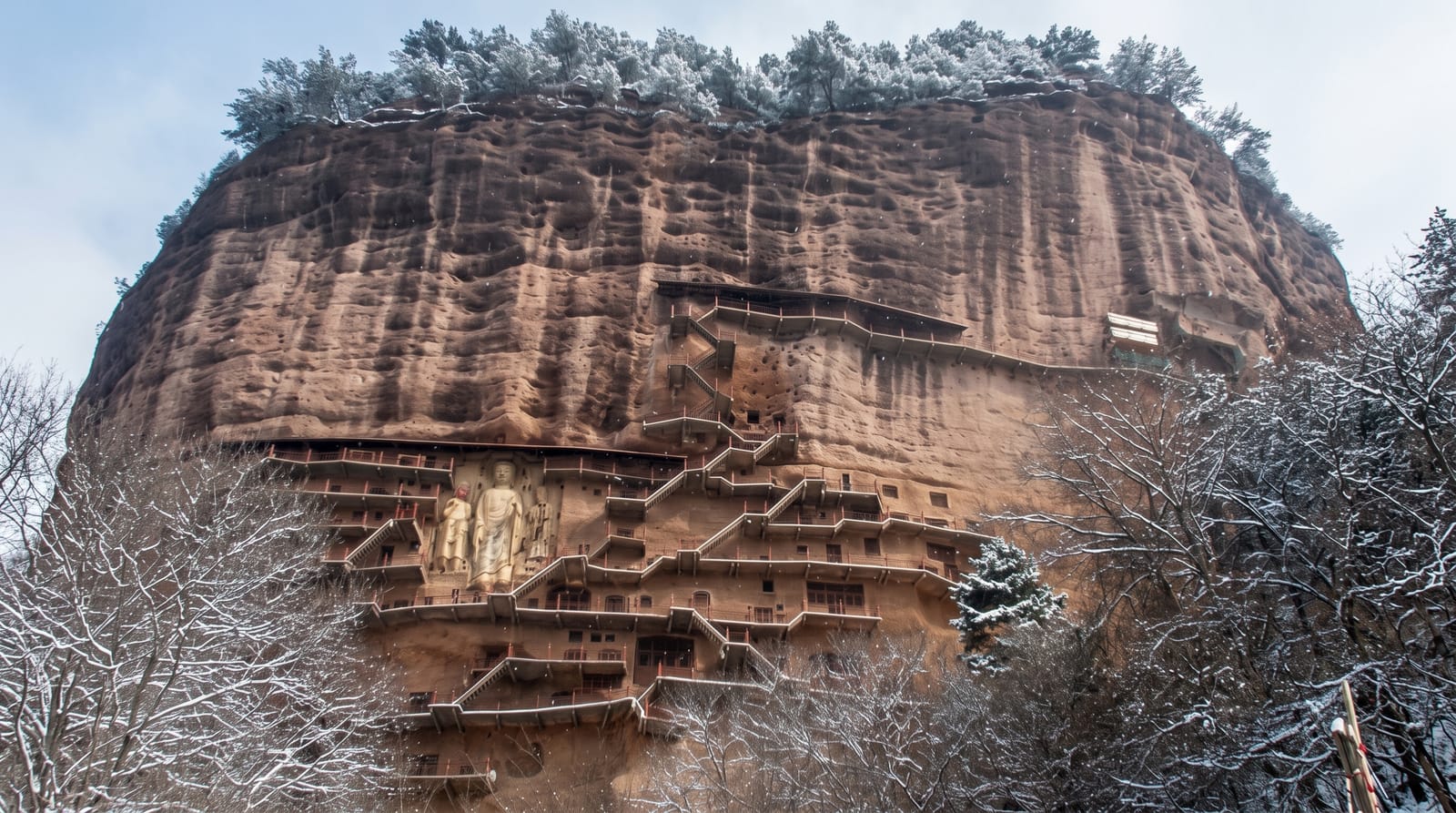
Cave shrines cut high into a haystack-shaped sandstone hill in Gansu, reached by walkways bolted across the cliff face.
Updated 18 October 2026
AI illustration
UNESCO World Heritage
Maijishan is a rounded sandstone hill shaped like a stack of wheat, and its south face is drilled with cave shrines on many levels. Because the rock is too soft for large-scale carving, most figures are modelled in clay over armatures, which gives them softer faces and more everyday expressions than the stone Buddhas elsewhere. Three colossal figures dominate the front of the cliff. To reach the caves you climb a system of steel and concrete walkways pinned to the rock, zigzagging across the face and passing shrine after shrine, most of them closed behind grilles that you look through. The hills around are green and damp, unlike western Gansu.
History
Work on the grottoes most likely began under Yao Xing, the second ruler of the Later Qin (384-417), a fervent Buddhist; between 420 and 422 the monk Tanhung founded a small monastic community here, joined by the senior monk Xuangao with 100 followers, and it grew to 300 members before the Buddhist persecution of 444. Standing near the crossroads of the route from Xi'an to Lanzhou and Dunhuang and the road south to Sichuan, the caves show influences from Central Asia first, then Indian and Southeast Asian features in some 6th-century figures, and more distinctly Chinese work from the Song and Ming renovations. A team of archaeologists from Beijing made the first modern exploration in 1952-1953 and devised the numbering still used for the 194 caves, which hold more than 7,200 sculptures and over 1,000 square metres of murals (Wikipedia, Maijishan Grottoes).
What you'll find
- The cliff walkways - stepped galleries bolted across the face, linking caves at several levels.
- The three colossal figures - the large clay Buddha and attendants on the outside of the cliff.
- The clay sculpture - modelled figures with unusually soft, individual faces.
- The view of the hill - the whole haystack shape seen from the approach path.
When to go
May to October. This corner of Gansu is greener and wetter than the province's west, and rain makes the walkways slippery. Weekday mornings are quietest; weekend queues build on the narrow stairs, where passing is difficult. Half a day is enough on site, plus around an hour and a half of travel each way from Tianshui.
Practical notes
The climb is a long series of open metal stairs across a cliff face, and anyone afraid of heights will struggle. Most caves are locked and viewed through mesh or glass in poor light, and the best caves cost extra and need a guide. Photography inside is limited. Individual figures are smaller than photographs suggest.
Nearby
Tianshui's Fuxi Temple is in the city, and the old Silk Road route continues northwest to Lanzhou.
Key facts
Source: Wikidata, item Q1885375, read on 18 October 2026.
What to pack for Maijishan Grottoes
Chosen from what this place is for. Tap a kit for the full checklist.
- Head torch + spare batteries - Hands-free light is essential; caves are truly dark. Find on Amazon
- Comfortable walking shoes - Sightseeing means kilometres of pavement and cobbles daily. Find on Amazon
- Modest clothing - Shoulders and knees covered - the single most common requirement. Find on Amazon
- Grippy closed shoes - Cave floors are wet, muddy and slick with formations. Find on Amazon
Some links on this page are Amazon affiliate links - if you buy through them we may earn a small commission at no extra cost to you.
All packing kitsPlan your trip
Where to start if Maijishan Grottoes is going on the list.
Booking links on this page are affiliate links - if you book through them we may earn a small commission at no extra cost to you. It never changes what we write about a place.
Opening times, ticket prices and seasonal closures change - check the official source before you go: official site.