The Cradle of Humankind
A UNESCO-listed complex of limestone caves near Johannesburg that has yielded some of the world's most important early human fossils.
Updated 18 October 2026
AI illustration
UNESCO World Heritage
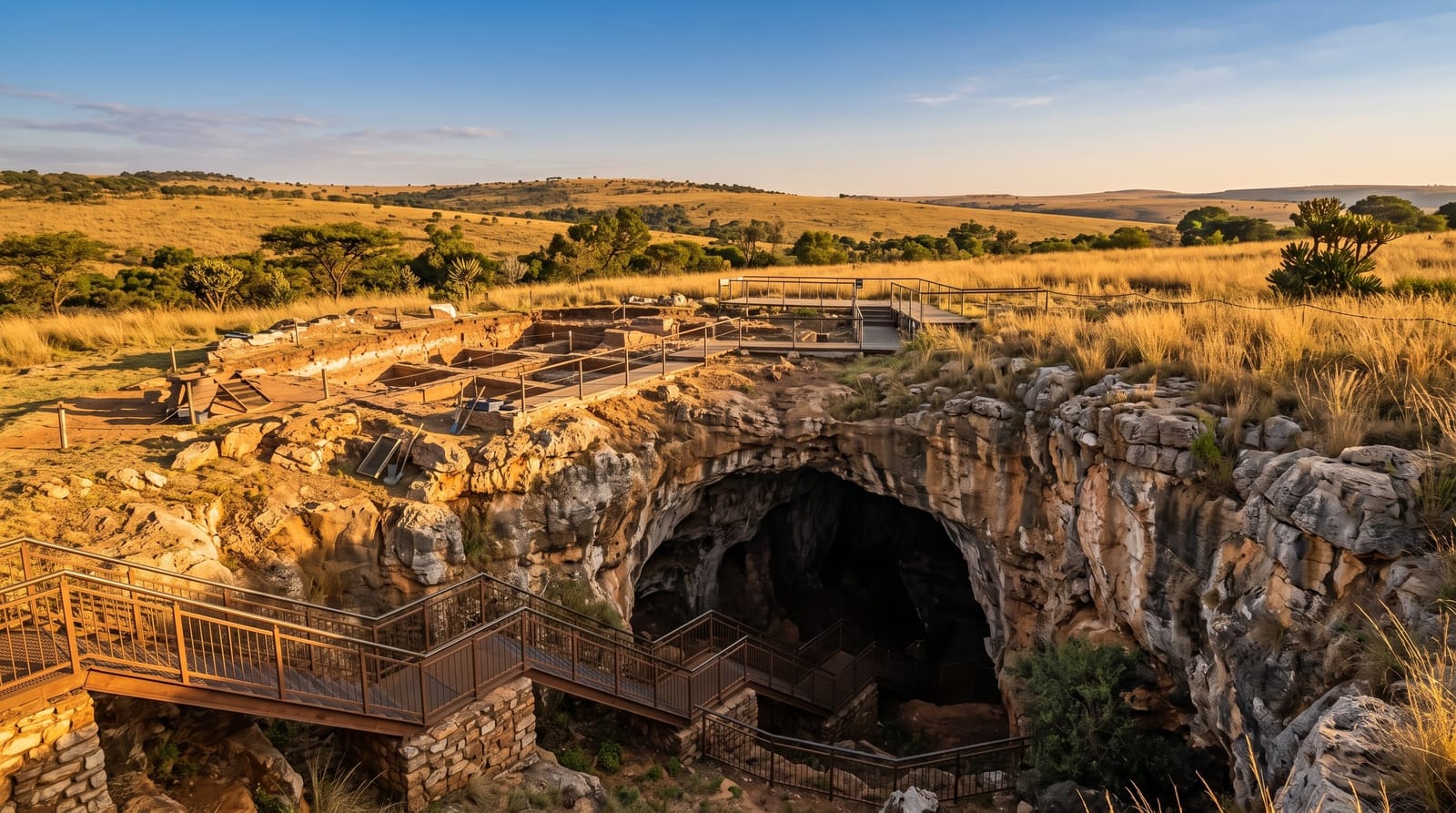
The Cradle of Humankind, an area of dolomitic limestone caves in the countryside near Johannesburg, is one of the richest sources of early human fossils in the world and a World Heritage Site, having produced finds that have reshaped our understanding of where we come from. Its most famous caves, at Sterkfontein, yielded the celebrated skull nicknamed Mrs Ples and the near-complete skeleton known as Little Foot, both belonging to Australopithecus, human relatives that walked the region millions of years ago, and later discoveries nearby have added whole new species to the story. Visitors can tour the Sterkfontein caves themselves, descending past the excavation where these fossils were found, and the nearby Maropeng visitor centre presents the wider story of human origins through exhibits and an underground boat ride. It turns the vast, abstract span of human evolution into something you can stand inside, an hour from the city.
History
Robert Broom found the first human fossils at Sterkfontein in 1935, in 1938 a schoolboy brought Raymond Dart skull fragments from nearby Kromdraai later identified as Paranthropus robustus, and in 1947 Broom and John T. Robinson found the 2.3-million-year-old skull nicknamed Mrs Ples at Sterkfontein. At Swartkrans, where Broom identified hominid remains in 1948 and C. K. Brain worked for three decades, lies the oldest evidence of controlled fire by Homo erectus, more than a million years old; Phillip Tobias began excavating Sterkfontein in 1966, the longest continuously running fossil dig in the world, and in 1997 Ron Clarke found the near-complete skeleton Little Foot there. Lee Berger found the first hominids at Gladysvale in 1991 and the remains of Australopithecus sediba, between 1.78 and 1.95 million years old, at Malapa in 2008, and the area became a World Heritage Site in 1999 as part of the Fossil Hominid Sites of South Africa (Wikipedia, Cradle of Humankind).
Highlights
- The Sterkfontein caves - a guided descent past the excavations that produced the fossils.
- The Maropeng centre - the exhibition and boat ride telling the human-origins story.
- The story of the fossils - Mrs Ples, Little Foot and the species found here.
- The excavation site - the working dig where discoveries are still being made.
When to go
Open year-round; the caves keep a comfortable temperature whatever the weather outside. Weekdays are quieter than weekends. It combines easily with a day trip from Johannesburg or Pretoria, and the two main sites, the caves and the visitor centre, are a short drive apart.
Things to know
The actual fossils on display are mostly casts, with the originals kept in research institutions, so this is about the place, the caves and the story rather than seeing the famous originals up close. The cave tour involves stairs, low passages and some tight, damp sections that do not suit everyone. The caves and the Maropeng centre are separate ticketed sites a drive apart, so allow time for both to get the full picture.
Nearby
Johannesburg and Pretoria are within an hour; the Magaliesberg hills lie nearby for a wider day out.
Key facts
Source: Wikidata, item Q1130112, read on 18 October 2026.
What to pack for The Cradle of Humankind
Chosen from what this place is for. Tap a kit for the full checklist.
- Head torch + spare batteries - Hands-free light is essential; caves are truly dark. Find on Amazon
- Comfortable walking shoes - Sightseeing means kilometres of pavement and cobbles daily. Find on Amazon
- Grippy closed shoes - Cave floors are wet, muddy and slick with formations. Find on Amazon
- A slim anti-theft daypack - Zips that close properly; keep it in front in crowds and on transit. Find on Amazon
Some links on this page are Amazon affiliate links - if you buy through them we may earn a small commission at no extra cost to you.
All packing kitsPlan your trip
Where to start if The Cradle of Humankind is going on the list.
Booking links on this page are affiliate links - if you book through them we may earn a small commission at no extra cost to you. It never changes what we write about a place.
Opening times, ticket prices and seasonal closures change - check the official source before you go: official site.