Yumen Pass
A Han dynasty customs post on the Silk Road, now a square of rammed earth alone in the desert.
Updated 21 October 2026
AI illustration
UNESCO World Heritage
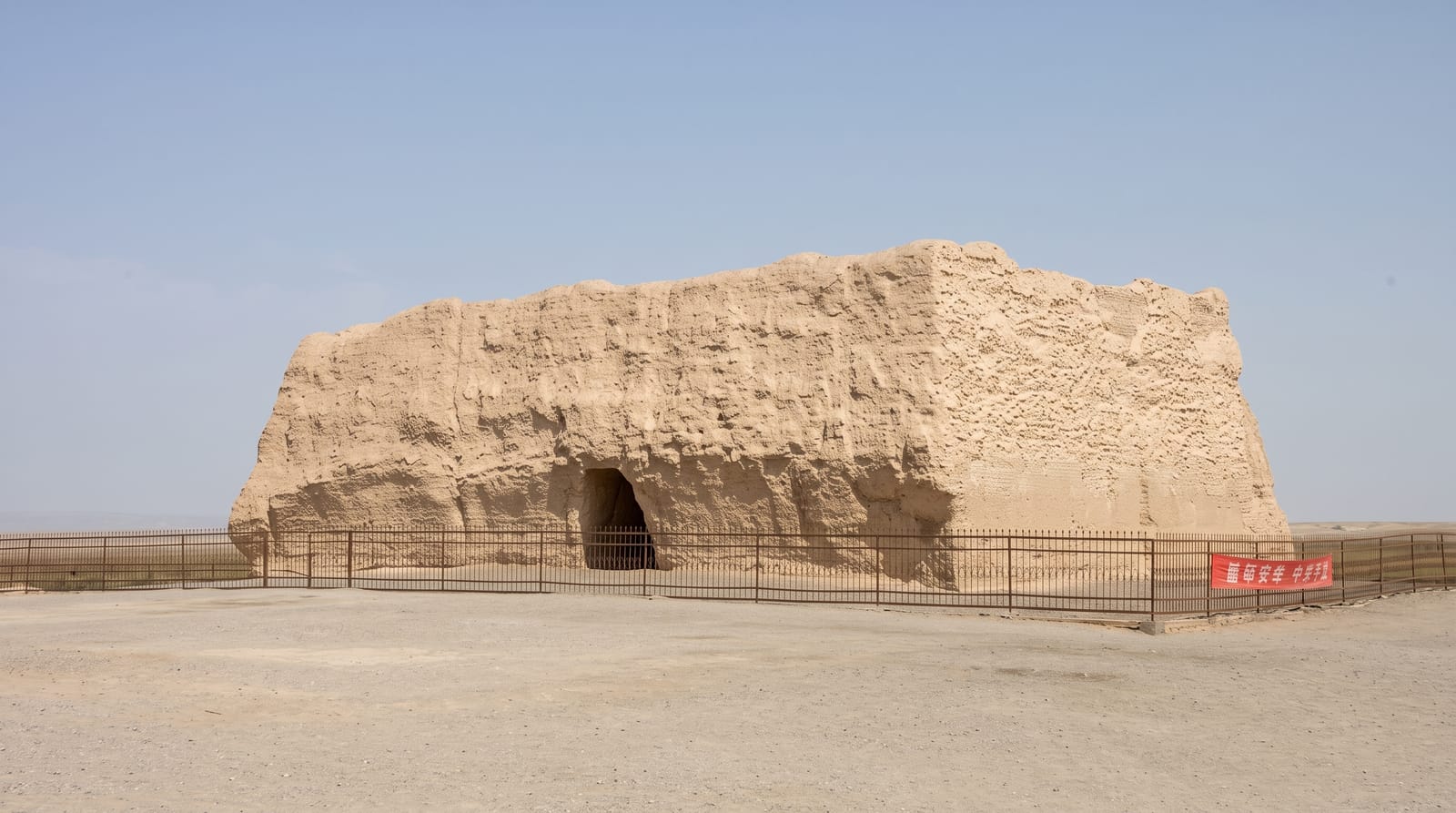
Yumen, the jade gate, was one of two passes through which the Han empire's western frontier was crossed, named for the jade that came east along this route from Khotan, and it functioned as a customs and garrison post from the second century BC. What survives is the small fort at Xiaofangpan, a square of rammed earth walls about ten metres high standing entirely alone on gravel desert, along with stretches of Han-period frontier wall built of layered reed and clay, and the ruins of a granary at Hecang. The pass appears repeatedly in Chinese poetry as the last point before the west begins.
History
Emperor Wu of Han set up the Jade Gate soon after 121 BC at the western end of a defensive line from Jiuquan, and its name came from the jade caravans from Khotan that entered by it; first called the Square City, it was, with the Yang Pass to the south, the last gate before the Western Regions. Trade on the route was disrupted in the 3rd and 4th centuries, and by the 6th century, as caravans took the northern road by Hami, the pass was abandoned. In 1907 Aurel Stein found bamboo slips naming the place Yumenguan, Chinese archaeologists confirmed it in 1944, and in 2014 it was inscribed as part of the Silk Roads World Heritage Site (Wikipedia, Yumen Pass).
What to look for
- The rammed earth fort - a square of Han walls standing alone in desert.
- The Han frontier wall - stretches built in layers of reed and clay.
- The Hecang granary - the ruined supply depot nearby.
- The emptiness - gravel desert running to the horizon in every direction.
When to go
April to May and September to October; summer is extremely hot with no shade and winter cold with severe wind. The site is usually combined with the Yadan park further northwest.
Practical notes
There is very little to see physically: one small ruin, some walls and a lot of desert, and many visitors find the ticket steep for that. Its interest is historical and needs context. No shade at all.
Nearby
The Yadan geopark lies northwest; Dunhuang is southeast.
Key facts
Source: Wikidata, item Q1324562, read on 18 October 2026.
What to pack for Yumen Pass
Chosen from what this place is for. Tap a kit for the full checklist.
- Loose, light, long clothing - Covering up beats bare skin in the desert - and locals dress this way for a reason. Find on Amazon
- Comfortable walking shoes - Sightseeing means kilometres of pavement and cobbles daily. Find on Amazon
- A wide-brim hat + sunglasses - Shade for your face and eyes where there is none overhead. Find on Amazon
- A slim anti-theft daypack - Zips that close properly; keep it in front in crowds and on transit. Find on Amazon
Some links on this page are Amazon affiliate links - if you buy through them we may earn a small commission at no extra cost to you.
All packing kitsPlan your trip
Where to start if Yumen Pass is going on the list.
Booking links on this page are affiliate links - if you book through them we may earn a small commission at no extra cost to you. It never changes what we write about a place.
Opening times, ticket prices and seasonal closures change - check the official source before you go: official site.

