The Mogao Caves, Dunhuang
A UNESCO-listed complex of hundreds of Buddhist cave temples cut into a cliff on the Silk Road, filled with a thousand years of murals and painted sculpture.
Updated 18 October 2026
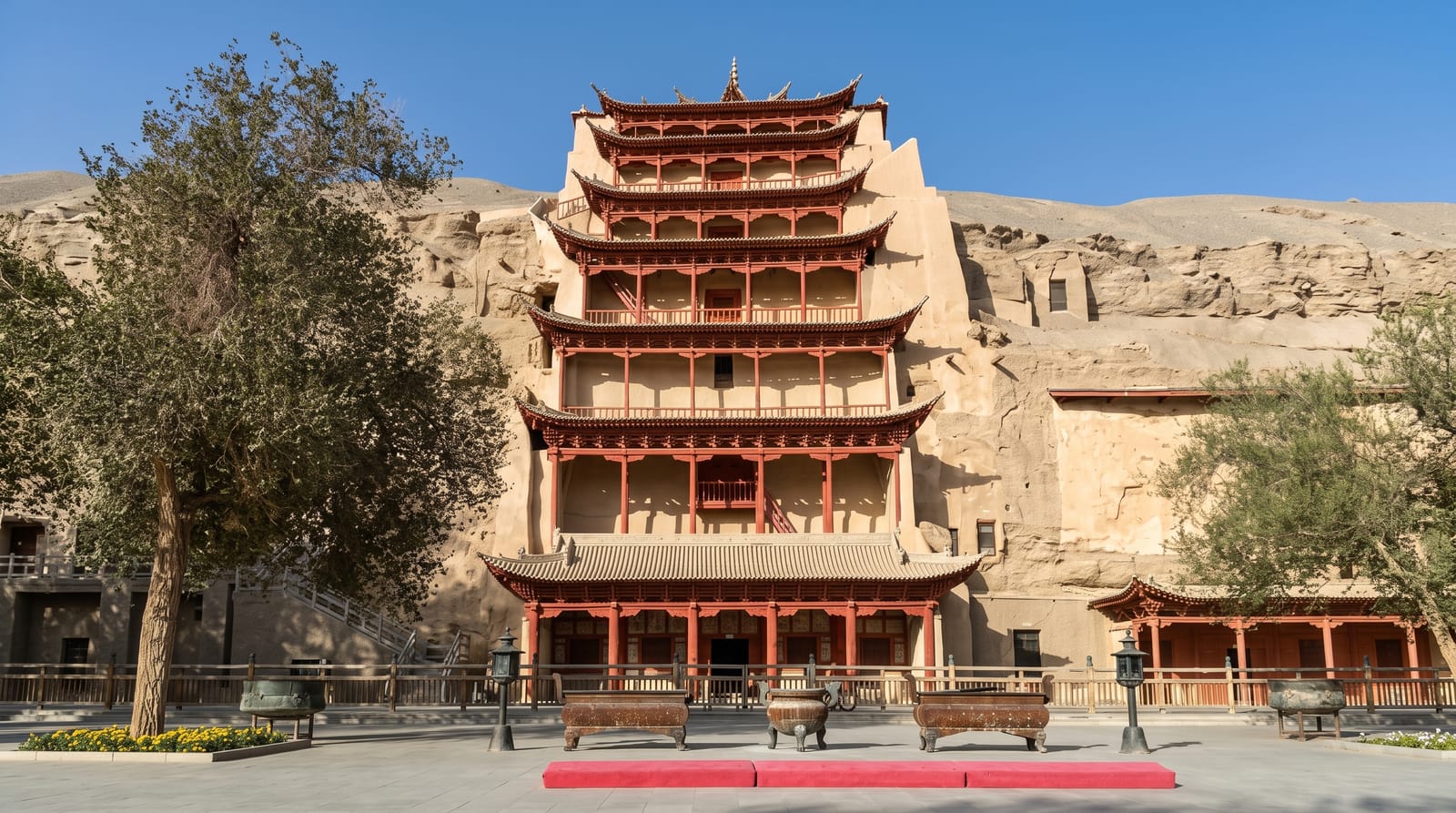
AI illustration
UNESCO World Heritage
The Mogao Caves, cut into a cliff face at the edge of the desert near the Silk Road oasis of Dunhuang, are one of the greatest treasuries of Buddhist art in the world and a World Heritage Site. Over a span of roughly a thousand years, from the fourth century onwards, monks and patrons carved hundreds of grottoes into the soft rock and covered their walls and ceilings with murals and filled them with painted clay statues, so that the surviving caves preserve an unbroken record of Buddhist art and of the life, trade and faith that passed along the Silk Road. The scale is astonishing: tens of thousands of square metres of wall paintings and thousands of sculptures, from serene giant Buddhas to swirling flying apsaras. A hidden library cave, sealed for centuries, yielded one of the greatest manuscript finds in history. Visits are tightly controlled to protect the fragile art, on timed guided tours of a rotating selection of caves.
History
The Han emperor Wudi founded Dunhuang as a frontier garrison in 111 BC, and it grew into a gateway to the West on the Silk Road. According to a text of the reign of Wu Zetian, the monk Le Zun had a vision of a thousand Buddhas bathed in golden light at the site in 366 and cut the first cave, though another document gives 353; the earliest decorated caves that survive, 268, 272 and 275, date from the Northern Liang between 419 and 439. Members of the Northern Wei and Northern Zhou ruling families built many more, the site flourished under the Sui, and by the Tang the caves numbered more than a thousand, paid for by clergy, local rulers, foreign dignitaries and emperors as well as merchants, officers and women's groups; caves went on being made until the 14th century (Wikipedia, Mogao Caves).
What to look for
- The mural caves - grottoes covered in a thousand years of Buddhist wall painting.
- The giant Buddhas - the great seated statues in the largest caves.
- The flying apsaras - the swirling celestial figures that are an emblem of Dunhuang.
- The Library Cave story - the sealed cave whose manuscripts astonished the world.
When to go
May to October is the most comfortable season in this desert region; summer days are very hot and winter cold. Tickets are limited and timed to protect the caves, so book well in advance, especially in the summer peak. Combine with the desert dunes and Crescent Lake at Dunhuang.
Before you go
Access is strictly controlled to preserve the fragile murals: you see only a rotating handful of the caves on a fixed guided tour, photography inside is forbidden, and tickets are capped and must be booked ahead, sometimes well in advance in peak season. The caves are dim, lit only to protect the art. It is a long way out in Gansu. What you see is world-class, but it is a managed, partial visit rather than free exploration.
Nearby
The Singing Sand Dunes and Crescent Lake are just outside Dunhuang; the Silk Road continues west into Xinjiang.
Key facts
Source: Wikidata, item Q43286, read on 18 October 2026.
What to pack for The Mogao Caves, Dunhuang
Chosen from what this place is for. Tap a kit for the full checklist.
- Head torch + spare batteries - Hands-free light is essential; caves are truly dark. Find on Amazon
- Loose, light, long clothing - Covering up beats bare skin in the desert - and locals dress this way for a reason. Find on Amazon
- Comfortable walking shoes - Sightseeing means kilometres of pavement and cobbles daily. Find on Amazon
- Modest clothing - Shoulders and knees covered - the single most common requirement. Find on Amazon
Some links on this page are Amazon affiliate links - if you buy through them we may earn a small commission at no extra cost to you.
All packing kitsPlan your trip
Where to start if The Mogao Caves, Dunhuang is going on the list.
Booking links on this page are affiliate links - if you book through them we may earn a small commission at no extra cost to you. It never changes what we write about a place.
Opening times, ticket prices and seasonal closures change - check the official source before you go: official site.