The Guggenheim Museum
Frank Lloyd Wright's white spiral on Fifth Avenue, a building that argued with every museum convention and won.
Updated 18 October 2026
AI illustration
UNESCO World Heritage
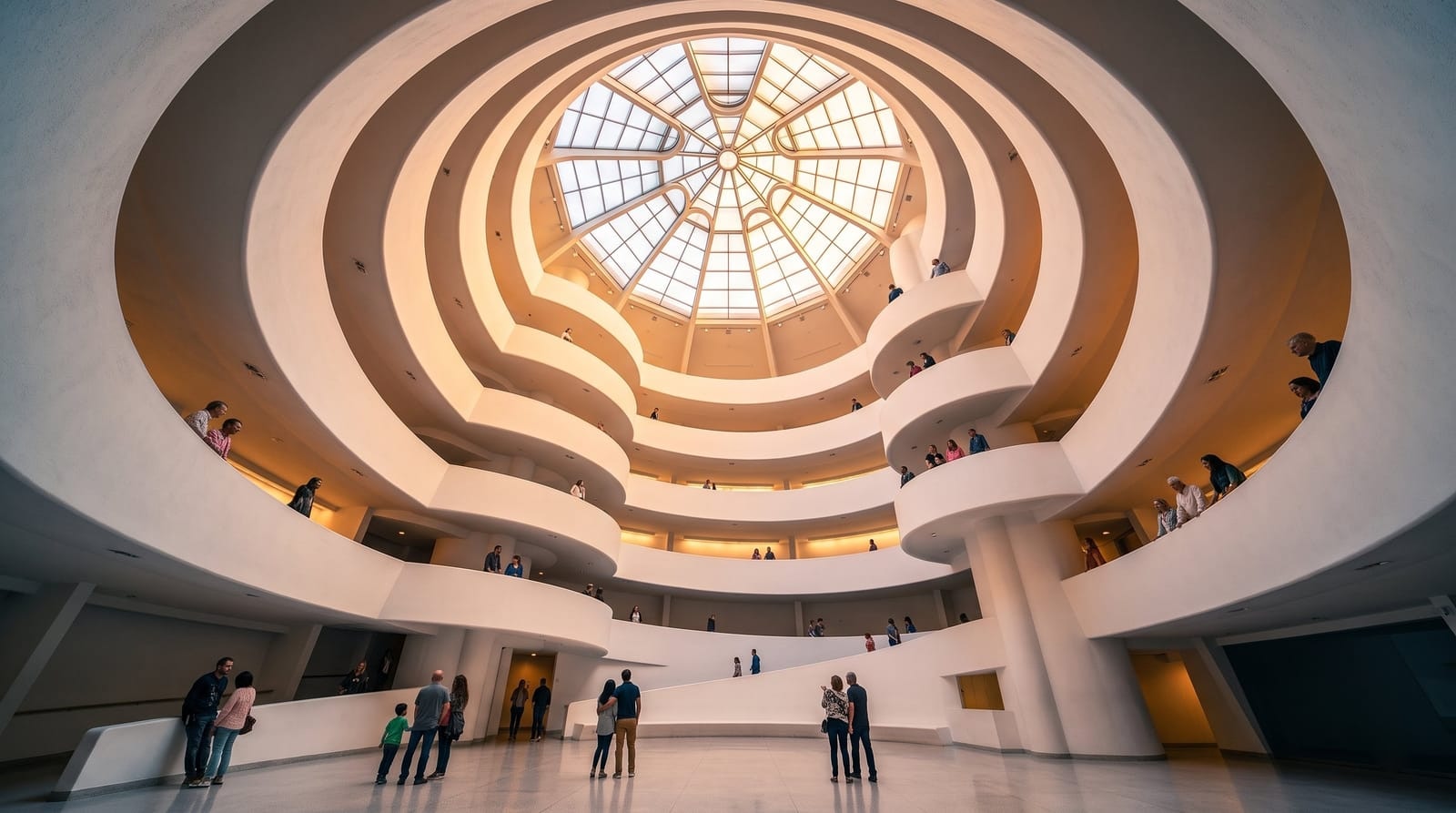
Wright spent sixteen years on this building and did not live to see it open in 1959. Instead of a series of rooms he made one continuous ramp spiralling up around a skylit void, so a visitor takes the lift to the top and walks down through the exhibition without ever retracing a step, and the building is as much the exhibit as anything hung on it. Critics complained that the sloping floors and curved walls fought the art, an argument that has never entirely stopped. It is one of eight Wright buildings inscribed together as World Heritage in 2019. The permanent collection is strong in early modernism, with Kandinsky in depth and the Thannhauser holdings of Picasso, Van Gogh and Cézanne.
History
Solomon R. Guggenheim, of a wealthy mining family, collected old masters until the artist Hilla von Rebay turned him in 1926 to European abstract art, above all Kandinsky; he set up his foundation in 1937, and its Museum of Non-Objective Painting opened on East 54th Street in 1939 under Rebay. In June 1943 they hired Frank Lloyd Wright, then 76, to design a permanent home, and it took him 15 years, more than 700 sketches and six sets of working drawings, with the cost doubling from the first estimate. The museum took its present name in 1952, three years after Guggenheim's death, and Wright's controversial spiral building on Fifth Avenue opened in 1959 (Wikipedia, Solomon R. Guggenheim Museum).
What you'll find
- The rotunda - the spiral ramp and skylight, best seen from the top down.
- The Kandinsky holdings - one of the deepest collections anywhere.
- The Thannhauser collection - Picasso, Van Gogh, Cézanne and Manet.
- The exterior - the white coil against the Fifth Avenue street wall.
When to go
Year-round; weekday mornings are quietest and weekend afternoons are shoulder to shoulder on the ramp. Pay-what-you-wish evenings are popular and queue early. Check what is installed, since major exhibitions sometimes occupy the entire rotunda and close the permanent galleries.
Before you go
The building often overshadows the art, and large works sit awkwardly against curved walls under a sloping floor. Gallery space is smaller than the exterior suggests, so two hours is usually enough. Ticket prices are among the highest in the city, and during a full rotunda installation there may be far less on show than you expect.
Nearby
The Metropolitan Museum is ten minutes down Fifth Avenue; Central Park is opposite.
Key facts
Source: Wikidata, item Q201469, read on 18 October 2026.
What to pack for The Guggenheim Museum
Chosen from what this place is for. Tap a kit for the full checklist.
- Comfortable walking shoes - Sightseeing means kilometres of pavement and cobbles daily. Find on Amazon
- A slim anti-theft daypack - Zips that close properly; keep it in front in crowds and on transit. Find on Amazon
- A refillable water bottle - Many cities have public fountains; save money and plastic. Find on Amazon
- A light layer + compact umbrella - For museum air-con and a sudden shower. Find on Amazon
Some links on this page are Amazon affiliate links - if you buy through them we may earn a small commission at no extra cost to you.
All packing kitsPlan your trip
Where to start if The Guggenheim Museum is going on the list.
Booking links on this page are affiliate links - if you book through them we may earn a small commission at no extra cost to you. It never changes what we write about a place.
Opening times, ticket prices and seasonal closures change - check the official source before you go: official site.


