Stonehenge
The most famous prehistoric monument in the world - a ring of colossal standing stones raised on Salisbury Plain some five thousand years ago, aligned to the sun, a UNESCO site.
Updated 18 October 2026
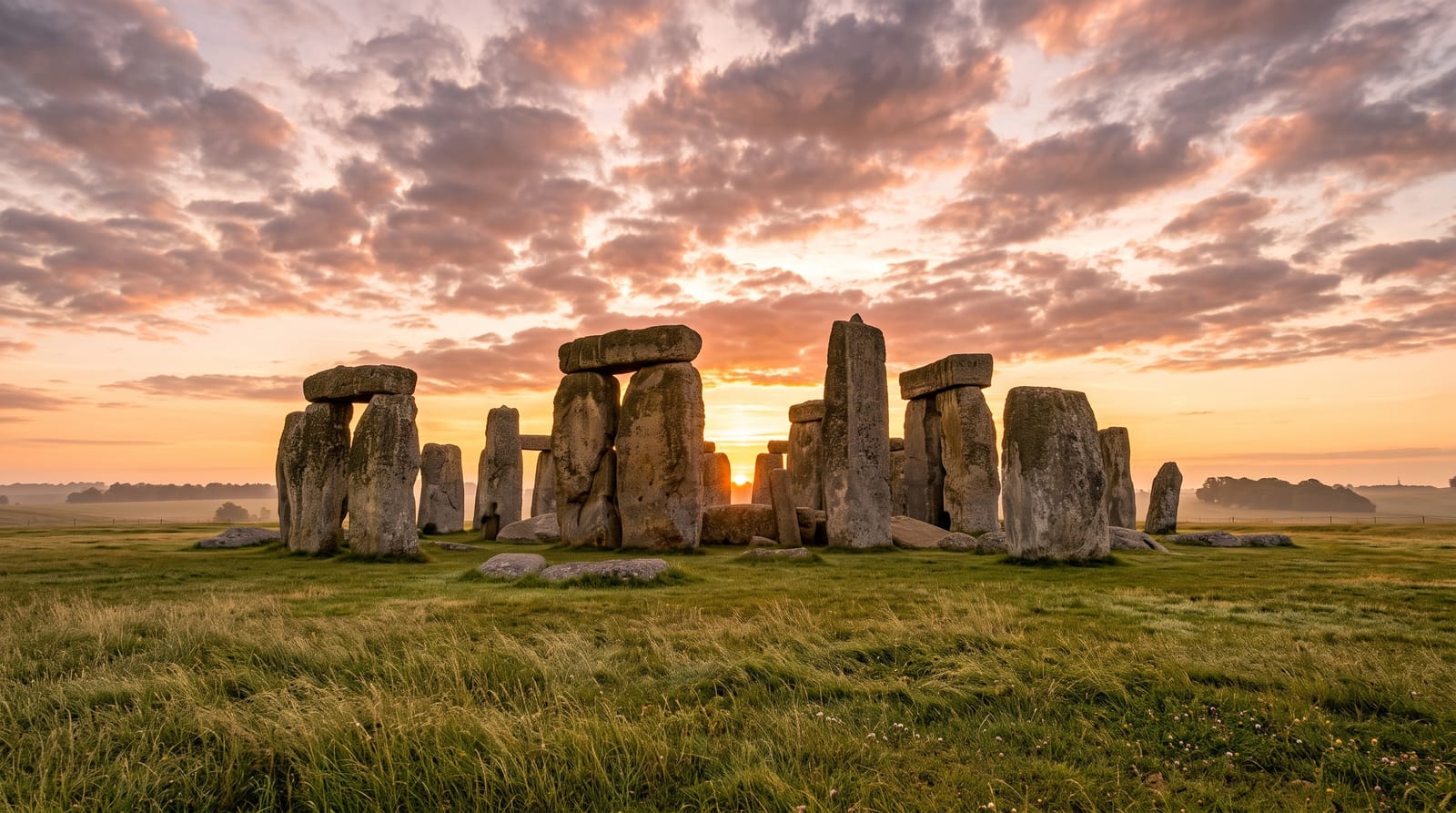
AI illustration
UNESCO World Heritage
Stonehenge is the most famous prehistoric monument in the world, a ring of colossal standing stones raised on Salisbury Plain in stages between about 3000 and 1500 BCE, its greatest stones dragged and hoisted with astonishing effort by a people who left no writing. Aligned to the rising and setting sun at the solstices, its purpose remains a mystery, and the UNESCO site still awes as a feat of Stone Age ambition and belief.
History
Stonehenge was built in several phases over some 1,500 years, from about 3100 BC, with an outer ring of sarsens around 4 metres high and some 25 tons each, linked by lintels held with mortise and tenon joints unique among monuments of its time, a ring of smaller bluestones and inner trilithons, all aligned with the midsummer sunrise and midwinter sunset. It stands amid the densest group of Neolithic and Bronze Age monuments in England, with several hundred burial mounds. Its name is first recorded by 11th-century writers as Stanenges, the stones held up in the air, and William Stukeley wrote in 1740 that Stonehenge in Saxon meant the hanging stones; the word henge has since given its name to a whole class of monuments (Wikipedia, Stonehenge).
What to look for
- The stone circle - the ring of colossal standing stones and lintels.
- The solstice alignment - the stones set to the midsummer and midwinter sun.
- The visitor centre - the exhibition and reconstructed Neolithic houses.
- The landscape - the ancient burial mounds across the surrounding plain.
When to go
Spring to autumn for the mildest weather on the exposed plain; the solstices draw crowds for special access to the stones. Book a timed ticket ahead, and go early or late to avoid the biggest coach-tour crowds.
Things to know
You normally view the stones from a path a short distance away, not among them, unless you book special early or late access; some find this distant. It is exposed and windswept, and very busy with coach tours by day. It is a quick sight, best paired with nearby Salisbury or Avebury.
Nearby
Salisbury and its cathedral, and the larger stone circle at Avebury, are close; Bath is within reach.
Key facts
Source: Wikidata, item Q39671, read on 18 October 2026.
What to pack for Stonehenge
Chosen from what this place is for. Tap a kit for the full checklist.
- Comfortable walking shoes - Sightseeing means kilometres of pavement and cobbles daily. Find on Amazon
- Modest clothing - Shoulders and knees covered - the single most common requirement. Find on Amazon
- A slim anti-theft daypack - Zips that close properly; keep it in front in crowds and on transit. Find on Amazon
- A scarf or shawl - To cover the head or shoulders on entry; women especially at mosques. Find on Amazon
Some links on this page are Amazon affiliate links - if you buy through them we may earn a small commission at no extra cost to you.
All packing kitsPlan your trip
Where to start if Stonehenge is going on the list.
Booking links on this page are affiliate links - if you book through them we may earn a small commission at no extra cost to you. It never changes what we write about a place.
Opening times, ticket prices and seasonal closures change - check the official source before you go: official site.