Baalbek
The colossal temples of the ancient world - a UNESCO site in the Bekaa Valley holding some of the largest and best-preserved Roman temples on earth, of stupendous scale, including the towering columns of Jupiter and the magnificent Temple of Bacchus.
Updated 18 October 2026
AI illustration
UNESCO World Heritage
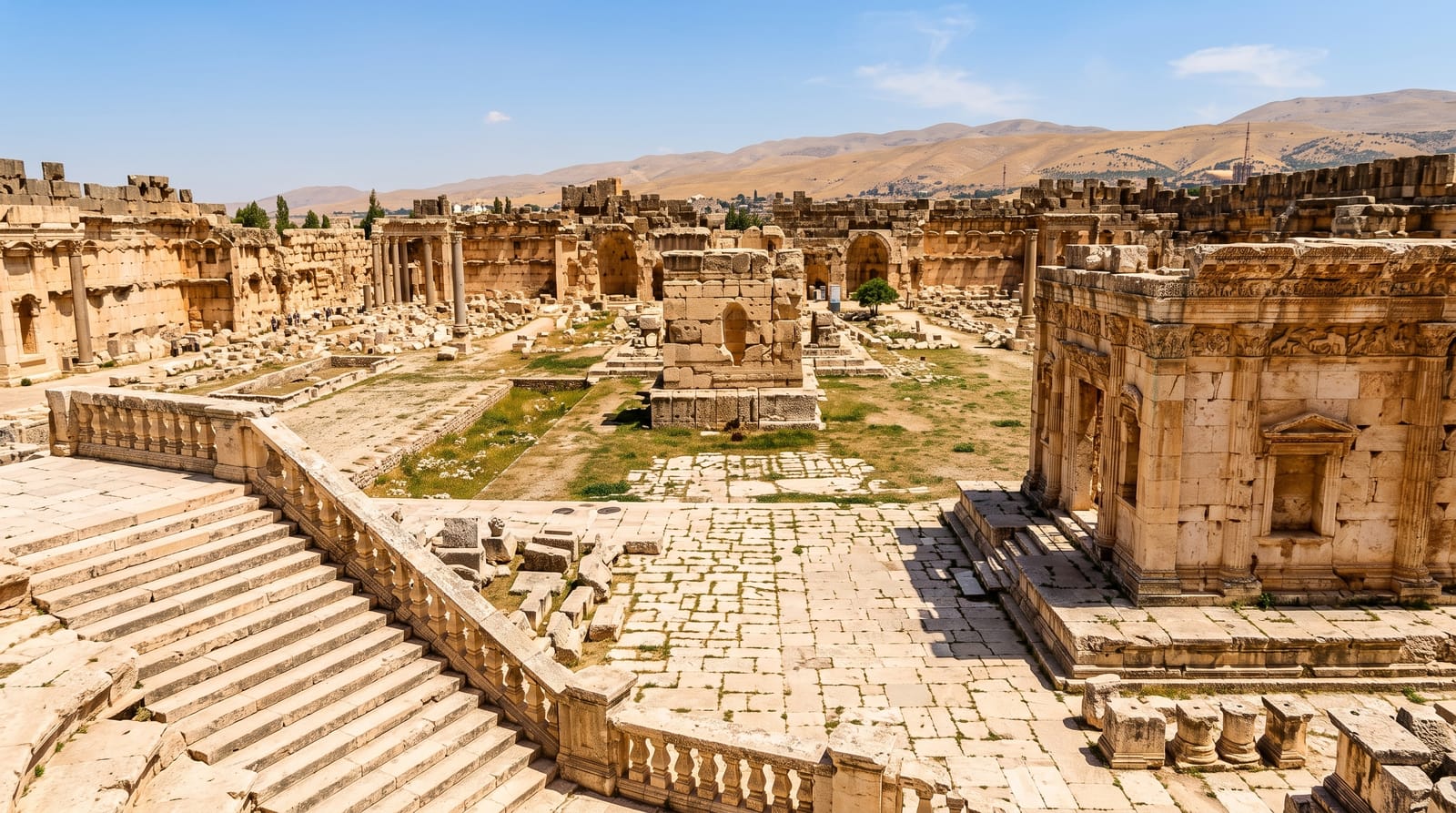
Baalbek, in Lebanon's fertile Bekaa Valley, is one of the most spectacular ancient sites in the world and a UNESCO World Heritage Site, home to some of the largest and best-preserved Roman temples ever built, on a scale that dwarfs almost all others. Ancient Heliopolis, as the Romans called it, was a great religious sanctuary, and its ruins are staggering: six colossal columns of the Temple of Jupiter, among the tallest ever raised, still stand against the sky, while the nearby Temple of Bacchus is one of the most complete and richly decorated Roman temples in existence. The sheer, stupendous scale of the stonework, including some of the largest hewn blocks on earth, makes Baalbek genuinely awe-inspiring.
History
The hilltop of Tell Baalbek shows almost continuous habitation over the last 8,000 to 9,000 years, and in the Canaanite period its temples honoured a triad of Baal, Astarte and their son; after Alexander's conquest of Persia it became Heliopolis, the Sun City, and under Augustus it received a Roman colony of veterans, probably of the 5th and 8th legions. The Temple of Jupiter, built on the foundation of an earlier shrine, was probably completed around AD 60. Already damaged by earthquakes, it was pulled down under Theodosius in 379 to make way for a basilica, and the city belonged to Damascus under the Umayyads and Abbasids until Fatimid Egypt took it in 942. The Mongol general Kitbuqa took Baalbek in 1260 and dismantled its fortifications, and of the 58 columns of the Temple of Jupiter 27 still stood in the 16th century, nine before the earthquakes of 1759 and six today. Kaiser Wilhelm II passed through on 1 November 1898 and dispatched an archaeological team that began work within a month, Otto Puchstein and his colleagues working here until 1904, and in 1984 Baalbek became a World Heritage Site (Wikipedia, Baalbek).
Highlights
- The Temple of Jupiter - the six colossal surviving columns.
- The Temple of Bacchus - the magnificent, well-preserved temple.
- The great courtyards - the vast temple complex.
- The megaliths - the enormous stone blocks of the quarry.
When to go
Spring, April to June, and autumn, September to October, for the mildest weather in the Bekaa Valley, which is hot in summer and cold in winter; the site is expansive and best explored with time and, ideally, a guide to grasp its history and scale.
Good to know
The sheer, stupendous scale and preservation of Baalbek's colossal Roman temples, among the greatest on earth, make it a genuinely awe-inspiring and unforgettable ancient site.
Nearby
The Bekaa Valley wineries and the town of Baalbek are close by.
Key facts
Source: Wikidata, item Q178835, read on 18 October 2026.
What to pack for Baalbek
Chosen from what this place is for. Tap a kit for the full checklist.
- Comfortable walking shoes - Sightseeing means kilometres of pavement and cobbles daily. Find on Amazon
- Modest clothing - Shoulders and knees covered - the single most common requirement. Find on Amazon
- A slim anti-theft daypack - Zips that close properly; keep it in front in crowds and on transit. Find on Amazon
- A scarf or shawl - To cover the head or shoulders on entry; women especially at mosques. Find on Amazon
Some links on this page are Amazon affiliate links - if you buy through them we may earn a small commission at no extra cost to you.
All packing kitsPlan your trip
Where to start if Baalbek is going on the list.
Booking links on this page are affiliate links - if you book through them we may earn a small commission at no extra cost to you. It never changes what we write about a place.
Opening times, ticket prices and seasonal closures change - check the official source before you go: official site.