Babylon
One of history's greatest cities - the ruins of ancient Babylon, capital of Mesopotamian empires, home of the legendary Hanging Gardens and the Ishtar Gate, a UNESCO World Heritage site at the very cradle of civilisation on the Euphrates.
Updated 18 October 2026
AI illustration
UNESCO World Heritage
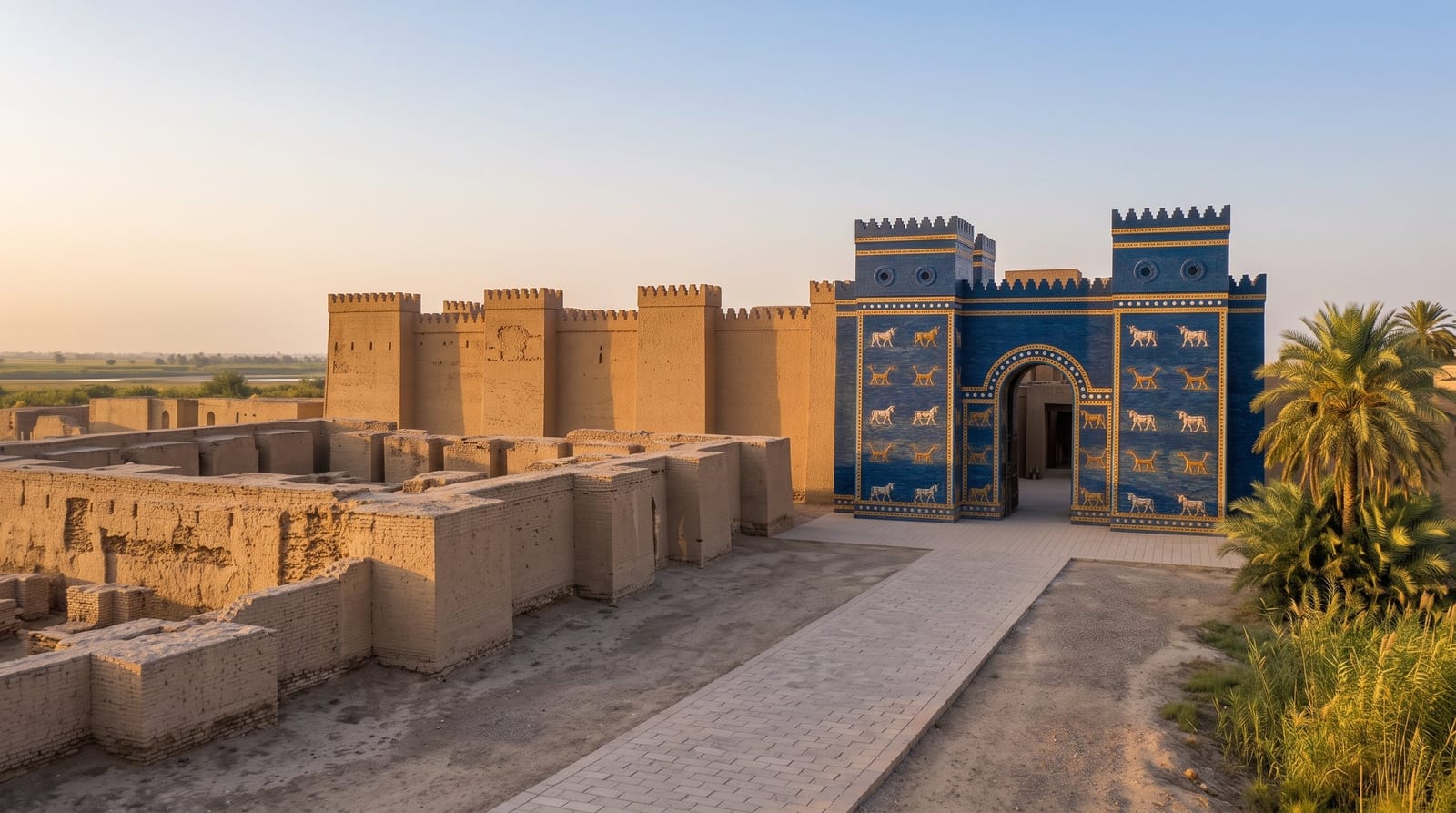
Babylon, on the Euphrates south of Baghdad, is one of the most famous cities of the ancient world and a cornerstone of human history. Capital of great Mesopotamian empires and, under Nebuchadnezzar II, of a dazzling civilisation, it was renowned for the legendary Hanging Gardens counted among the Seven Wonders, and for the magnificent blue-tiled Ishtar Gate. Today its extensive ruins, part reconstructed, spread across the plain, inscribed by UNESCO as a World Heritage site. Standing here at the heart of ancient Mesopotamia, the land between the rivers where cities, writing and law first arose, is to stand at the very cradle of civilisation.
History
The earliest mention of Babylon dates to the late 3rd millennium BC, when a year name of the Akkadian ruler Shar-Kali-Sharri records two temples built here, and Amorite rule began with Sumu-abum or Sumu-la-El, both credited with building its walls. Babylon was a minor city-state until Hammurabi, who reigned from 1792 to 1750 BC, made it the capital of an empire covering all of southern Mesopotamia and codified its laws; in 1595 BC it is thought to have been sacked by the Hittite king Mursili I. Nebuchadnezzar II, who reigned from 605 to 562 BC, rebuilt the imperial grounds in baked brick, including the Etemenanki ziggurat and the Ishtar Gate, and Alexander the Great died in his palace in 323 BC, after which the city declined in the Hellenistic period. Claudius Rich excavated here in 1811-12 and 1817, many finds of the French mission of 1852-1854 were lost when their boats sank in the Tigris in 1855, and Robert Koldewey's German team made the first scientific excavations, sending pieces of the Ishtar Gate to Berlin. From 1978 the Iraqi government rebuilt features of the ancient city on top of its ruins, and in July 2019 Babylon became a World Heritage Site (Wikipedia, Babylon).
What to look for
- The Ishtar Gate - the reconstructed and original blue-tiled gateway.
- The processional way - the ancient ceremonial avenue.
- The ruins and walls - the extensive remains of the great city.
- The site of the gardens - the legendary Hanging Gardens' setting.
When to go
October to April, the cooler months, are far more comfortable than the fierce summer heat of the Mesopotamian plain, ideal for exploring the exposed ruins on foot. The soft winter light suits the site's mud-brick walls and reconstructed gate especially well.
Before you go
Babylon has seen heavy reconstruction over the past century, so parts of the site mix modern rebuilding with the ancient foundations, and the summer heat on the open plain is intense. As one of the most legendary cities in all human history and a UNESCO World Heritage site at the cradle of civilisation, though, Babylon is a place of extraordinary resonance.
Nearby
The town of Hillah and other ancient Mesopotamian sites lie in the region.
Key facts
Source: Wikidata, item Q5684, read on 18 October 2026.
What to pack for Babylon
Chosen from what this place is for. Tap a kit for the full checklist.
- Comfortable walking shoes - Sightseeing means kilometres of pavement and cobbles daily. Find on Amazon
- Modest clothing - Shoulders and knees covered - the single most common requirement. Find on Amazon
- A slim anti-theft daypack - Zips that close properly; keep it in front in crowds and on transit. Find on Amazon
- A scarf or shawl - To cover the head or shoulders on entry; women especially at mosques. Find on Amazon
Some links on this page are Amazon affiliate links - if you buy through them we may earn a small commission at no extra cost to you.
All packing kitsPlan your trip
Where to start if Babylon is going on the list.
Booking links on this page are affiliate links - if you book through them we may earn a small commission at no extra cost to you. It never changes what we write about a place.
Opening times, ticket prices and seasonal closures change - check the official source before you go: official site.