The Jurassic Coast
England's first natural World Heritage site - 95 miles of Triassic-to-Cretaceous cliffs, fossil beaches and the stone arch of Durdle Door.
Updated 18 October 2026
AI illustration
UNESCO World Heritage
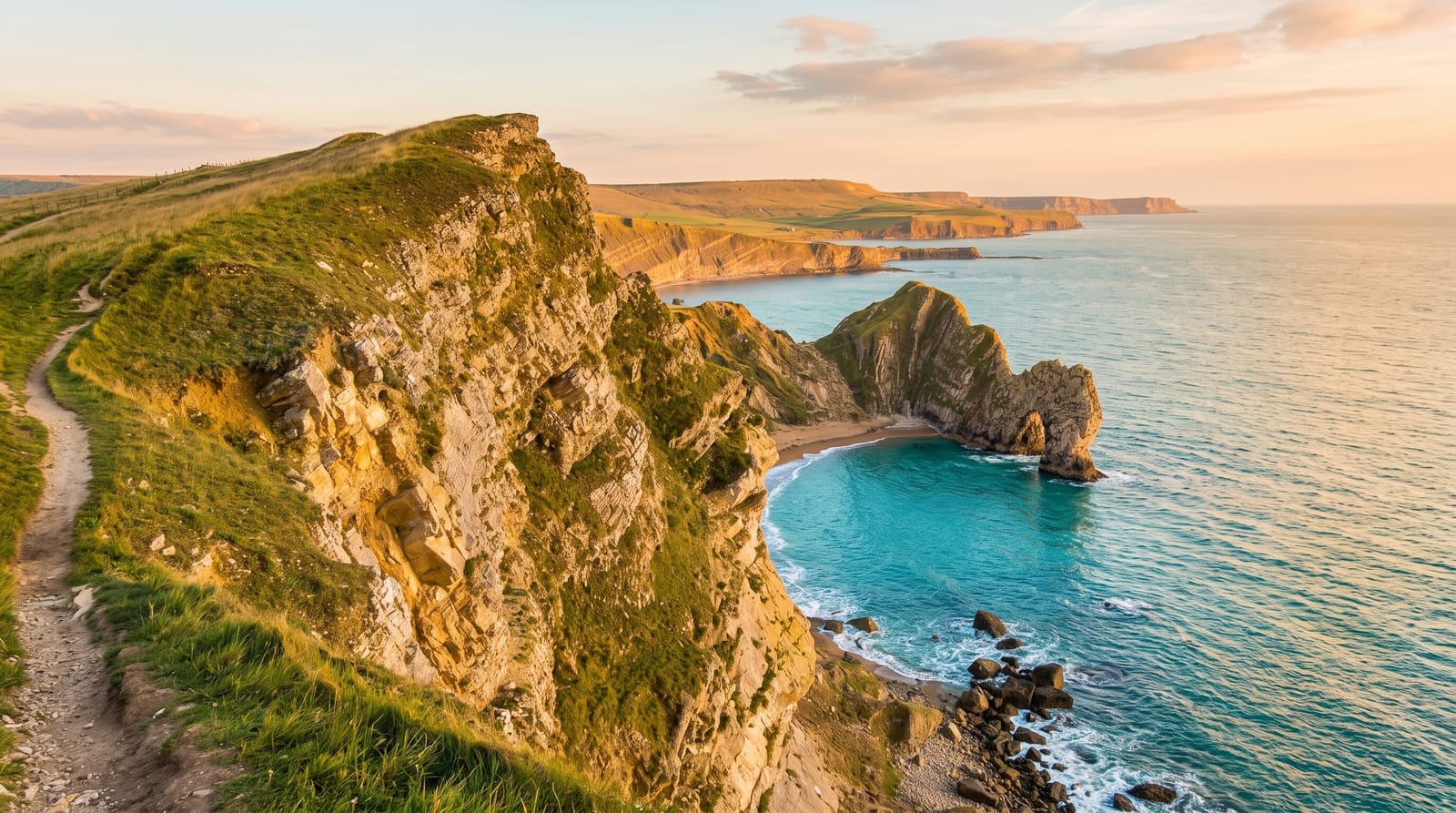
The Jurassic Coast runs 95 miles from Exmouth's red Triassic cliffs in East Devon to the chalk stacks of Old Harry Rocks in Dorset, and its inscription as England's first natural World Heritage site in 2001 honours a geological trick found almost nowhere else: the tilted rock layers expose roughly 185 million years of Earth history - Triassic, Jurassic and Cretaceous in sequence - so walking the coast path is walking through deep time. The greatest hits crowd the Dorset half: the perfect scallop of Lulworth Cove, the wave-cut arch of Durdle Door, golden Man O'War beach, and fossil-rich shores at Lyme Regis and Charmouth where Mary Anning found the marine reptiles that helped invent palaeontology - beach-combing after winter storms still surrenders ammonites. The South West Coast Path stitches it together over switchback climbs, with Golden Cap rising as the south coast's highest point.
History
At the end of the 18th century Georges Cuvier showed that some fossil animals were unlike any living ones and so could die out, giving rise to palaeontology, and the fossil beds of east Devon and west Dorset, until then gathered as curios for visitors, became a field of science. Mary Anning of Lyme Regis, who followed her father as a collector, became an expert on the fossils of the Blue Lias and found the first complete ichthyosaur skeleton, followed by plesiosaurs, a pterosaur and fossil cephalopods with their ink sacs. In the Second World War parts of the coast were taken over by the military, and the village of Tyneham was evacuated; in December 2001 the coast, about 96 miles from Exmouth to Studland Bay and spanning 185 million years of rock, became a World Heritage Site (Wikipedia, Jurassic Coast).
What's there
- Durdle Door - the limestone arch above its barrel-curved beach.
- Lulworth Cove - the textbook scallop bay carved through the rock layers.
- Lyme Regis fossils - Mary Anning's shore, ammonites after storms.
- Old Harry Rocks - the chalk stacks closing the coast at Studland.
When to go
April to October for settled walking weather; winter's storms bring the best fossil hunting to Charmouth and Lyme the days after. Durdle Door in July and August is shoulder-to-shoulder by late morning.
Before you go
The cliffs crumble - rockfalls are regular, so stay off the cliff bases and back from edges, and fossil-hunt on the foreshore, not by digging the cliffs. Honeypot parking at Lulworth and Durdle Door is expensive and fills early. The coast path's endless descents and climbs are honest work.
Nearby
Corfe Castle's ruins, the Isle of Portland and Weymouth's Georgian seafront.
Key facts
Source: Wikidata, item Q575976, read on 18 October 2026.
What to pack for The Jurassic Coast
Chosen from what this place is for. Tap a kit for the full checklist.
- Broken-in walking shoes or boots - Grip and ankle support matter more than looks; never hike in brand-new boots. Find on Amazon
- Reef-safe sunscreen - High SPF that will not bleach the coral you are swimming over. Find on Amazon
- Spare batteries + cards - Cold and long shoots drain power; never run out at the good light. Find on Amazon
- Layers + a waterproof shell - Mountain weather turns fast; a packable rain jacket saves the day. Find on Amazon
Some links on this page are Amazon affiliate links - if you buy through them we may earn a small commission at no extra cost to you.
All packing kitsPlan your trip
Where to start if The Jurassic Coast is going on the list.
Booking links on this page are affiliate links - if you book through them we may earn a small commission at no extra cost to you. It never changes what we write about a place.
Opening times, ticket prices and seasonal closures change - check the official source before you go: official site.