Arslantepe
A UNESCO mound at Malatya holding a fourth-millennium palace, wall paintings and the oldest swords ever found.
Updated 18 October 2026
UNESCO World Heritage
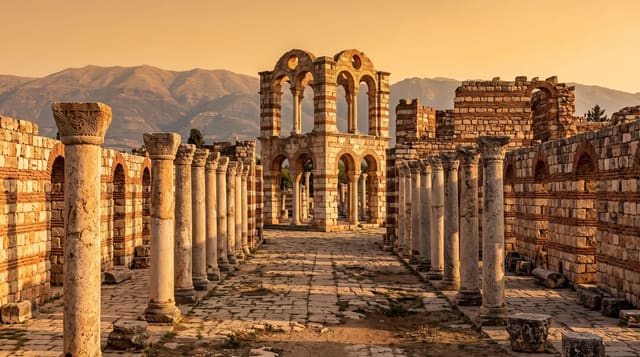
Arslantepe is a settlement mound occupied for thousands of years, and it was inscribed by UNESCO in 2021 for a specific reason: the late fourth-millennium BCE levels contain a monumental complex - corridors, storerooms, ceremonial rooms with wall paintings - that excavators interpret as one of the earliest known palaces, evidence of a centralised state emerging in the region several centuries before comparable structures elsewhere. From the same phase came a hoard of metal weapons including swords about five thousand years old, among the earliest true swords found anywhere. Later levels are Neo-Hittite, with a monumental gate flanked by stone lions - arslan, hence the modern name - and reliefs, though the best of those are in Ankara. The site is covered by a large protective structure over the mud-brick palace, with walkways through it, and there is a museum. The mud-brick itself is fragile and the shelter is the reason anything survives to look at.
History
The mound was first settled in the Chalcolithic, and in the late 4th millennium BC, the late Uruk period, it held a large temple and palace complex, which lay in ruins by the end of the period; around 3000 BC the earlier settlement was burned, and pottery of the Kura-Araxes culture of the Caucasus appeared. In the Late Bronze Age it was a heavily fortified administrative centre of the kingdom of Isuwa, which the Hittite king Šuppiluliuma I conquered around 1350 BC in his war against the Mitanni, and after the Hittite empire fell it became the capital of the Neo-Hittite kingdom of Melid, with a palace and stone lions, until the Assyrian king Sargon II sacked it in 712 BC. Louis Delaporte dug here from 1932 to 1939, Italian teams from Sapienza University of Rome have excavated since 1961, and in 2021 the mound became a World Heritage Site (Wikipedia, Arslantepe).
Highlights
- The mud-brick palace - the fourth-millennium complex under its shelter.
- The wall paintings - traces in the ceremonial rooms.
- The lion gate - the Neo-Hittite entrance and reliefs.
- The site museum - finds and the excavation story.
When to go
April to June and September to October. Mornings; Malatya summers are hot and the mound is exposed outside the shelter.
Good to know
It is mud-brick architecture at low height under a modern roof - the significance is archaeological rather than visual. The site was reported closed for maintenance in 2025, so check that it is open before travelling. The swords and best reliefs are in museums in Malatya and Ankara. A car helps.
Nearby
Battalgazi's old town and Malatya's apricot orchards are close; Levent valley is west toward Akçadağ.
Key facts
Source: Wikidata, item Q705132, read on 18 October 2026.
What to pack for Arslantepe
Chosen from what this place is for. Tap a kit for the full checklist.
- Comfortable walking shoes - Sightseeing means kilometres of pavement and cobbles daily. Find on Amazon
- Modest clothing - Shoulders and knees covered - the single most common requirement. Find on Amazon
- A slim anti-theft daypack - Zips that close properly; keep it in front in crowds and on transit. Find on Amazon
- A scarf or shawl - To cover the head or shoulders on entry; women especially at mosques. Find on Amazon
Some links on this page are Amazon affiliate links - if you buy through them we may earn a small commission at no extra cost to you.
All packing kitsPlan your trip
Where to start if Arslantepe is going on the list.
Booking links on this page are affiliate links - if you book through them we may earn a small commission at no extra cost to you. It never changes what we write about a place.
Opening times, ticket prices and seasonal closures change - check the official source before you go: official site.