Apollonia
A Greek and Roman city on a quiet hill of olive groves - a restored bouleuterion facade, a monastery museum and almost no visitors.
Updated 18 October 2026
AI illustration
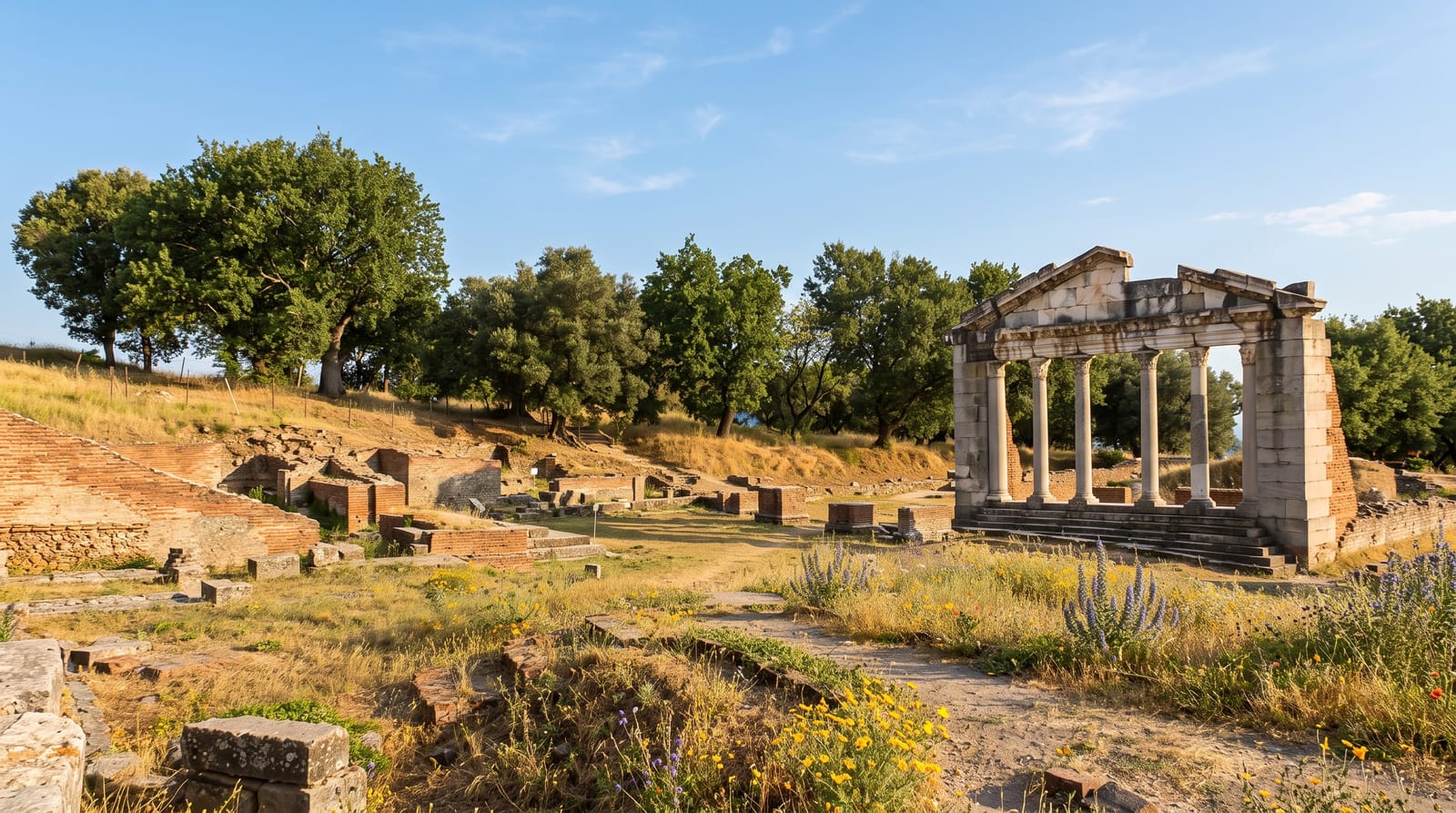
Founded by Greek colonists around 600 BCE and later a significant Roman city where the young Octavian was studying when Caesar was assassinated, Apollonia sits on a low hill above the Vjosa plain surrounded by olive groves. Its most photographed structure is the restored facade of the bouleuterion, the council building, with six tall columns standing against the sky. Around it lie a theatre, a library, city walls and stretches of paved street, and a thirteenth-century Byzantine monastery on the site houses a small museum and a church with fine frescoes. It sees a fraction of the visitors that comparable sites in Greece or Italy do.
History
People of the Early Bronze Age buried their dead in mounds here, the earliest from around 2700 BC, but the area was little used until Greek colonists from Corinth, and possibly Corcyra, founded a trading settlement around 600 BC on a largely abandoned coastal site, invited by the local Illyrians, at the crossroads of a route between the Adriatic coast and the interior that later became the Roman Via Egnatia. The city seems to have declined with the rise of Vlorë; European classicists rediscovered it in the 18th century, Austrian archaeologists first dug here during the occupation of 1916-1918 and a French team in 1924-1938, and Albanian teams have worked since 1948, though much remains unexcavated. In 1967 heavy machinery and some 400 concrete military bunkers did serious and lasting damage, the museum in the monastery was plundered in the unrest after 1990, and a new museum opened in December 2011 (Wikipedia, Apollonia - Illyria).
The main sights
- The bouleuterion facade - the restored columned front of the council house.
- The odeon and theatre - performance spaces in the ruins.
- The monastery of St Mary - Byzantine church, frescoes and site museum.
- The olive-grove setting - the hill and plain views around the ruins.
When to go
Spring and autumn give comfortable walking and green surroundings; spring adds wildflowers among the stones. Summer is hot and shadeless on the hill. The site is open year round with reduced winter hours.
Things to know
Much of the city remains unexcavated, so visitors expecting Ephesus-scale ruins will find something quieter and more fragmentary - the pleasure here is atmosphere and emptiness. Signage is limited and a guide adds a great deal. Getting there without a car is awkward; taxis from Fier are the usual solution. Combine with Berat, roughly an hour away.
Nearby
Berat's Ottoman old town, the Vjosa river and the coast at Vlore.
Key facts
Source: Wikidata, item Q505703, read on 18 October 2026.
What to pack for Apollonia
Chosen from what this place is for. Tap a kit for the full checklist.
- Comfortable walking shoes - Sightseeing means kilometres of pavement and cobbles daily. Find on Amazon
- Modest clothing - Shoulders and knees covered - the single most common requirement. Find on Amazon
- A slim anti-theft daypack - Zips that close properly; keep it in front in crowds and on transit. Find on Amazon
- A scarf or shawl - To cover the head or shoulders on entry; women especially at mosques. Find on Amazon
Some links on this page are Amazon affiliate links - if you buy through them we may earn a small commission at no extra cost to you.
All packing kitsPlan your trip
Where to start if Apollonia is going on the list.
Booking links on this page are affiliate links - if you book through them we may earn a small commission at no extra cost to you. It never changes what we write about a place.
Opening times, ticket prices and seasonal closures change - check the official source before you go: official site.