Dougga
The best-preserved Roman town in North Africa, spread across a hillside of olive groves with its theatre and capitol intact.
Updated 18 October 2026

AI illustration
UNESCO World Heritage
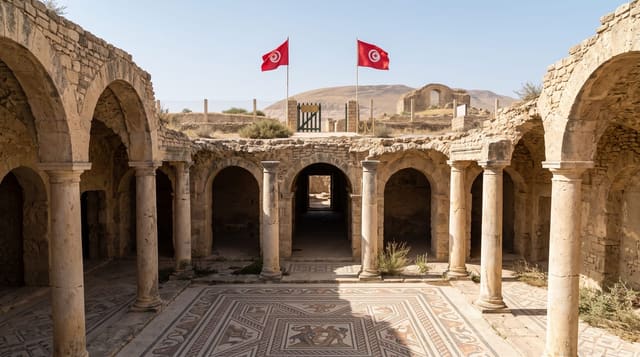
Dougga is a whole Roman town rather than a monument: streets, houses, baths, latrines, temples, a market and a theatre for several thousand people, spread over seventy-five hectares of hillside among olive trees, with the plain opening below. Because no modern town grew on top of it, the street plan survives intact and you walk it as a town rather than a set of ruins. The capitol, with its columns and pediment standing nearly complete, is the image everyone photographs. Older than the Roman layer is the Libyco-Punic mausoleum, a tapering tower from the second century BC that belongs to the Numidian kingdom that preceded Rome here. Very few visitors come compared with Carthage or El Jem.
History
The town seems to have been founded in the 6th century BC, and some historians identify it with Tocae, taken by a lieutenant of Agathocles of Syracuse at the end of the 4th century BC; its oldest remains are a necropolis with dolmens, and a temple to the Numidian king Masinissa, built in 139 BC beneath the later forum, shows that the town centre was already built up before the Romans came. The so-called Numidian walls have turned out to be late antique fortifications, and the Libyco-Punic mausoleum, the capitol, the theatre and the temples of Saturn and Juno Caelestis survive because no modern town grew over the site. In 1997 it became a World Heritage Site as the best-preserved Roman small town in North Africa, covering 75 hectares (Wikipedia, Dougga).
Highlights
- The capitol - the temple facade standing nearly complete above the forum.
- The theatre - seating for thousands, still used for occasional performances.
- The Libyco-Punic mausoleum - a pre-Roman Numidian tower monument.
- Houses and baths - mosaicked floors, latrines and street plan across the hillside.
When to go
October to May; summer is hot and the site has almost no shade. Spring brings wildflowers among the ruins. Mornings are best for light on the capitol.
Good to know
There is no public transport, so a car, taxi or tour is required. The site is large and spread over a slope with uneven paving, so it takes real walking. Facilities are minimal and there is little shade or water. Signage is thin, which makes a guide worthwhile.
Nearby
Bulla Regia's underground villas are north; Tunis is two hours east.
Key facts
Source: Wikidata, item Q32378, read on 18 October 2026.
What to pack for Dougga
Chosen from what this place is for. Tap a kit for the full checklist.
- Head torch + spare batteries - Hands-free light is essential; caves are truly dark. Find on Amazon
- Comfortable walking shoes - Sightseeing means kilometres of pavement and cobbles daily. Find on Amazon
- Modest clothing - Shoulders and knees covered - the single most common requirement. Find on Amazon
- Grippy closed shoes - Cave floors are wet, muddy and slick with formations. Find on Amazon
Some links on this page are Amazon affiliate links - if you buy through them we may earn a small commission at no extra cost to you.
All packing kitsPlan your trip
Where to start if Dougga is going on the list.
Booking links on this page are affiliate links - if you book through them we may earn a small commission at no extra cost to you. It never changes what we write about a place.
Opening times, ticket prices and seasonal closures change - check the official source before you go: official site.