Testour
A town founded by Andalusian Muslim refugees in the seventeenth century, with a clock that runs backwards.
Updated 16 October 2026
Testour was founded in the early seventeenth century by Muslims expelled from Spain, who laid it out on a Spanish grid rather than a Tunisian medina plan and built in a hybrid style. The Great Mosque of 1631 shows it clearly: a minaret with Andalusian tilework, Stars of David worked into the decoration, and a clock on the tower whose hands run anticlockwise, for which several explanations are offered and none confirmed.
Background
Testour sits on hills above the Medjerda Valley, 20 km south-west of Medjez-el-Bab, where roads from Tunis, Béja and the north of the country meet. In Roman times the town was called Tichilla, a name meaning green grass, since it lies where the Siliana valley opens out. Muslim and Jewish settlers from Andalusia later rebuilt it and gave its buildings and street plan their own character. Jewish pilgrims come to the tomb of Rabbi Fraji Chawat. Since 1967 the town has hosted an international festival devoted to Malouf and traditional Maghrebi music. The 2014 count gave a population of 13,397.
Source: Wikipedia, "Testour"
Highlights
- The Great Mosque - a 1631 building mixing Andalusian and Tunisian forms.
- The backwards clock - the minaret clock whose hands turn anticlockwise.
- The Spanish grid - a street plan laid out on Iberian rather than local lines.
- The Malouf tradition - the Andalusian music the town keeps, with a summer festival.
When to go
October to May is the most comfortable. The Malouf music festival falls in summer. Fridays are busy around the mosque.
Good to know
The mosque interior is closed to non-Muslims and the clock is seen from outside. The town is workaday and there is little else for visitors. Facilities are limited.
Nearby
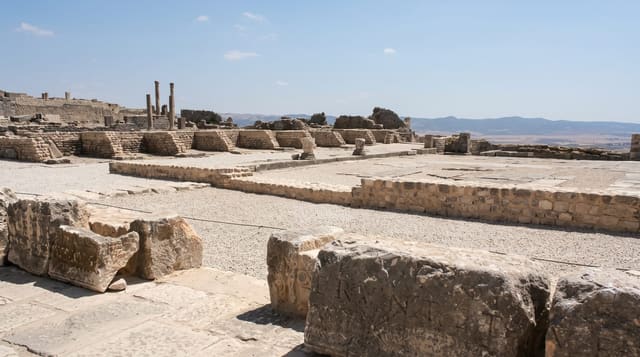
Dougga is southwest, and Beja is northwest.
Key facts
Source: Wikidata, item Q1250999, read on 18 October 2026.
What to pack for Testour
Chosen from what this place is for. Tap a kit for the full checklist.
- Comfortable walking shoes - Sightseeing means kilometres of pavement and cobbles daily. Find on Amazon
- Modest clothing - Shoulders and knees covered - the single most common requirement. Find on Amazon
- A slim anti-theft daypack - Zips that close properly; keep it in front in crowds and on transit. Find on Amazon
- A scarf or shawl - To cover the head or shoulders on entry; women especially at mosques. Find on Amazon
Some links on this page are Amazon affiliate links - if you buy through them we may earn a small commission at no extra cost to you.
All packing kitsPlan your trip
Where to start if Testour is going on the list.
Booking links on this page are affiliate links - if you book through them we may earn a small commission at no extra cost to you. It never changes what we write about a place.
Opening times, ticket prices and seasonal closures change - check the official source before you go: official site.