Masada
A dramatic desert fortress of last resistance - the ruins of King Herod's clifftop palace-fortress high above the Dead Sea, site of a legendary ancient siege, reached by cable car or a dawn climb, a UNESCO site.
Updated 18 October 2026
AI illustration
UNESCO World Heritage
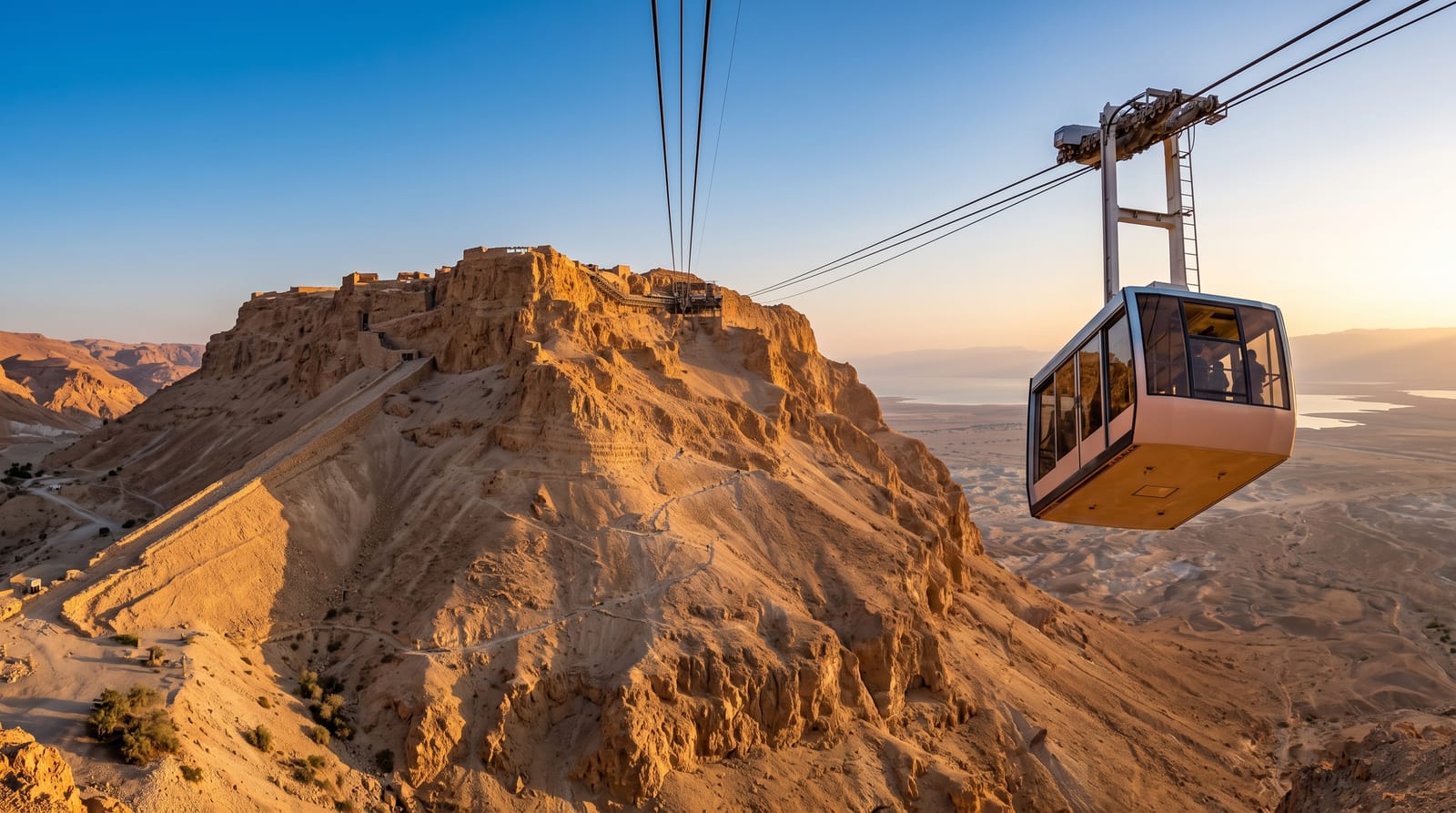
Masada is one of the most dramatic and evocative archaeological sites in Israel, the ruins of a great palace-fortress built by King Herod atop a sheer, isolated plateau high above the Dead Sea in the Judean Desert. A UNESCO site, it is famous as the place where, according to the ancient historian Josephus, a group of Jewish rebels made a last stand against the Roman legions, a story of resistance that has made it a powerful national symbol, its ruins reached by cable car or a strenuous dawn climb.
History
Josephus, the source of almost everything known about Masada, says it was first fortified by the Hasmonean ruler Alexander Jannaeus, though no Hasmonean buildings have been found, and that Herod the Great built a great fortress here between 37 and 31 BC as a refuge, with two palaces, storerooms and a water system. In 66 a group of rebels, the Sicarii, took the fortress from its Roman garrison by a ruse. In 73 or 74 the Roman governor Lucius Flavius Silva besieged it with the Tenth Legion, ringed it with a wall and camps and built an assault ramp against the western face, largely on a natural spur of rock; when the Romans broke in, Josephus writes, the defenders had set the buildings on fire and taken their own lives or killed each other, 960 men, women and children. Edward Robinson and Eli Smith identified the site in 1838, Yigael Yadin excavated it from 1963 to 1965, and the Roman siege works, the best preserved of their kind, are the reason it became a World Heritage Site (Wikipedia, Masada).
What's there
- The clifftop ruins - Herod's palaces, storehouses and synagogue.
- The Roman siege ramp - the great earthen ramp built by the legions.
- The sunrise - the dawn over the Dead Sea from the summit.
- The views - the panorama over the desert and the Dead Sea.
When to go
October to April for bearable temperatures, as the desert is fiercely hot in summer; the dawn climb up the Snake Path to catch the sunrise over the Dead Sea is a classic, avoiding both the heat and the crowds who take the later cable car.
Practical notes
The desert heat is extreme in summer, so the site restricts or closes access in the hottest hours; go in the cool of early morning. The Snake Path climb is steep and strenuous, best done pre-dawn, while the cable car is the easy alternative. The dramatic siege story, while iconic, is debated by historians. The setting and views are magnificent.
Nearby
The Dead Sea, the Ein Gedi oasis and the Judean Desert are alongside.
Key facts
Source: Wikidata, item Q186312, read on 18 October 2026.
What to pack for Masada
Chosen from what this place is for. Tap a kit for the full checklist.
- Loose, light, long clothing - Covering up beats bare skin in the desert - and locals dress this way for a reason. Find on Amazon
- Comfortable walking shoes - Sightseeing means kilometres of pavement and cobbles daily. Find on Amazon
- A wide-brim hat + sunglasses - Shade for your face and eyes where there is none overhead. Find on Amazon
- A slim anti-theft daypack - Zips that close properly; keep it in front in crowds and on transit. Find on Amazon
Some links on this page are Amazon affiliate links - if you buy through them we may earn a small commission at no extra cost to you.
All packing kitsPlan your trip
Where to start if Masada is going on the list.
Booking links on this page are affiliate links - if you book through them we may earn a small commission at no extra cost to you. It never changes what we write about a place.
Opening times, ticket prices and seasonal closures change - check the official source before you go: official site.