Malia Palace
The third great Minoan palace, on a coastal plain, with a famous gold bee pendant found in its cemetery.
Updated 21 October 2026
AI illustration
UNESCO World Heritage
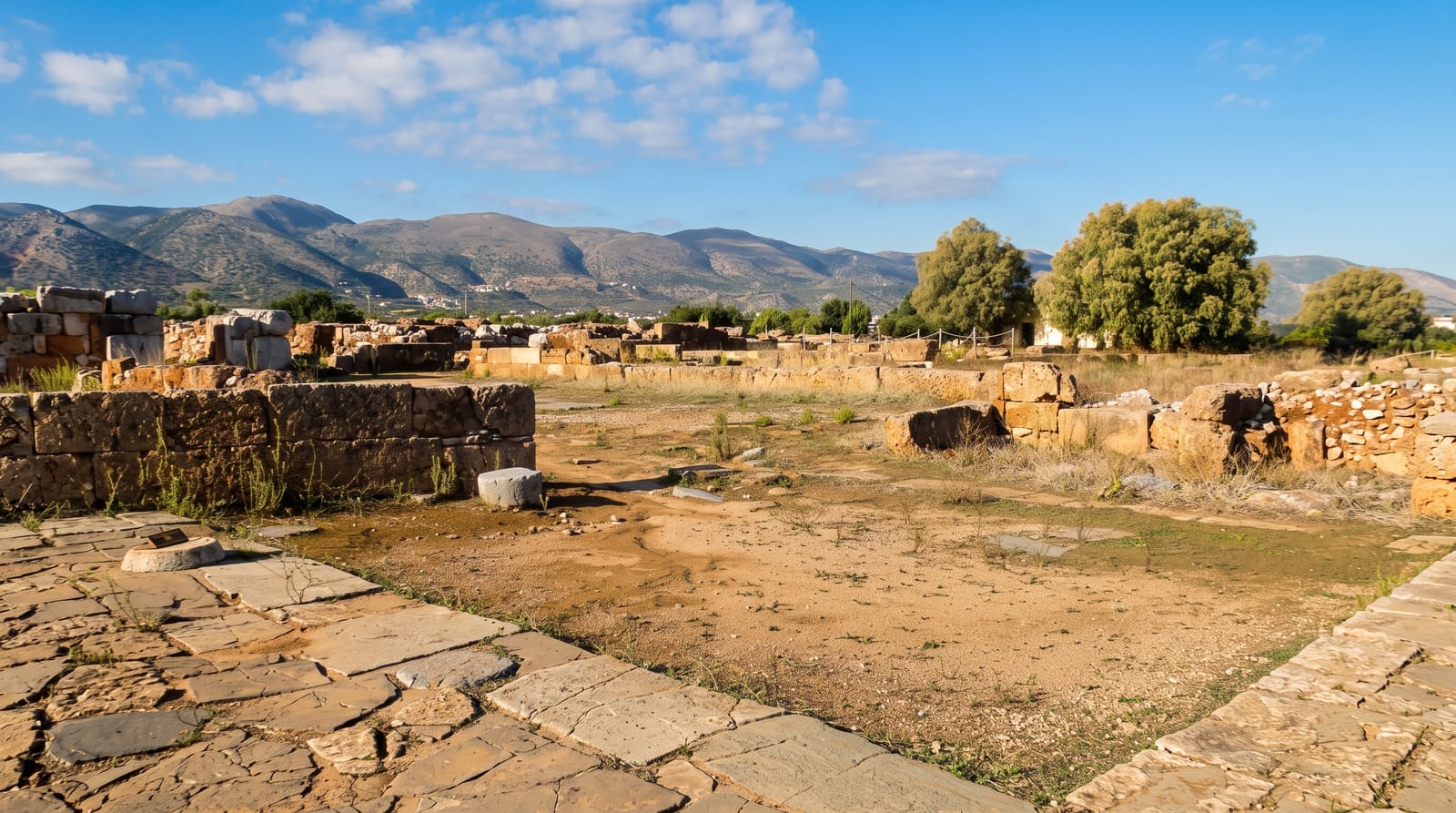
Malia's palace was built around 1900 BC and rebuilt after destruction, covering some 7,500 square metres on a flat coastal site, which makes its plan unusually easy to read: the central court with its altar pit, the ceremonial staircase, the pillar crypt, the storage magazines with pithoi still standing, and a large round stone with thirty-four hollows, the kernos, probably used for offerings. To the north lies the Chrysolakkos burial complex, where the gold pendant of two bees holding a honeycomb, one of the finest pieces of Minoan goldwork, was found; it is displayed in Heraklion. A French-run excavation has worked here since the 1920s, and part of the site is sheltered under a modern roof. The modern town of Malia, three kilometres west, is a very different proposition.
History
People settled at Malia in the middle of the 3rd millennium BC, and by the Middle Minoan period a large mudbrick palace stood here, with obsidian from Anatolia showing wide trade; parts of the town were destroyed around 1700 BC, the palace was rebuilt and destroyed again around 1450 BC, and the Mycenaeans then revived the town until its final destruction around 1250 BC. Joseph Hazzidakis explored the site from 1919 to 1922, finding the gold bee pendant at Chrysolakkos, and the French School of Athens has excavated here since 1922; in 2025 Malia was inscribed by UNESCO with the other Minoan palatial centres (Wikipedia, Malia - archaeological site).
What's there
- The central court - the palace heart with its altar and paved surface.
- The kernos - a round offering stone with thirty-four hollows.
- The storage magazines - rooms with their great jars still in place.
- Chrysolakkos - the burial complex where the gold bee pendant was found.
When to go
Spring and autumn; the site is flat, coastal and shadeless, and midsummer is punishing. Morning visits avoid both heat and the day-trip traffic from the resorts.
Things to know
The palace is less immediately impressive than Knossos and less scenic than Phaistos, and the famous finds are in Heraklion. The neighbouring resort town is a busy nightlife destination with no connection to the site.
Nearby
Heraklion and Knossos lie west; the Lasithi plateau road climbs south from here.
Key facts
Source: Wikidata, item Q1887316, read on 18 October 2026.
What to pack for Malia Palace
Chosen from what this place is for. Tap a kit for the full checklist.
- Comfortable walking shoes - Sightseeing means kilometres of pavement and cobbles daily. Find on Amazon
- A slim anti-theft daypack - Zips that close properly; keep it in front in crowds and on transit. Find on Amazon
- A refillable water bottle - Many cities have public fountains; save money and plastic. Find on Amazon
- A light layer + compact umbrella - For museum air-con and a sudden shower. Find on Amazon
Some links on this page are Amazon affiliate links - if you buy through them we may earn a small commission at no extra cost to you.
All packing kitsPlan your trip
Where to start if Malia Palace is going on the list.
Booking links on this page are affiliate links - if you book through them we may earn a small commission at no extra cost to you. It never changes what we write about a place.
Opening times, ticket prices and seasonal closures change - check the official source before you go: official site.