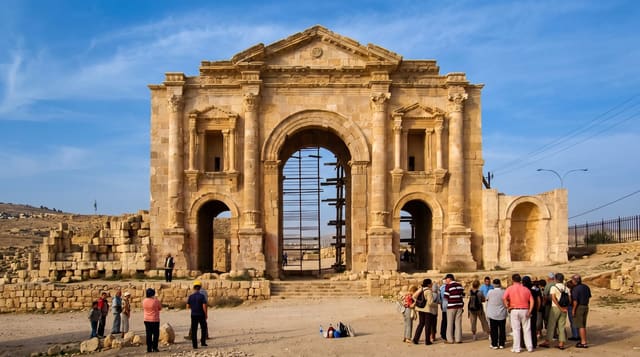
Si Thep Historical Park
A Dvaravati city inscribed by UNESCO in 2023, with a stupa mound whose form is found almost nowhere else.
Updated 18 October 2026
UNESCO World Heritage
Si Thep was a substantial city of the Dvaravati culture, occupied from around the third to fifth century, later showing Khmer influence, and abandoned by perhaps the thirteenth - a moated double-walled town on the Pa Sak river with over a hundred monuments inside and around it. UNESCO inscribed it as a World Heritage Site in 2023, which raised its profile sharply after decades as an obscure site visited by almost nobody. The two central monuments, Khao Klang Nai and Prang Si Thep, sit inside the walls; the more unusual is Khao Klang Nok outside them, a large stepped laterite stupa base whose stucco reliefs of dwarves and animals survive in places and whose form has few parallels. A third site, Thamorat cave, holds carved Buddha images in a hillside a short drive away. The park is open and unshaded, and a tram runs between the main monuments.
History
Si Thep grew from a prehistoric farming village in the Pa Sak valley: a burial found in 2016 near the centre of the round moated town has been radiocarbon dated to 240-390 AD, and the circular moat by thermoluminescence to 414-602. From the 6th century it was an urban Dvaravati centre and one of the first places in Thailand in contact with India, as a 6th-century Sanskrit inscription in Pallava script shows; Vaishnavism mattered here, two images of Krishna lifting Mount Govardhana date from the late 6th and late 7th centuries, and a moat enclosed 4.7 square kilometres. Later under Khmer influence, the city was abandoned around the 13th century as Sukhothai and Ayutthaya rose; Prince Damrong surveyed it in 1904, and it was listed as an ancient monument in 1935 (Wikipedia, Si Thep Historical Park).
What to look for
- Khao Klang Nok - the large stepped stupa base with surviving stucco reliefs.
- The walled city - moats, ramparts and monuments across the enclosure.
- The Dvaravati work - sixth-century onward, with later Khmer influence.
- The 2023 inscription - one of Thailand's newer World Heritage Sites.
When to go
November to February, early or late - the park is open ground with very little shade. Three to four hours with the tram; Thamorat cave is a separate drive.
Practical notes
Almost no shade and very hot from mid-morning. Monuments are foundations and bases rather than standing buildings. Interpretation in English is limited given the recent inscription. Ticketed.
Nearby
Phetchabun and Khao Kho are north; Lopburi and Saraburi are south.
Key facts
Source: Wikidata, item Q1517758, read on 18 October 2026.
What to pack for Si Thep Historical Park
Chosen from what this place is for. Tap a kit for the full checklist.
- Head torch + spare batteries - Hands-free light is essential; caves are truly dark. Find on Amazon
- Comfortable walking shoes - Sightseeing means kilometres of pavement and cobbles daily. Find on Amazon
- Grippy closed shoes - Cave floors are wet, muddy and slick with formations. Find on Amazon
- A slim anti-theft daypack - Zips that close properly; keep it in front in crowds and on transit. Find on Amazon
Some links on this page are Amazon affiliate links - if you buy through them we may earn a small commission at no extra cost to you.
All packing kitsPlan your trip
Where to start if Si Thep Historical Park is going on the list.
Booking links on this page are affiliate links - if you book through them we may earn a small commission at no extra cost to you. It never changes what we write about a place.
Opening times, ticket prices and seasonal closures change - check the official source before you go: official site.